




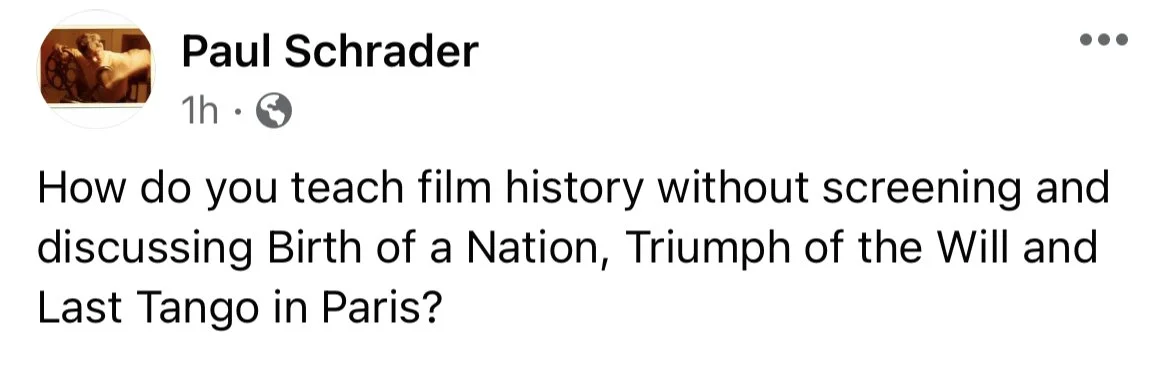
Paul Schrader is wondering how one can firmly grasp Film history without watching problematic films such as Riefenstahl’s “Triumph of the Will,” Griffith’s “Birth of a Nation” and Bertolucci’s “Last Tango In Paris.”
How do you teach film history without screening and discussing Birth of a Nation, Triumph of the Will and Last Tango in Paris?
Fair point. Two of those three got screened, a few times, many years ago, when I was in film school. Only Bertolucci’s film wasn’t, and, although I think it’s great, it’s not as essential as the other two when it comes to firmly grasping the history of film.
“Triumph of the Will,” possibly the most technically influential film of all time, was a Nazi propaganda film that, despite its disturbing subject matter, revolutionized the way movies were made.
Riefenstahl single-handedly rewrote the language of cinema with her use of cinematography and music. This was a work of staggering brilliance with shots that are still hard to achieve to this very day, for any filmmaker.
The likes of Peter Jackson, George Lucas and Ridley Scott have all admitted to having studied and copied Rifenstahl’s masterpiece. Watching the film with firm attention to all the details on screen is an incredible experience; add in the fact that this was meant as a propaganda tool by the Third Reich and you have one of the most harrowingly disturbing cinematic experiences imaginable.
Without ‘Triumph’ there would have even been less advancement in sports broadcasting camerawork — hell, Riefsentahl is even credited as introducing slow-motion in cinema, among many other camera and editing tricks in her film.
I’m sure there a few film schools that still dare to show this film today, but maybe not as many as, say, 10 years ago. It used to be freely available to watch online, but in 2019 YouTube actually banned it by specifying that it “promoted or glorified Nazi ideology, which is inherently discriminatory.”
“The worst thing about The Birth of a Nation is how good it is” — Richard Brody
Then we have “The Birth of a Nation,” DW Griffith’s landmark silent-era epic, lauded at the time for its technical innovation. It was also the first American 12-reel film ever made.
Griffith’s epic pioneered closeups, tracking shots, parallel action and fadeouts. It’s also one of, if not the most, reprehensibly racist films in Hollywood history; promoting the confederacy, the KKK and black people as predators. The film was so popular at the time of its release that it was credited as the main reason for the revival of the KKK in the United States.
In 1992, a saner, more thoughtful time in culture, the Library of Congress deemed the film "culturally, historically, or aesthetically significant" and selected it for preservation in the National Film Registry.
How can film school students miss out on watching, even just snippets, of a movie that Jonathan Kline once wrote "created contemporary film language... virtually every film is beholden to [The Birth of a Nation] in one way, shape or form.”?
Roger Ebert described The Birth of a Nation "a great film that argues for evil".
By censoring both of these films, who are we protecting exactly? Being afraid of history can lead to catastrophic consequences. At the very least, if you’re a professor, show these films and, if you have to, give a warning to the students that it includes disturbing content. But show them. Mention the formal elements with the content and messaging. You really can’t teach film history without these two films.

Boyle's answer was met with a shout of "Never do that shit again" from the crowd, and the TIFF moderator swiftly brought the Q&A to a close, thanking everyone for coming.