

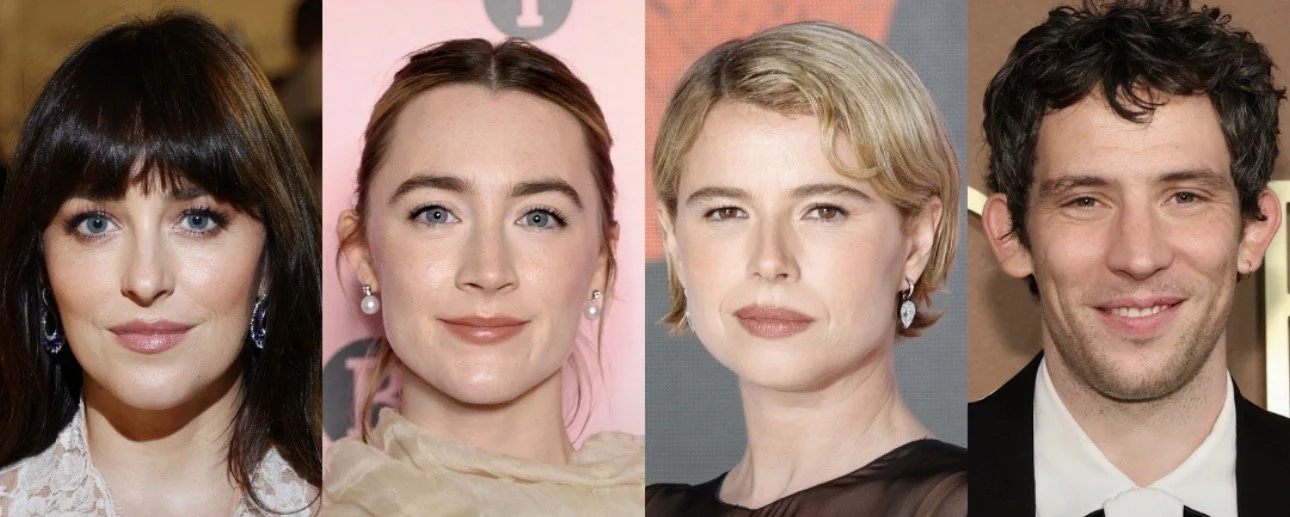
Alice Rohrwacher, one of the best filmmakers working today, has started production on her adaptation of Audrey Niffenegger’s bestselling novel “Three Incestuous Sisters,” with Ottessa Moshfegh co-writing the script with her.
The cast includes Dakota Johnson, Saoirse Ronan, Jessie Buckley, Josh O’Connor, Mick Jagger, and Isabella Rossellini.
We were wondering if this was, in fact, the black-and-white silent film Rohrwacher has been teasing for well over a year. Now, The Film Stage has confirmed that it is indeed that movie. Hélène Louvart is the cinematographer.
Yes, in an era when blockbuster cinema gets louder and more chaotic, Rohrwacher is moving in the opposite direction — toward muteness. A silent film in 2026 sounds like a provocation. Here’s what Rohrwacher had to say about this decision:
It’s not pretentious, but comes from a deep conviction of [silent cinema’s] communicative power, as a form of experimentation that should continue to exist in parallel to sound cinema. Silent cinema demands precious attention. You can’t do anything but watch a movie. It forces total focus on the image.
The film is only loosely based on the book, with actual plot details being kept under wraps. Silent cinema might align with what “Three Incestuous Sisters,” the book, is about. The book presents a series of eerie black-and-white illustrations paired with short captions that follow three sisters who live in total isolation, cut off from society and from normal emotional development. Their extreme closeness becomes unhealthy.
Furthermore, Variety also reports that Rohrwacher has already lined up her next feature after that, set to shoot Q3 next year, likely following the inevitable “Incestuous Sisters” Cannes premiere.
She’s set to direct an adaptation of Italo Calvino’s coming-of-age fable “The Baron in the Trees,” published in 1957. The story centers on Cosimo Piovasco di Rondò, a 12-year-old baron who, after arguing with his father, climbs into a tree and decides to live there for the rest of his life.
Rohrwacher, whose “Happy as Lazzaro” (2018) made good on the enormous promise of her earlier work, has always made films that blur boundaries—between time periods, between realism and myth, between the visible and the unseen. In 2024, “La Chimera,” starring O’Connor, came out in the U.S. a year after competing for the Palme d’Or, and it was her strongest work yet—filled with dreamlike ambiguity and narrative shapeshifting.

Surprise?! HBO has ordered a five-episode limited revival of “Girls,” ten years after the show ended. Lena Dunham is back, so are Allison Williams, Jemima Kirke, and Zosia Mamet.