


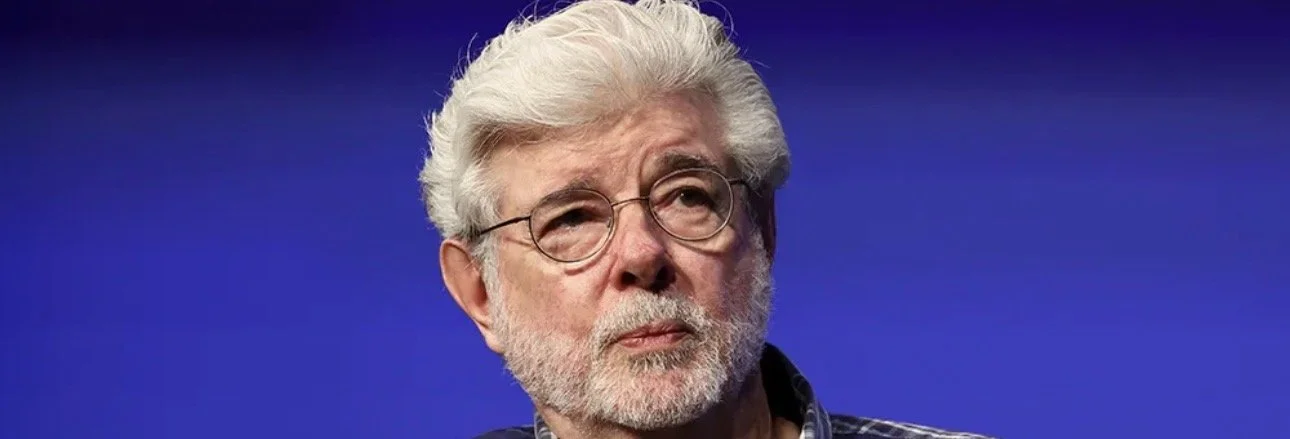
George Lucas, who has always been at the forefront of VFX technology and would eventually form the groundbreaking Industrial Light & Magic, has joined his fellow elder statesmen — more of them below — who believe in the promise of AI.
Yes, Lucas has fully embraced the technology and sees immense potential in its application to cinema. In a new interview with A Rabbit’s Foot, he goes a step further, calling AI “the future” of moviemaking and telling its detractors that there is little they can do to stop its inevitable rise within cinema.
Artificial intelligence means it’s much easier for us to make movies […]
It’s very much like sitting here saying, ‘Well, I believe the horse and the buggy is really where it’s at. These cars, they break down, they need gas, there’s all kinds of problems with them, and pretty soon they’ll be making them into tanks, and then they’ll be killing people. It’s terrible.’ There’s nothing you can do about it…That’s progress; it’s the future…
If you want AI that tells you when something is fake and where it came from, AI can do that. Humans can’t; we’re not that smart. The whole idea is you’re a human being, you’re responsible for what you say and what you do ..
In essence, Lucas sees AI as the democratization of filmmaking—it will allow people to make films on the widest canvas imaginable, for a fraction of the cost, and in the process help discover new talent and filmmaking prodigies who may never have had the opportunity otherwise.
Now, a vocal majority of the industry is firmly against AI. So are many younger people, especially online, who will have to grow up with it at the forefront of their lives and have coined the term “AI slop” to describe the mass-produced content it’s generated.
What I’ve noticed most about the AI debate within the movie industry is a blatant generational divide. Younger filmmakers, artists, and audiences tend to view AI with skepticism, concerned about its impact on creativity, employment, and the value of human-made work. Meanwhile, many older industry creatives and executives see it as a tool for innovation .. and cost reduction.
There have been some notable directors—mostly older veterans—who have come out in support of AI’s use in cinema. Lucas is certainly not the only prominent figure championing the technology. Other supporters include Darren Aronofsky, Roger Deakins, Brady Corbet, Steven Soderbergh, Michael Mann, James Cameron, Paul Schrader, Werner Herzog, George Miller, Doug Liman, Andy Serkis, Alex Proyas, Martin Scorsese, and Roger Avary.
Liman shot his latest film entirely on AI-generated stages. Serkis is using the technology to de-age his actors in ‘The Hunt for Gollum.’ Mann has also teased using AI-driven de-aging technology on his upcoming “Heat 2,” the same technology George Miller utilized on “Furiosa.” Aronofsky caught fury recently for producing a few 1776-related AI episodes. Scorsese is just using the technology for storyboarding, but still got hell for it. Meanwhile, filmmakers who haven’t been to greenlight projects in decades, such as Avary and Proyas, have now hopped on-board new films.
Still, the main question I have is whether the younger generation of creatives will be as open to AI as these older filmmakers. The technology will eventually become inescapable, and when push comes to shove, if the only way to bankroll a pricey passion project is to incorporate some of that technology, they will have to decide whether it is worth setting aside their own principles to make it happen. Odds are, they will.

Quentin Tarantino has released ten films, but which one is his masterpiece? A critics’ poll I started back in 2024, and left sitting in my drafts ever since, is currently deadlocked between two films.