



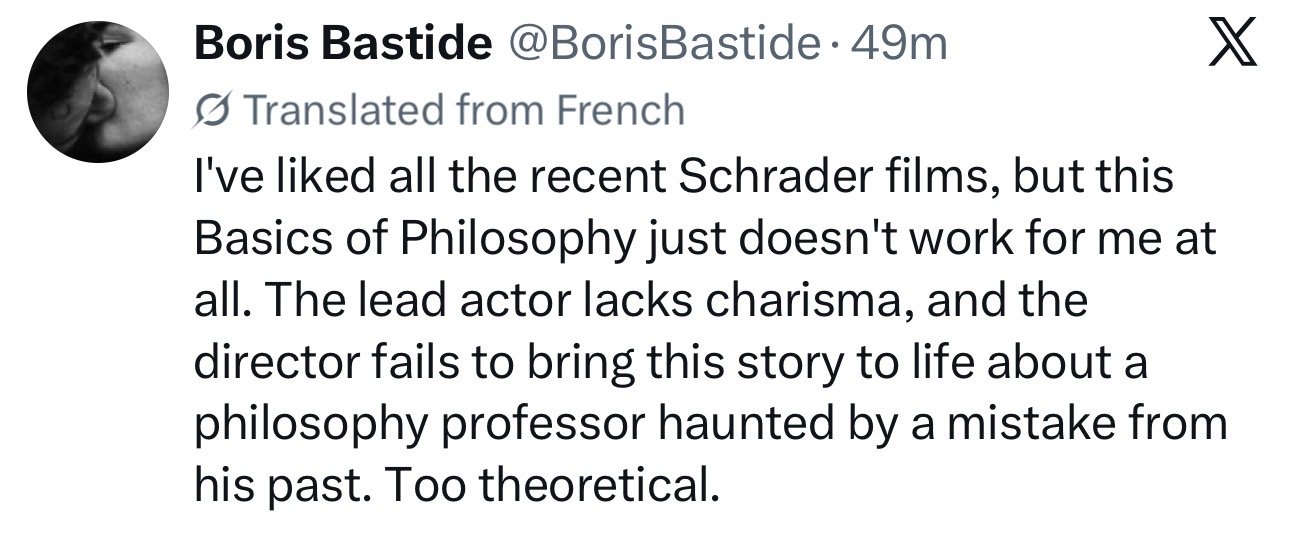
It gives me no pleasure to report that Paul Schrader’s “The Basics of Philosophy” is one of the worst films of his career. Wooden acting, Jack Huston and Sofia Boutella are badly miscast, the script is dull, the photography is flat; nothing works here.
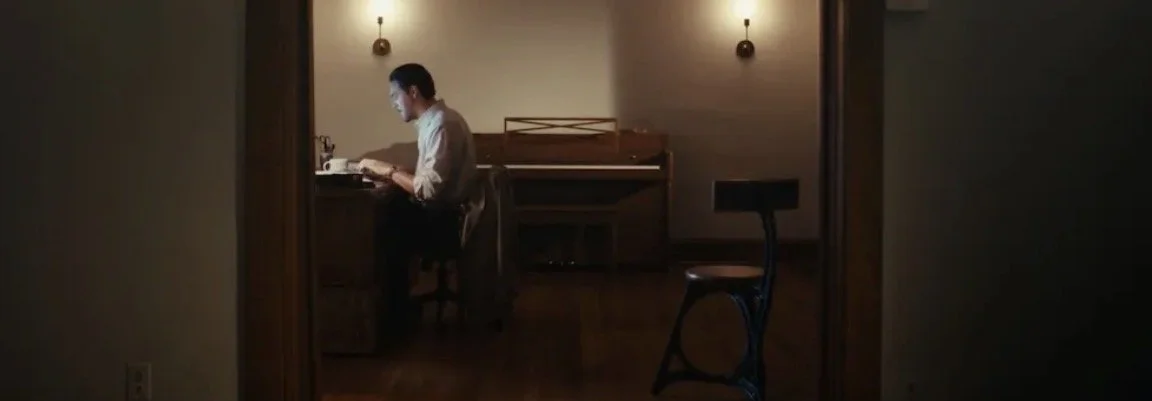
The film follows John Jorrisen (Huston), a philosophy professor whose carefully controlled life is haunted by his sexual abuse of a 14-year-old student, Miguel, years earlier. He’s now engaged to a woman (Boutella) but oddly cold towards her.
After his wealthy father dies, John seeks out Miguel, now a successful realtor, apparently hoping to confront his past and find some form of redemption. He starts obsessively stalking Miguel while working on a book about Spinoza.
The premise is deliberately uncomfortable, but the film’s tangled story struggles to turn that moral dilemma into any sort of convincing drama. John spends much of the film intellectualizing his guilt via narration and questioning his own identity, while the plot just drifts and drifts, without much drama.
It doesn’t help that the film is too familiar, another entry in Schrader’s “Man in a Room” quadrilogy, which started off great (“First Reformed”), was followed by a notable entry (“The Card Counter”) and an underwhelming one (“Master Gardener”) — “The Basics of Philosophy” is by far the weakest of the bunch; another Bresson-inspired treatise that fails to reach its transcendent ambitions. Also, unlike Ethan Hawke and Oscar Isaac, Huston is just not capable of carrying this thing — he gives an intense performance, but his delivery is too tightly controlled, too stiff. Even the film’s ambiguity feels somewhat forced.
In “The Basics of Philosophy,” you will find Schrader’s usual obsessions with guilt and redemption, but they are presented with such heavy-handed dialogue and obvious symbolism. The stilted, theatrical scenes and high-contrast black-and-white flashbacks, poorly lit, might I add, only further enhance this film’s artificial quality.
In the end, “The Basics of Philosophy,” which was made for only a little over $2M, feels like a an overextended exercise in Schrader’s familiar intellectual and spiritual shtick. There’s nothing wrong with revisiting those themes, but here they’re handled with such little depth, or dramatic conviction that the film’s supposed profundity becomes increasingly hard to take seriously.



Nathan Fielder and Lance Oppenheim's "You Can See Everything" has been in theaters for, what, three days? And it's already the highest-rated feature film of all time on Letterboxd.