


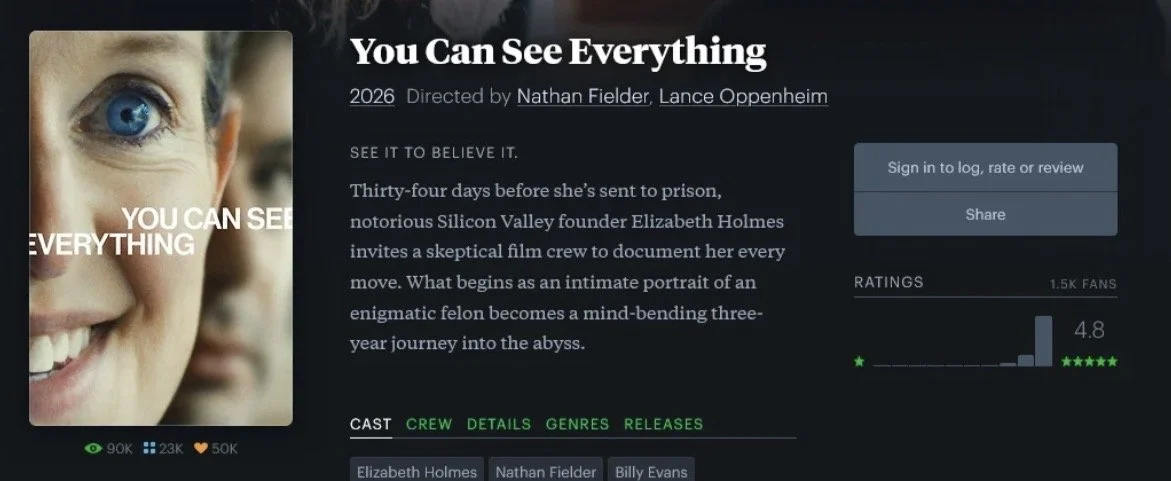
Nathan Fielder and Lance Oppenheim's "You Can See Everything" has been in theaters for, what, three days? And it's already the highest-rated feature film of all time on Letterboxd.
The A24 doc about Elizabeth Holmes currently sits at a 4.8 average based on 144,673 user reviews, 73% of which are five stars. That's higher than "Harakiri" (4.7), "12 Angry Men" (4.6) and "The Godfather: Part II" (4.6), “Seven Samurai” (4.6). The number will probably move around as more people log it. But still.
I'm a fan of Fielder’s doc. The reviews have been through the roof, 99 on Metacritic, and it's the best-reviewed movie of the year on Rotten Tomatoes. I'm not here to tell you otherwise. What I am here to tell you is that a movie that opened on Friday shouldn't be outranking the greats, and the fact that it can says a lot more about Letterboxd than it does about the movie.
We've been through this before. “Parasite” — released only seven years ago — was once at the top, and only recently dethroned. Back in June 2023, ‘Across the Spider-Verse’ hit #1 with a 4.7. I wrote at the time that I doubted it would last and that it was a moment to ponder the absurdity of these lists. A few weeks later, and following backlash, Letterboxd rewrote its whole formula, admitting the site had become more susceptible to "ratings distortion."
Three years later, the new math got beat by a documentary on its opening weekend. So much for that.
It's not complicated. The people logging a movie on opening weekend are the people who couldn't wait to see it. They've been hyped since the Telluride surprise screening and they're going to hand out five stars like candy. "Harakiri" got its 4.7 the hard way, over decades, from people who went out of their way to watch a 1962 black-and-white samurai movie.
Which brings me to the bigger point. If Letterboxd's all-time list can't be taken seriously, where is one supposed to go? For 70 years the answer was easy: the Sight and Sound poll. Critics, programmers and filmmakers from all over the world, voting once a decade. It was the one list that was supposed to be immune to hype, and agendas. Even Roger Ebert, who had zero patience for this stuff, made an exception for it. He voted in it every decade from 1972 to 2012, and outside of his yearly ten best, it was the only list he ever voted in.
Ebert also got why Sight and Sound mattered. Back in 2002 he called it "the only one most serious movie people take seriously." Experts from around the world, once a decade. That was the deal.
And then that broke too.
"Bicycle Thieves" won in 1952. "Citizen Kane" held the top spot from 1962 to 2002. "Vertigo" finally took over in 2012, and even that felt huge, but it had been climbing for decades. That's how this poll was supposed to work. Slowly.
Then came 2022, BFI decided to nearly double the voting pool, from 846 to 1,639, as a way to be more inclusive, and "Jeanne Dielman" jumped from #35 to #1. I wrote a piece called "The Year the Sight & Sound Poll Died" and I haven't changed my mind. Paul Schrader said the jump hurt the poll's credibility and he was right. I have nothing against Akerman's film. It's a major work. But going from 35 to 1 in ten years isn't critics slowly changing their minds. That's a statement being made, and once a poll starts making statements it stops being a poll.
So I honestly don't know if there's any prestigious list left anymore. Letterboxd's can be flipped in a weekend. Sight and Sound decided it would rather send a message. IMDb’s Top 250 has been around for decades and, despite its flaws, has withstood everything. It's the ultimate populist list, lacking adventurous taste, with "The Shawshank Redemption" still on top (it's #7 on Letterboxd). That's the thing, though: the IMDb list never hid its populist agenda. "Shawshank" is beloved by the masses and has been seen by millions. So who exactly is Letterboxd's list for? Film Twitter?

Denzel playing a broken ex-cop with nothing to lose, under McQuarrie's direction? We all know Washington loves to attach himself to redemption stories. It's his bread and butter.