

Continuing on with this series, here’s a look back at 1986, which was a rich year for cinema—and that’s despite taking place in a decade often defined by high-concept blockbusters, an industry increasingly driven by commercial instincts, which led to the mass popularization of sequels.
And yet, beneath that glossy surface, something more interesting was happening.
At the mainstream level, for better or worse, “Top Gun” became a defining cultural artifact. Sleek, muscular, and unapologetically commercial, it captured the decade’s fascination with gloss, velocity, and star power—cementing Tom Cruise as a bona fide movie star. It wasn’t a very good movie, but audiences ate it up—the perfect example of the empty, populist moviemaking that raged throughout the decade.
The box office of 1986 was dominated by films that perfectly captured that gloss. At the top sat “Top Gun.” Close behind was “Crocodile Dundee,” which became a surprise smash. Sequels and genre hits also performed strongly, with “Aliens” and “Star Trek IV: The Voyage Home.”
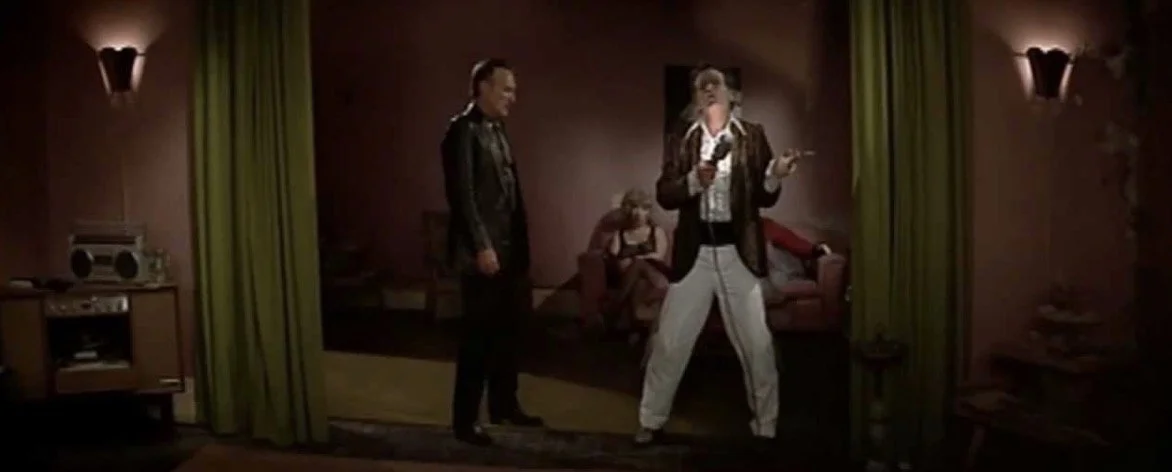
If “Top Gun” represented the masses with slick entertainment, then “Blue Velvet” represented the polar opposite: American hell—a nightmarish subversion that completely upended Hollywood junk food in favor of something audiences had never seen before. David Lynch’s disturbing vision of small-town America remains one of the most unsettling works of the decade. It’s the kind of film that endures precisely because it refuses easy interpretation. There are so many images in this film that I will never be able to shake.
Elsewhere, David Cronenberg delivered one of the great remakes with “The Fly”—a grotesque, tragic love story disguised as body horror. Anchored by Jeff Goldblum’s unhinged performance, it elevated genre filmmaking into something unexpectedly moving and artful. It might be the best film David Cronenberg has ever made.
War cinema, too, found a new voice. “Platoon,” from Oliver Stone, made on a skimpy $6M budget, rejected the romanticism of earlier war movies in favor of something raw and personal. Drawing from Stone’s own experiences, it presented the Vietnam War not as spectacle, but as a psychological minefield. Pushing back against the blockbuster era, the Oscars crowned “Platoon” as Best Picture, with Stone winning Best Director.
Meanwhile, another great American film of 1986 was Woody Allen’s “Hannah and Her Sisters,” which saw the filmmaker at the height of his powers, weaving together multiple storylines—relationships, philosophy, humor—into one of his most enduring works. Allen would go even darker three years later with another one of his best films: “Crimes and Misdemeanors.”
“Ferris Bueller’s Day Off,” directed by John Hughes, became an instantly rewatchable movie—not just for its humor, but for its rebellious celebration of youth. It broke the fourth wall, bent narrative rules, and captured a carefree spirit that still resonates.
And then there’s “Aliens,” James Cameron’s surprising sequel that managed the rare feat of expanding on its predecessor while carving out its own identity. Where “Alien” was horror, “Aliens” was full-on action—two different filmmakers, with both films standing apart from each other, which is exactly what you want out of a franchise. This was the blueprint.
I cannot fail to mention Michael Mann’s “Manhunter,” which remains one of the most overlooked films of the decade—a sleek and unsettling thriller that quietly pushed the crime genre into more psychological territory. That cool color palette, the synthesizer score—pure Mann. This was our first look at Hannibal Lecter, a key precursor to Jonathan Demme’s “The Silence of the Lambs” and a foundational work in the modern serial killer canon.
Speaking of Demme, his “Something Wild” came out this very year—one of the boldest genre hybrids, starting as a playful screwball comedy, before Ray Liotta’s psychopath shows up and the film turns into something far darker and more dangerous. The result is unpredictable, daring, and constantly mutating—arguably Demme’s greatest film.
The Palme d’Or went to Roland Joffé’s “The Mission,” a sweeping historical drama that many believed then—and still believe now—was not deserving of top honors. It does make sense that a mainstream filmmaker like Sydney Pollack, who was president of the jury, would honor the most “prestige” film in competition.
It’s not like there weren’t worthier options. Also in competition were Martin Scorsese’s “After Hours,” Andrei Konchalovsky’s “Runaway Train,” Neil Jordan’s “Mona Lisa,” Jim Jarmusch’s “Down by Law,” and, most importantly, Andrei Tarkovsky’s “The Sacrifice.”
Maybe Tarkovsky’s masterpiece was too spiritual for Pollack’s jury—a meditative work that feels almost outside of time, and all the more powerful for it. It would go on to be the Russian master’s final film; he died seven months later at just 54.
The Best Films of 1986
Blue Velvet
The Fly
Something Wild
Platoon
Hannah and Her Sisters
The Sacrifice
Aliens
My Beautiful Laundrette
Manhunter
Ferris Bueller’s Day Off
Notable runners-up include—Salvador, Sid and Nancy, Down by Law, Mona Lisa, The Color of Money, The Green Ray, Henry: Portrait of a Serial Killer, Round Midnight, Nothing in Common, Peggy Sue Got Married, Ruthless People, Pretty in Pink, Back to School, Three Amigos, Hoosiers, Down and Out in Beverly Hills.

Still no distributor for "Bucking Fastard," "Alpha Gang," "The Last Photograph," "Closing Night," and "The Life and Deaths of Wilson Shedd." The issue seems to be quality more than a lack of willingness to buy.