



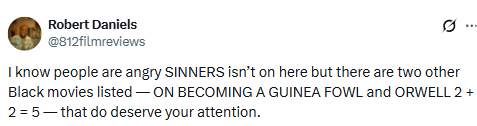
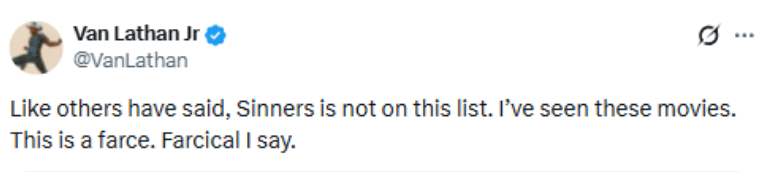
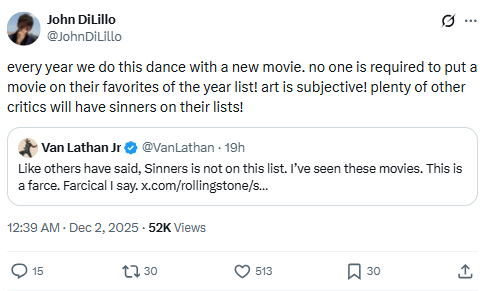
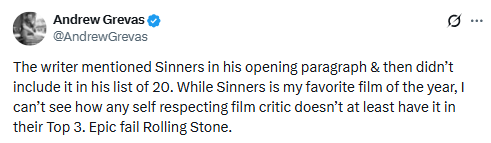
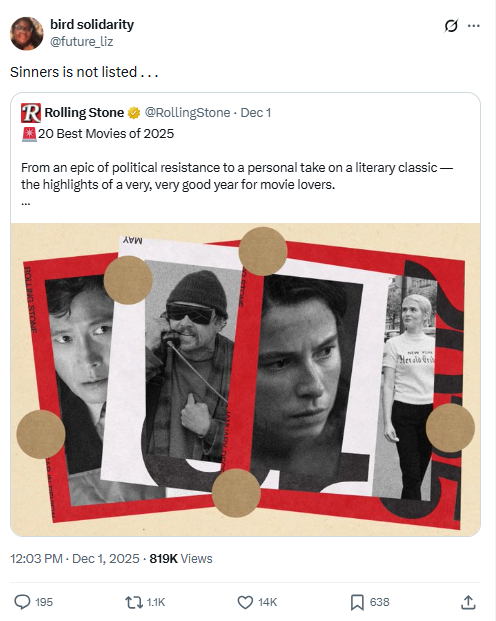
The online hive-mind has struck again — this time aimed at Rolling Stone for leaving Ryan Coogler’s “Sinners” off its “Top 20 Movies of 2025” list. I’m serious. This is what it’s come down to.
Rolling Stone’s list, written and assembled by David Fear, dropped yesterday, and while it contained a strong mix of indies, international and big-studio plays, many fans were somehow outraged that “Sinners” was nowhere to be found. Social-media threads erupted with accusations that the omission was “racist,” “criminal,” or proof that the magazine “doesn’t get movies anymore.”
The bigger picture for me is what this blowback says more about the current state of film discourse than it does “Sinners” — the increasingly rigid hive-mind dominating the field. What this controversy really tells me is that film criticism is now one big echo chamber: either you’re with us, or you’re against us.
These days, conformity is rewarded. Once a film is deemed essential by the online communists, any dissent — even a simple omission from a list — is treated as sacrilege. Critics who fail to align with the consensus are assumed to be wrong, or worse, have ulterior motives.
This is how hive mind works:
A film is declared a masterpiece by a dominant segment of online fandom.
Any deviation from that viewpoint becomes suspicious.
Critics who don’t echo the group’s sentiment risk being attacked, dismissed, or dogpiled.
It has reached the point where some critics have privately told me they hesitate to rank or review certain films honestly because they fear the online reaction. The field has basically turned into a culture of enforcement.
Demanding that every respected outlet must include one particular film — no matter how acclaimed — is antithetical to the entire idea of criticism. There has always been disagreement in film culture. There has always been debate. However, what we’re seeing now is something different: a demand for ideological alignment, enforced via public shaming.



So there's a script. That's something. It looks as though “The Movie Critic” really is dead and buried, and that this is a brand-new project, and title, but the premise is unknown.