





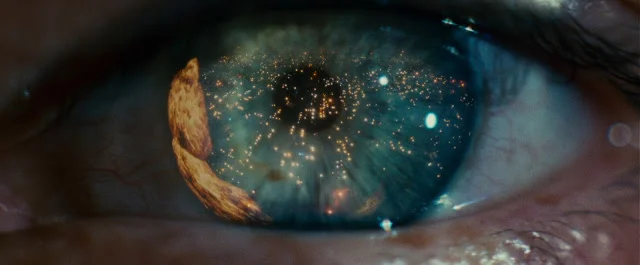
Upon its release in 1982, "Blade Runner“ had so much studio interference that its history is the stuff of legend. Receiving mixed reviews upon its release, it ended up receiving a cult following on home video — which got director Ridley Scott amped up and screening his own "final" versions, out of his own pocket, to audiences around the country. There have been several versions of "Blade Runner", seven to be exact, but the ultimate seems be 1992's "Final Cut" which got rid of the narration, left us with an extra final brilliant shot, and fixed many of the plot holes present in the original. It was the only time Scott ever had total creative freedom in the editing room for the film and it would only come 25 years after its release.
Way before Leonardo Dicaprio's Cobb had his totem in "Inception" and was questioning what was a dream and what was reality, Scott's film was asking the existential questions, using sci-fi as his leeway, and having Harrison Ford's Deckard wonder if he was human or replicant. Three decades later and we are still asking that same question.
I was never part of the camp that thought "Blade Runner" was a great movie but, over the years, I've built appreciation for the film, despite the distancing effect. My history with the film is unique and unlike any other I've had. Its images, simmering with Jordan Cronenweth‘s all-time great cinematography, recall those of the great poetic paintings of the 18th century. The special effects, even by today’s standards, are absolutely stunning as the film rummages through a desolate but high-tech futuristic Los Angeles condemned by social and class warfare. The 1% has won, they live atop the grandest of towers, with skyline views that take your breath away, and the poor are all shacked up either in claustrophobic apartments, or the slummy L.A. streets overcrowded with what seem to be a primarily Japanese, Arabic and Caucasian population.
The vision of "Blade Runner" is based on Phillip K. Dick's short story, Do Androids Dream of Electric Sheep?, but the cinematic aspect is all Scott. To understand the importance of "Blade Runner" on film history, one must realize that before its release there wasn't anything like it. The film's dark style and futuristic designs served as the blueprint for the next 35 years of science fiction. So what did "Blade Runner" pave the way for in sci-fi? It used "film noir" to tackle what are now clichéd tropes of the sci-fi genre: giant global corporations, environmental rot, overpopulation, the rich getting richer, and poverty or slavery at the bottom. The great sci-fi films since "Blade Runner" all use these devices to set their worlds up: "The Matrix," "Children of Men," "Brazil," "12 Monkeys" "Minority Report," "Looper," "Gattaca," are all offsprings of the "Blade Runner" legacy.
Scott also adds sci-fi tropes that were already available to him thanks to groundbreakers like 1927'sFritz Lang-directed "Metropolis," maybe the only other science fiction film that could be more influential than "Blade Runner." Scott adds in flying cars, towering infrastructure, and high towers that feel genuinely colossal. If Lang's vision managed to masterfully seep its way onto the screen in 1927, despite the obvious technical limitations of that era, then Ridley Scott expands on all of that. Yes, CGI was still not as advanced back in 1982 as it is today, but Scott managed to take our breath away with the visual schema of his film. Think of the giant billboards with moving, speaking faces on them, which Denis Villeneuve used impeccably in his sequel "Blade Runner 2049;" it's a prediction that has come to full realization today -- have you been in Times Square lately?
To say the least, the stylized world Ridley Scott created and its themes of futurism, isolation, and “artificial” humanity made an impact the size of the meteor crater in Arizona. To that effect, numerous films, and even Japanese anime, drew influence from its visual style and themes, infusing the landscape of Japanese animation with what would come to be known as cyberpunk. If Scott's film didn't exist, then there wouldn't be the towering anime achievement of "Akira."
Scott's opus positioned a society in which Replicants were just as much humanized as we were. In fact, they were born so fully formed, infused with artificial memories they believed to be part of a past they never really had, that its maker Tyrell, czar of the corporation, sets them up with an expiration date that takes effect after four years; after the four year mark, having adapted with our society and knowing all the nooks and crannies to get around, replicants would become too smart and would begin to develop human emotions and feelings, which would make them feel too human to exist. To prevent a civil rights crisis they need die.
That’s where Deckard comes in, he’s a “blade runner,” a man assigned to track down six replicants that have rebelled and want their life expectancy expanded, and they will go as far as murder to prevent themselves from expiring. Of note, Deckard’s task is to kill six replicants, but we only see 5 — does that mean he’s the sixth and final kill? By all accounts, we see him as a human throughout the film, but Replicants are supposed to be just that — “more human than human,” as Tyrell says. The existential themes of the film end up revolving around Deckard; we don’t know much about him but we know enough to suspect that his past, or lack thereof, is suspicious. There are instances and there are clues but they all purposely contradict one another.
As mentioned, it's taken me several viewings to warm up to Scott's classic, if you want to call it that, but each viewing brings about new insights and details that I hadn't noticed the previous rounds. There's so much carefully crafted detail in Jordan Cronenworth's shots that you could just spend an entire viewing focusing on what's on the frame instead of the story. It's not uncommon either to just freeze a frame and study it when it comes to this movie. And that wouldn't be a bad idea, since I've always found the story thinly veiled and almost like an excuse to expound of Scott's deepest visual desires at the time, rather than to entertain. This is not an uncommon complaint when it comes to "Blade Runner" because, despite its reputation as a sci-fi classic, it still has many people left to convince. Speak to any dissenter of the film and they will acknowledge that the film is easier to admire than to like. It's not a film that you could necessarily warm up to. The brilliance of "Blade Runner" comes in its existential ideas rather than its ability to hook, which, quite frankly will turn off many viewers in its lack thereof. No, the film's legacy is that of a visual groundbreaker rather than anything else, and it posits itself as a shape-shifter that ultimately changed the vision of sci-fi in movies. [The American Society of photographers sealed its legacy by naming it the 9th best photographed film since 1950.]

Earlier this year, Zack Snyder mentioned having seen James Gunn’s “Superman.” Heaping praise on it. Now he’s saying he actually hasn’t caught up with it yet?