


Two years ago, the streaming service’s then-newly hired chief content officer, Dan Lin, admitted that its strategy going forward would be to make films “more about audience, and less about auteurs.” The news came only a week after David Lynch revealed that Netflix had rejected a pitch for his next film.
So, after years of funding passion projects from the likes of Scorsese, Coen, Lee, Cuarón, Iñárritu, Campion, Cooper, Soderbergh, and Bong, among many others, the streaming giant has finally decided it should stick to producing the kind of brainless fare that tends to dominate its weekly Top 10. Call it a business decision.
Fast forward to today, and Netflix barely has any potential Oscar contenders to show for in the upcoming awards race. Of course, there’s Fernando Meirelles’ “Here Comes the Flood,” which feels more like a commercial heist thriller, and Greg Kwedar’s “Saturn Return,” a major question mark. Netflix is essentially betting all its chips on two titles for Oscar contention: David Fincher’s “The Adventures of Cliff Booth,” set for a November release, and Javier Ambrossi and Javier Calvo’s “La Bola Negra,” which it acquired out of Cannes in May for $5M.
I honestly expected the film to sell for much more than $5M. Remember when Netflix acquired “Emilia Pérez” for $12 million out of Cannes?
Now comes word that Netflix is giving “La Bola Negra” a 28-day theatrical window beginning November 6. The film, which won Best Director at Cannes, will debut on the platform on December 4. By Netflix standards, this is a robust theatrical rollout and complements “The Adventures of Cliff Booth,” which is also receiving a four-week IMAX-exclusive run. For a company that has often treated theatrical exhibition as an afterthought, the strategy suggests a renewed commitment to giving its top contenders a meaningful big-screen presence.
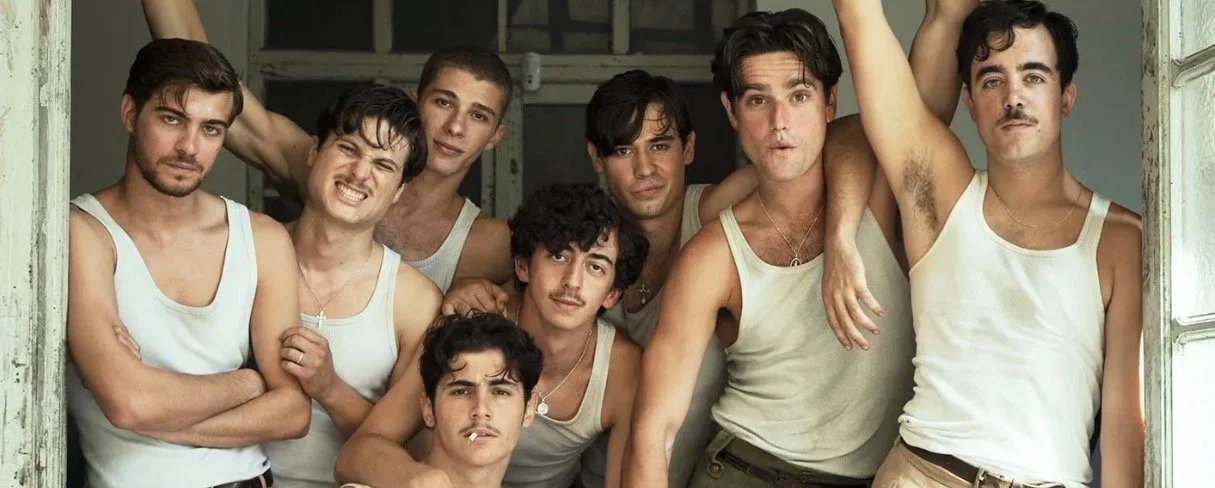
“The Black Ball,” which stars Guitarricadelafuente, Miguel Bernardeau, Carlos González, and Milo Quifesis, with Penelope Cruz and Glenn Close in supporting roles, is an ambitious but wildly uneven 2.5-hour Spanish drama that blends historical fiction, queer melodrama, and meta-literary adaptation. With no clear Best Picture frontrunner emerging from Cannes, the U.S. press—especially Oscar-minded journalists—seemed eager to bestow that status on the film during the festival’s final days.
I didn’t find it particularly impressive. It plays like a Weinstein-era Oscar-bait vehicle, only in Spanish, and is likely to divide critics’ groups. The film actually didn’t perform all that well on the Cannes critics’ grids. It scored a 2.0 on the Screen Jury Grid, a 2.05 on ICS, a 1.2 on MoiRée, and a 2.1 on Cahiers du Cinéma. However, it currently sits at 85 on Metacritic (based on 10 reviews) and 87% on Rotten Tomatoes, so it may ultimately be up to mainstream critics to push the film into the Oscar race.

Warner Bros. has delayed "Gremlins 3" from its original November 19, 2027 release date to October 27, 2028, making it a Halloween-timed release. A teaser has also been released.