Only 24 hours before the Venice Film Festival kicked off, its chief director, Alberto Barbera, cautioned attendees that approaching his—or any festival—expecting the next masterpiece is a mistake.
The mistake people make when they go to a festival, and they have a certain list of titles in mind for which they have huge expectations, is that everyone expects them to be completely satisfying masterpieces. But unfortunately that’s not always the case — in fact, it’s never the case.
We’re now halfway through the latest edition. Eleven of the 21 competition films have screened and, as Barbera predicted, no masterpiece has emerged. However, a handful of “good” films have surfaced—“Cover-Up,” “Bugonia,” “Jay Kelly,” “No Other Choice.” Still to come are new works from Bigelow, Safdie, Van Sant, Ozon, and Ben Hania, among others, so optimism lingers.
Considering the drama surrounding it, I never expected Jim Jarmusch’s “Father Mother Sister Brother” to be a masterpiece—and in a way, it delivers exactly as anticipated, though with surprisingly satisfying results. Add it to the “good” list.
The film was brushed off by Cannes and has now landed in Venice, and it’s not hard to see why Cannes might have passed on it: this is Jarmusch stripped down beyond the bare bones, a film composed of pauses and absences, moments waiting for resolution and finding none. It’s his most experimental film.
Jarmusch has always had the gift of turning dead air into art, and in “Father Mother Sister Brother” he pushes that to an extreme. Three stories, three family dynamics—sons and mothers, daughters and fathers—presented with the kind of flat style, deliberate staging that can best be described as uber-minimalism.
This is the kind of film that feels like a dare; it asks you to lean in closer and closer until you’re not sure if you’ve heard anything at all. It isn’t a major work—certainly not within Jarmusch’s own remarkable catalog—but the strange thing is how effectively this minor collection of stories manages to stay with you.
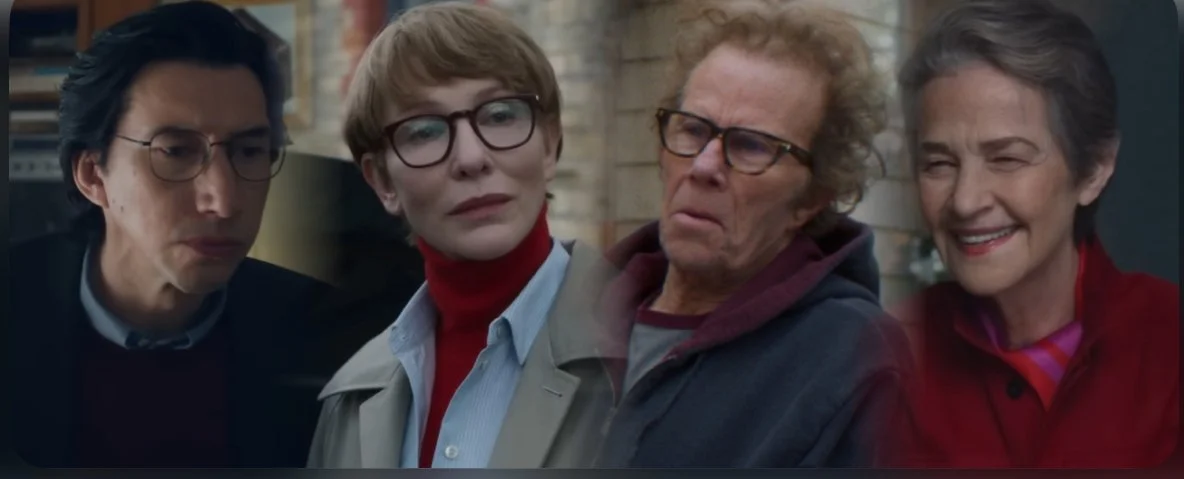
“Father” has son and daughter (Adam Driver and Mayim Bialik) visiting their father (Tom Waits) for a casual sit-down—health and money concerns hover over the conversation, hinted at but never quite confronted. “Mother” gives Charlotte Rampling the stage for her ritualized once-a-year tea with two daughters (Cate Blanchett and Vicky Krieps); the scene plays less like a reunion and more like a stark portrait of estrangement. And “Sister Brother,” with Indya Moore and Luka Sabbat as twins who lost their parents in a plane accident, is the weakest of the three.
What’s startling is how little connective tissue Jarmusch provides—no “we’re all secretly linked” gimmickry. Instead, there are odd little details that appear in every story: skateboards, Rolex watches, glasses of water. There’s almost no music. No drama. Just people sitting in awkward silence and making us squirm.
People will dismiss “Father Mother Sister Brother” as too small, too slight to matter. And yet Jarmusch seems to be aiming for something significant in these awkward family exchanges—something about the absurdity and tenderness of modern family dynamics. Chances are you will relate to one, or even all, of these stories.

The short version: "Woman Unknown" was a compromise. The jury deadlocked over "Possible Love" and "NAZA," not able to com to terms, fell back on their #3, May el-Toukhy's film.