



Here’s another Venice competition title that’s receiving mixed reviews, and for good reason. That’s because Olivier Assayas’ “The Wizard of Kremlin” decides to focus on the wrong character.
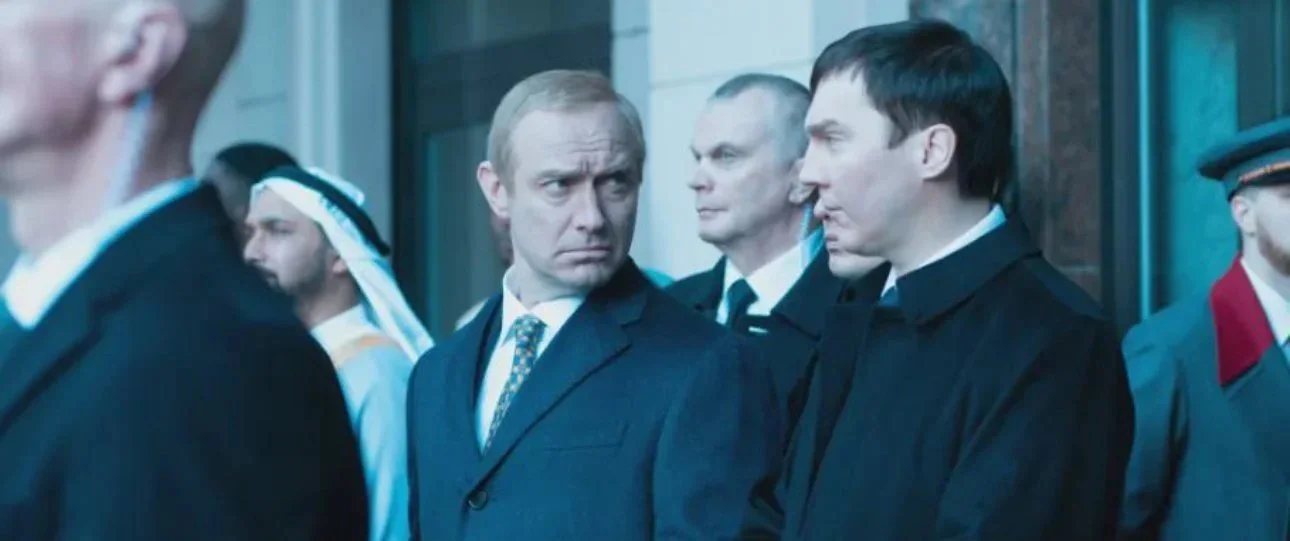
In the film, Jude Law plays Vladimir Putin with total command—decisive, charismatic, cunning. It’s a performance so concentrated that whenever he’s on screen, the movie ignites. He comes off as the sharpest, most competent figure in the room, a shrewd go-getter in a political swamp. Magnetic is the right word to describe his performance.
Sadly, Putin slips in and out of scenes, and in fact, completely disappears from the third act. Assayas, who co-wrote the script with Emmanuel Carrère, doesn’t really want to make a movie about Putin. He wants to make a movie about Vadim Baranov (Paul Dano), a television producer turned political operator, who helps build up Putin to the Russian public. Dano, like Law, also speaks in British accent, and he underplays everything. He’s effective enough, but he’s no match for Law, who only gets a fraction of the screen time.
The film begins in the late ’90s, with Russia intoxicated by post-Soviet freedom, drunk on its own chaos. Boris Yeltsin staggers through office while oligarchs reign supreme. Berezovsky (Will Keen), a scheming billionaire, thinks he’s found the perfect puppet in Putin, a security chief who he believes can be controlled. Of course, the jokes on him, and the puppet becomes the master.
It’s a great story, but “The Wizard of the Kremlin” doesn’t know how to tell it. Assayas structures everything around flashbacks, Baranov’s confessions to an American journalist (Jeffrey Wright), and for good measure throws in Barnanov’s decades-long romance with Ksenia (Alicia Vikander), a singer turned oligarch’s mistress who eventually goes back to him.
These are screenwriting mistakes. They stretch the film to 150 minutes, and the result feels unfinished, episodic. Putin’s rise is a fascinating saga, but all I kept thinking about was how good a TV mini-series it would be with fuller and more fleshed-out characters, the format would fix the gaping narrative holes the film has.
Assayas (”Irma Vep,” “Carlos,” “Personal Shopper”) seems trapped between wanting to make a sprawling political chronicle and a character study of a second-tier character. The movie has ambition but rarely takes off. When Law is on screen, you want more of him. When he isn’t, you miss his presence.

Paul Greengrass’ "The Uprising," starring Andrew Garfield, opened to $3.2M from 2,068 theaters this weekend. Yikes. The budget hasn’t been disclosed, but is said to be in the $20-$30M range.