Michael Almereyda Talks ‘Marjorie Prime,’ Artificial Intelligence & The Film’s Unsettling Premise

I spoke to director Michael Almereyda for The Playlist earlier this year. His latest film, starring Jon Hamm and Lois Smith,  is a unique take on the sci-fi genre, it's a chamber drama entitled Marjorie Prime [INTERVIEW]
"Almereyda takes you on an almost psychedelic journey through the human subconscious. It’s not easy to let yourself swim into the film’s initial coldness, but if you are open to the film’s Resnais-esque contemplations on life and allow yourself to bring your own experiences to the drama, the journey is as rewarding as anything out there at the moment. By the film’s climax, the future feels closer than ever before, one which will be inevitable dominated by artificial touches. It’s hard for the film’s themes of aging and memory not to hit home."

OSCARS: 170 Films Eligible For Best Documentary Category, New Record

The full list HERE

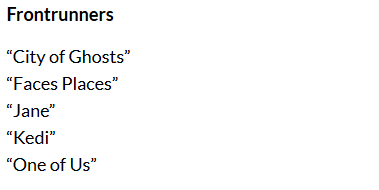
I have seen a healthy amount of non-fiction films this year. It's been an incredible year for the documentary form. These have been the best of the best for me:

1) “Faces Places”
2) “City of Ghosts”
3) “Icarus”
4) “Dawson City: Frozen Time”
5) “Human Flow”
6) “Jane”
7) “Get Me Roger Stone”
8) “Quest”
9) “Step”
10) “An Inconvenient Sequel: Truth to Power”

--------------------

 IndieWire's awards pundit Anne Thompson has these as the main contenders:


William Friedkin admits he's never seen any of the "Exorcist" sequels


One of the great unsung American directors is no doubt William Friedkin ("The French Connection," "The Exorcist," "Sorcerer," "To Live and Die in L.A"). Friedkin had a mini comeback of sorts with 2006's "Bug," but, especially, 2011's masterful "Killer Joe," two shockers that pushed the boundaries of tension in American cinema. I was hoping that set of films could be a rejuvenation of sorts for the 82-year-old director but, alas, it never came. The fact that both those movies were all but ignored upon release has made it rather difficult for him to find the sufficient funding to make another cinematic statement.

It's been 6 years since "Killer Joe" was released and he has nothing really planned, at least in terms of fiction. His latest non-fiction venture, "The Devil and Father Amortha," had its world premiere at the Venice Film Festival this past September and it sounds just fascinating. The film is the story of Father Gabriele Amortha's and picks up as he's about to perform his ninth exorcism on an Italian woman. There is no release date for the film as of yet, but, suffice to say, the festival reviews have been very good.

The connection between Friedkin and the exorcism genre is unsurpassed, after all he brought it to the mainstream with his 1973 classic "The Exorcist." However, it is surprising to hear that he never saw any of the 4 sequels that followed it:

“I never saw any of the ‘Exorcist’ films, not even Bill’s [William Blatty, The Exorcist III]. I saw a few minutes of ‘Exorcist II,’ but that was only because I was in the Technicolor lab timing a film that I had directed — I forget which one — and one of the color timers at Technicolor said, hey, we just made a print of ‘Exorcist II,’ would you like to have a look at it? I said OK. I went in, and after five minutes, it just blasted me. I couldn’t take it,” Friedkin said. “I thought it was just ridiculous and stupid. But that was only five minutes, so I can’t make an ultimate judgement about it. It just seemed to me to have nothing to do with ‘The Exorcist.’ ”

“I know Bill [Blatty] did one, which was not meant to be called ‘Exorcist III.’ It was from another novel he’d written called ‘Legion.’ I had no interest. I loved Bill Blatty. I dedicated my documentary to him and we remained close friends to his death. But I know that he had to make a lot of compromises — he had to put an exorcism scene in there, which he never intended, so that the producers could call it ‘Exorcist III'

He also added that was a fan of "It," which recently unseated "The Exorcist" as the highest grossing horror movie of all-time, but he cautions us not to consider it the horror movie box-office champ, given the inflation in movie ticket prices today when compared to 40 years ago.

“I thought it was a little bit over the top, but ‘It’ was really good. The clown was pretty scary stuff. I really like it. But here’s the thing. It will never have as many admissions as ‘The Exorcist’ in terms of people who came to see it,” he explained. “The price of a ticket when ‘The Exorcist’ came out was probably on average less than two dollars; I think today it’s closer to nine. Neither ‘The Exorcist’ nor any of the other films that made a lot of money will ever have as many viewers as ‘Gone with the Wind‘ or ‘Birth of a Nation.’ I think it cost 15 cents or a quarter to see. So you can’t talk about how many people saw this more than something else because of the difference in the value of money. But it’s kind of unusual for Warner Bros. to get behind a story like that because ‘The Exorcist’ has been such an important film to them. It’s the gift that keeps on giving. Still, I liked ‘It.’ I thought it was terrific.”

Source: IndieWire

Louie C.K's "I Love You, Daddy"


"I Love You, Daddy" is director-actor Louie CK's unique ode to Woody Allen but, more specifically, "Manhattan." Shot in black-and-white and set in New York City it features an old-fashioned romantic musical score, but retains the talky neuroses of Allen's 1979 classic. Shot on 35mm in, what seems to be, low-budget indie form, this comedy was directed and co-written by C.K. himself. In it, he plays Glen Topher, a television creator with writer's block who has given his 17-year-old daughter China (Chloe Grace Moretz) everything and more in life, this is a kid that never heard the word "no" and has been spoon-fed by the luxuries that come in having a successful dad. There's been no guidance in her life, no manners taught whatsoever. 

Glen's high-rise apartment in the middle of Manhattan tells us everything we need to know about his wealth, but there's also a lack of satisfaction, he seems to be craving for more. Moretz’ performance is exactly what this thinly-written character needed to burst off the screen, the 20-year-old actress captures the sheer childish nature of this spoon-fed, dependent-on-daddy princess. Her scenes with CK, playing a version of himself here just like he did on "Louie," are the clear-cut highlights of this messy film.

China, fresh off spring break and almost always scantily clad in her mini weeny bikini overabundant uses the phrase “I love you, Daddy!” to get what she wants, so much so that it starts to earn an airless meaning. Glen's friend, played by Charlie Day, senses that she's trouble and that he should probably not inquire about what this girl does not just on spring break, but on any trip she goes off to with "friends.” He further enhances Glen's paranoiac thoughts by telling him that maybe, just maybe, his precious daughter might not be promiscuous, telling him about a sexually explicit game that is very popular among teenagers entitled "Mother May I,” which, well, let's just say leaves Glen in a state of shock for the rest of the film, consistently re-mentioning the prospect of her daughter playing this filthy game. 

Despite just inking a deal to create 12 episodes for a new series about nurses, Glenn feels like he's just signed up to the wrong show. Adding to that it's April and the show is supposed to start airing in September. That gives Glenn less than 6 months to write, cast and shoot the entire thing. His production partner (the excellent Edie Falco) has a platter full of stressful planning to deal with and she's about had it with Glen.  Things start to pick up for our beloved neurotic writer once Grace Cullen (Rose Byrne) comes into the picture, she's a famous Hollywood movie star that wants the leading role in Glen's show. Glen starts to think that this woman, whom he's clearly fantasized about in the past, could be the muse that kick-starts things back up again for him. In a not so surprising twist of fate, they sleep together and, eureka, he starts writing again.

Grace invited Glen and China to the Hamptons, where they are introduced to the film's antagonist Leslie, (John Malkovich) a 68-year-old film director prone to sleeping with under-aged girls, who also happens to be Glenn's idol. Malkovich, donning a goatee, bourgeois verbosity and an overall highbrow attitude is perfectly cast, he's stuck-up but loose, brush-offish but open to new people and new ideas. He's an enigma packed with contradictions and, of course, he sets his sights on China and they start frequenting each other.  Glen hears that China is so enamored with her new best friend that she plans on going with him and some other friends on a retreat in France.  Glen's writer's block comes back and, to make matters worse, the relationship he has with Grace is ended after they argue over Leslie and China's "friendship." The world is falling apart for this writer.

This film is no doubt meant as a provocation on the part of C.K, who is no stranger in veering into uncomfortable and cringe-worthy material in both his brilliant standup routines and his FX show "Louie." The themes here are no doubt boundary-pushing but the film ends up stranding the viewer in its second half by not following up on its promising setup. In other words, it feels like C.K. was scared off by what he was pursuing, the prospect of tackling child molestation, in this movie and decided to go the non-threatening route instead.

"I Love You, Daddy" is Louis CK's first film since 2001's "Pootie Tang," a Chris Rock Blaxploitation mock-up that has barely been remembered in the years since  but has attained a smallish cult following as well. This latest film deserves points for tackling such a hot-button topic as an older predatory man going after under-aged girls, especially given the current zeitgeist we are living in at the moment, it is daring enough to go "there" and not leave a bitter aftertaste afterwards. The film does bare striking similarities to CK's own FX show and is not unlike Larry David's well-known brand of neuroses in "Curb Your Enthusiasm."  The problem with this latest endeavor for the 50-year-old comedian is that at 123 minutes "I Love You, Daddy" does tend to ramble on, which disappoints because a good chunk of the movie works and lures the viewer in. 

What this film essentially feels like is a rough-cut, a film made by a director that is confused as to what he wants to really say and how he intends to say it. There's potential in C.K's voice as a filmmaker but he still needs to sharpen up his craft, hone it if you will, and learn from some of the mistakes he's making here. Maybe next time instead of editing his own film he might want to try and hire a professional editor to cut off the fat and give his film a proper structure built-in with more shape and tone.

"Only the Brave" and "Thank You for Your Service"


Right now in theaters are two films that deal with heroic figures, and I'm not talking about "Thor" or the upcoming "Justice League." No, I mean real, legitimate heroes: Firemen and soldiers. Does heroism achieve any more noble a cause that those two fields of work? Maybe policemen as well. "Only the Brave" has been greeted by positive reviews with a 90% RT score but "Thank You for Your Service" has been met with a more mixed reactions. No matter, I wrote reviews for both over at The Film Stage. 

Only the Brave [REVIEW]

"This testosterone-infused film recalls some of Peter Berg’s more recent heroic true story tales — especially Lone Survivor and Deepwater Horizon — but Kosinski’s penchant for not relying on as much jingoism does his film a great service. Only the Brave is not a simplistic portrait. The understandable mistakes — misfortunes, if you will — and just sheer bad luck the firefighters had on that day don’t go unnoticed. Joe Biden, speaking at the memorial of the fallen 19, eloquently stated “All men are created equal, but then a few become firefighters.” By painstakingly focusing on the smaller, humane aspects of the story, Kosinski does these fallen warriors justice."

Thank You For Your Service [REVIEW] 


"Hall’s lack of subtlety has its setbacks. Flashbacks detract from the film’s tempo and structure, and erase any kind of allure or mystery to the characters. This is a case where some things are better left unsaid, especially when you have the actors tell a world of emotions just by facial gestures and recurring ticks. The present-day sequences are much stronger and effective, even if there are times when they can be overtly symbolic and try to hammer home obvious messages. Take, for instance, the random, albeit clichéd sequence in which a soldier, back at home, tries desperately to rescue an injured pit bull that lost a fight, just like he would have if he were back in Baghdad fighting the insurgency. Cue the flashbacks and haunted memories."

"Thor: Ragnarok" - Move over James Gunn, Taika Waititi is the future voice of Marvel

Image result for thor ragnarok

The first two "Thor" movies were so self-serious and pompous that not even a director as esteemed and capable as Kenneth Branagh could save the initial launch. There were many problems, one of which was that Thor, hammer ET all, and is one of the least interesting characters of the Marvel canon, not to mention one of the least humane and relatable. The film also suffered from a thinly sketched love story between our beloved God of thunder and, of all people, Natalie Portman. Things got only worse, its sequel, "The Dark World," was an insufferable experience, overstuffed with special effects, lacking any kind of character building and, again, took itself excessively seriously.

I come to you as both the bearer of good news and bad news. "Thor: Ragnarok" is a vast improvement upon the first two installments. Part of the reason for this half-successful attempt resides upon its director Taika Waititi (“Hunt for the Wilderpeople” and “What We Do in the Shadows”) who infuses the surroundings without the self-aggrandizing of the formers but instead with a healthy dose Meta humor, the word "wacky" comes to mind in describing it. Yes, this latest "Thor" follows in the footsteps started by "Guardians of the Galaxy," "Deadpool," "Spider-Man: Homecoming," "Ant-Man" and "Doctor Strange" of not taking itself so damn seriously. This pays dividends in terms of overall jumpiness and colorfulness, Waititi fills his frames with bouncy colors that match the overall tone he is going after.

It is also great to see familiar faces supporting Thor. This is not a solo outing like the first two movies. Doctor Strange, Black Widow, and, most notably The Hulk, show up to assist in raising the entertainment factor up a notch. “Thor: Ragnarok” is easily the best of the three Thor movies. Much credit must go to its writers Eric Pearson, Craig Kyle and Christopher L. Yost who fill the film with a joke-a-minute zippiness that sometimes does wonders to the otherwise bland plot, which, by the way, the script does make fun of in certain scenes. Hell, Thor even ends up garnering a new, shorter hairdo, courtesy of Marvel creator Stan Lee no less (in another hilarious cameo).

Yes, with "Ragnarok" the creators have decided to go out with the old and in with the new. After all, the game-changing 2014 "Guardians of the Galaxy" seemed to have sparked a new attitude in Marvel movies, why be so serious about a movie essentially based on a comic book? DC seems to have gotten the memo as well with this year's highly successful "Wonder Woman" being their most loose, amicable affair to date.

Kudos to New Zealand director Waititi for trying to find any sort of fun in Thor, a character that is otherwise, unlike his colleagues Tony Stark, Peter Parker, and Steve Rogers,  a pretty boring dude. Hemsworth is a capable actor as proven in films like "Rush," "Cabin in the Woods," and he all but stole the show with his cameo in the otherwise uninspired "Vacation." Waititi has not found the answers in making Thor a more exciting character, but he has found ways to go around this flaw and make his film a, sometimes, inspiring affair. Waititi has decided to rely less on Thor and more on the supporting characters especially Tom Hiddleston's Loki, The Hulk, and Jeff Goldblum, yes Jeff Goldblum.

The convoluted plot gathered for “Ragnarok” is once again Shakespearean-overkill as Oscar winner Cate Blanchett as Hela, check out the gothic leather gear and those devious antlers, who plays the older, troubled sister to Thor and Loki, returns to make good on ancient prophecy that would destroy their realm of Asgard. When facing off against her brothers, this Goddess more or less schools them, crushing Thor’s hammer, banishing them from Asgard and sending her brothers to Sakaar, a loony planet filled with trash and headed by Jeff Goldblum's "Grandmaster" who organizes gladiatorial battles and buys Thor off renegade and former Asgard-resident Valkyrie (Tessa Thompson). A battle between Hulk and Thor is the film's highlight, brilliantly edited by Zene Baker and Joel Negronn, and directed with pulse-pounding velocity by Waititi, the fight is noteworthy in that it encompasses a wide range of shots but also uses, effectively might I add, the top of the art special effects Marvel has always utilized. The scenes in Sakaar are refreshing and noteworthy in that they try to distance the plot far away from Asgard, which always felt like a handicap for the "Thor" films. Influenced by the Norse legend, Asgard feels like a place overstuffed with cardboard extras masking as "population," whom are dressed up in the lamest cliché-ridden Greek-nurtured costumes imaginable.

Once the Hulk has morphed back into Bruce Banner and our heroes leave Sakaar and go back to Asgard to save the day, the generic aspect of the Thor films comes back and Waititi cannot do much to prevent the inevitable lack of subtlety about to come. There is an overabundance of monsters and, like most of these Marvel/DC movies, an anticlimactic finish filled with CGI overkill, battles and explosions galore.

However, the real star of the show is, quite honestly, Jeff Goldblum, milking it for the camera, and being his very campy self, he is an enigma when it comes to Marvel movies, never making any concessions to what has made him successful all these years, the 65-year-old actor was clearly hired to bring in the deadpan laughs and he succeeds in that department admirably here. If anything, his character is underused in the film. 

First Image of Matt Dillon in Lars Von Trier's Horror 'The House That Jack Built' - Also Starring Riley Keough, Uma Thurman, and Bruno Ganz

House-That-Jack-Built-Matt-Dillon

Lars Von Trier told The Guardian that his latest film was inspired by Donald Trump.

“'The House That Jack Built’ celebrates the idea that life is evil and soulless, which is sadly proven by the recent rise of the Homo trumpus – the rat king,”

Yikes. Whatever the case, a new Von Trier usually has cinephiles intrigued, you can't really discount the writer-director of "Breaking the Waves," "Dancer in the Dark," "Melancholia," and "Dogville," despite the fact that the last few years he's kind of "lost" his marbles with bouts of schizophrenia and depression which led to crazy press conferences at Cannes in which he showed compassion for Hitler and, more or less, insulted Nicolas Windig Refn. Also, despite the buzz that came before its release, "Nymphomaniac" was just not that good.

The Playlist has the synopsis as follows:

Set in Washington during the ’70s and ’80s, and stretching out across twelve years, the story will be told from the point of view of Jack (played by Matt Dillon), and chronicle his development into a serial killer, all while he tries to finish his “masterpiece” as he eludes capture. So far, the only other cast member is Bruno Ganz, but there are four prominent female roles that are yet to be cast, and hopefully we’ll hear about those soon.

This will surely be Cannes-bound. The House That Jack Built will be released in 2018. 

the-house-that-jack-built

Kevin Feige Responds to Criticism of Similar Tones in MCU Movies

Image result for mcu

I am about to watch "Thor: Ragnarok" tomorrow and I have to tell you, this is the most excited I've been for any Thor movie. No, really. Why? Because it seems like, based on early reviews, its director Taika Waititi has brought the same colorful humor that he brought to his other films ("Hunter for the Wilderpeople," and "What We Do in Shadows.") It can be a breath of fresh air to have a Marvel movie that doesn't take itself too seriously, ala "Guardians of the Galaxy" or "Deadpool." You know, the kind of meta, yeah-yeah-yeah-we-know-this-is-a-Marvel-movie attitude that I wish more of these MCU films would employ. They have the action sequences down pat, the CGI and special effects are top-notch, but sometimes the stories stray and the tones are overtly familiar.

The criticism of Marvel movies following the same tone and narrative structure is nothing new, it's something that many critics have been complaining about for over a decade and more. Kevin Feige was asked about this very topic by Uproxx:

"I think it’s just the way we make the movies. I think all the movies are relatively different. I think there’s a narrative that people like to write about because they’re all produced by the same team and they all inhabit the same fictional cinematic universe. That we look for common similarities. And I’m not saying there aren’t common similarities throughout it, but I think Thor: Ragnarok and Spider-Man: Homecoming are two totally different types of movies. They’re both fun. People both enjoy them. Is that a similarity? If so, I’ll take it. If that’s a criticism, I’ll take that, too. But really, yeah, Homecoming, Ragnarok, Panther, into Infinity War, Ant-Man and the Wasp after that. And a ’90s-set Captain Marvel after that; these are six very different movies. If what they have in common is they’re all really enjoyable and fun to watch, then I’ll take it."

OFFICIAL: "The Devil's Rejects" will have a sequel

Image result for the devil's rejects 600x200

Today's announcement by Bloody Disgusting of a sequel to Rob Zombie's 2005 film "The Devil's Rejects" is very much welcome here. Its after all, and it's not even close Zombie's best movie. I have my doubts it will be better than the previous film, but it will hopefully make the cult of the film grow further.

"Bloody Disgusting reports that Rob Zombie is directing a sequel to The Devil’s Rejects, but the details begin and end there. They speculate that it could be a spin-off focusing on related characters or a prequel, both of which seem reasonable considering what happened to the cast at the end of the previous movie. They’re also not sure when he plans to get production underway, but considering how his last few films have been received, “as soon as humanly possible” feels like the right course of action."

Based on the ending wouldn't it have to be a prequel?
This was Zombie's follow-up to "House of 1,000 Corpses," which I despised actually. "House of 1,000 Corpses" was more like a carnival freak show, but it was the supernatural that turned me off. "The Devil's Rejects" felt real, very real, and was a very brutal watch. I was reminded of "Helter Skelter", a sort of homage to Charles Manson, with the lead even resembling him. 

So what seduced me in "The Devil's Rejects"?  The bloody carnage of it all, the fact that Zombie wasn't scared to make his story, about serial killers, feels so real and perverse. It might just be the filthiest and most vulgar movie I've ever responded positively to, and the characters were so sadistic and relentlessly unlikable after all these were unabashedly emotionless serial killers as our main protagonists. 

I also loved how cinematic the film actually was. If I remember, the cinematography was really brilliant, and used the 'swipe' and 'freeze-frame' methods, sometimes resembling a comic book. Oh, and the music, filled with classic seventies rock, fit well. Of course, Lynyrd Skynyrd's "Free Bird" was used for the film's final memorable scene in which a hail of bullets, Bonnie and Clyde style, greets or characters in a moving car. It's quite unique to have a movie like this exist, in which we hate the main characters so much, and feel sympathy for the victims, and yet we can't look away at the drama. I've never felt so much hatred and disgust towards alleged protagonists in a film before, This was Rob Zombie's ode to seventies slasher flicks but with a realism that could make you wince. I don't think Zombie's ever made a film that comes close to the quality of "The Devil's Rejects."

[Slash Film]

"Bright" trailer still leaves much to be desired


Is this for real? I mean, I actually thought this was a spoof for a few second before I came back to reality and settled with the fact that this movie is legit. A $90M sci-fi mashup starring Will Smith. I'm guessing Netflix had meetings where they studied every successful Will Smith movie and decided to mash all of them up together into Bright's screenplay. Bad Boys? Check. Men in Black? Check. Independence Day? Check. Suicide Squad? Check.

Bypassing Oscar season, Clint Eastwood’s ‘The 15:17 To Paris’ will be released on February 9th, 2018

Image result for eastwood 600x200

Director Clint Eastwood has helmed fourteen movies since hitting the age of 70. Has any director come close to that feat at this late stage in their career? Yes, Woody Allen‘s nearly been there thirteen films post-70, but Eastwood is still making hyper-relevant films at the near twilight of his career and sometime breaking the box office in the process with something like “American Sniper.” Case in point his last two films: ‘Sniper‘ and “Sully,” both of which had the classicism of old-school Hollywood filmmaking, and yet, felt vitally alive and current. The resonant theme that binded both was the cost of hero worship. Both films have male characters who feel isolated and flawed, despite being deemed heroes by those around them.
It looks like “The 15:17 to Paris,” will be treading that line as well. Eastwood shot the film in the span of a month, which is based on the true story of the three American students who stopped a terrorist attack two years ago in Paris. But in the ballsiest twist in recent mainstream filmmaking, the 87-year-old director has decided to screw conventional Hollywood casting and tapped the actual three real-life American students who stopped the terrorist on the train as the leads of the film. A risk that has had people talking, but it seems like Eastwood saw something in these young men that made him believe he could pull this off. My advice? Trust Clint. Also, Eastwood really gives zero fucks these days so he probably doesn’t care anyhow.
The film was breezily supposed to be ready for an Awards-Season release in December. However, Deadline is now reporting that they've decided to release it in February, no word on a possible single day Oscar-qualifying run, but it sure seems unlikely as February 9th, 2018 is the date in which they have settled upon. Did the WB think that the film just wasn't good enough to be advertised for Oscar season? Who knows, Eastwood's last few films have failed to ignite critics and there's a sense that the director is just making movies to pass the time. I say that's nonsense. To say I'm looking forward to “The 15:17 to Paris” would be an understatement, anything Eastwood does is welcome in my books, Oscar season or not. 

‘Geostorm’ Could Lose as Much as $100 Million For Warner Brothers & Skydance

Image result for geostorm 600x200

You can tell that the studio cut deep into the advertising budget for this film. It would have been nice to know who was in it. Or what it was about. In fact, I didn't see a single trailer for this before its opening. Not purposely, of course, it just wasn't advertised. It was as if they didn't make any effort in preventing it from bombing. As for me, I haven't seen it yet, they didn't screen it for any critics and decided to withhold it from any press screenings. All in all, a clusterfuck for the WB and Skydance.

"Box office and finance analysts who spoke with TheWrap estimate that the break-even point for “Geostorm” is likely between $300 million and $350 million worldwide. Usually, for a non-franchise event release, the bar is set between $350 million and $400 million. But WB cut its marketing budget for the weather-themed catastrophe movie after pushing back the release date three times from March 2016 to this past weekend, when no Thursday preview screenings were held."

"It didn’t help that critics gave it a 13 percent Rotten Tomatoes score. Along with “King Arthur,” “Geostorm” is the fifth film with a $100 million-plus price tag to fall apart at the box office this year. Other big flops include “Monster Trucks” ($64 million worldwide gross against a $125 million budget), “Ghost In The Shell” ($169 million gross/$110 million budget), and “Valerian and the City of a Thousand Planets” ($225 million gross/$177 million budget). The good news for WB is that they have put themselves in good enough of a position to take the hit. The film was co-financed with Skydance and Ratpac, meaning the three studios will share the loss between them. Also, unlike when “King Arthur” was in theaters, WB has built up an immense amount of revenue over the past four months. Its last four hit releases, “Wonder Woman,” “Dunkirk,” “Annabelle: Creation” and “It,” have grossed a combined $2.3 billion worldwide and given the studio an industry-best 20.3 percent of domestic market share for 2017, according to Box Office Mojo. With such success, the writedown WB will take for “Geostorm” pales in comparison."

[The Wrap]

Latest "Lady Bird" poster is stunning


Here's my review of Greta Gerwig's directorial debut. Probably the funniest movie of the year, and it's quite moving as well. I saw it again on Sunday at the Brattle as part of the IFFBoston.

"Gerwig's film feels like a memoir about the end of adolescence, each and every scene seeming to hint at an important moment that might have happened in her life."

Poster for A24's 'Lady Bird' - Starring Saoirse Ronan, Laurie Metcalf, Tracy Letts, Lucas Hedges, and Timothee Chalamet - Written & Directed by Greta Gerwig.

Look for it in theaters on November 3rd.

Devout Christian Mark Wahlberg regrets doing "Boogie Nights"

Image result for boogie nights
Mark, I know you're a devout Christian et all, but, dude, your career happened because of "Boogie Nights." and it's probably the best movie you've ever done.
“I just always hope that God is a movie fan and also forgiving, because I’ve made some poor choices in my past,” Wahlberg said, adding: ” ‘Boogie Nights‘ is up there at the top of the list.”
“I’ve never been shy about sharing my past and the bad decisions I’ve made and being affiliated with gangs, being incarcerated, so absolutely I think they can identify with me on a personal level, and that’s why I’ve continued to try to do as much as I can to help young people,” he said. “It’s one thing to give money, or to start programs, but to be there and be able to talk to them, and tell them there is someone who has been through the same things they are going through and was able to turn their life around, and turn it into a big positive. That’s always important.”

After a few disappointments, is Wong Kar-Wai ready to make a comeback?

Image result for wong kar wai

Originally Posted on [The Playlist] by yours truly.

Nobody, and I do mean nobody, was as hot a director on the foreign circuit as Wong Kar-Wai in the 90's and 00's. During that time he went on a stretch that was one of the greatest in modern cinematic history: "Chungking Express," "Fallen Angels," "Happy Together," and, the peak of it all, "In the Mood For Love." He oddly enough followed the latter up with a mesmerizing sequel entitled "2046," which, as it stands, is the last, industry-shaking, indisputably great movie he's released. You see, the 59-year-old-director has been in a bit of a funk of late, it started with his first foray in English-language features, 2007's misbegotten "My Blueberry Nights," which had, of all people, singer-songwriter Norah Jones as the lead and played like a desperate greatest hits of his better more rewarding features, he followed that with the most un-Wong Kar-Wai movie imaginable, "The Grandmaster," a kung-fu action epic starring Ziyi Zhang. The reviews for the latter were ok, at the very least much better than "My Blueberry Nights," but there was something missing. Gone was the master that we got to know for the better part of two brilliant decades. Wong Kar-Wai seemed lost. It didn't help that his longtime DP Christopher Doyle was sensing that something was indeed off with the director, telling The Guardian "You do realize that you have basically said what you needed to say, so why say more? I think you have to move on." Yikes.

So what does a great director stuck in the situation that Wong is presently in do? How about follow in the footsteps of many noteworthy directors like Martin Scorsese, David Fincher, David Lynch, Joel and Ethan Coen among many others and take a stab at TV. Television is, after all, being seen these days as the "new novel" and Wong Kar-Wai sees its potential. Amazon unveiled in early September, that it is working on a series entitled "Tang Wars," which was described as combining the history of Chinese immigration to the U.S. with a crime syndicate building up at the same time. The series is to be written by Paul Attanasio (“Quiz Show,” “Donnie Brasco”) and released in 2018.

We didn't know much else about the series beyond those few details. However, speaking at the famed Lumiere theater in Lyon this week, Wong elaborated what he has in mind for this excitingly new venture in his career “The thing that attracted me to this project was the first opportunity to tell the story of the first Chinese-American experience in the most authentic and proper way, because I think there aren’t many films about this experience,” He also mentioned that the story begins in 1905 and concludes in 1971.

Talking about the possibilities that come with television as compared to the cinema, the director went on to say:

“The format of a TV series just provides filmmakers to have a bigger canvas to tell their stories. Of course, I know why there are questions about this because today people are worried about whether this TV series or this kind of storytelling will become a competition to the cinema,” he said. “I don’t think so. They are just the different children of Lumiere. For filmmakers, they are just different canvases to paint their work, to show their ideas and tell their stories.”

He also hasn't quit cinema either, revealing what his next movie would be, an adaptation of Jin Yuchen’s novel “Blossoms.” IndieWire describes the plot as being "the story follows the lives of Shanghai residents from the end of China’s Cultural Revolution in the early ‘60s through the end of the 20th century, with some scenes set in San Francisco." Wong further elaborated his personal connection to that film saying “Shanghai is my hometown and the time that the book describes is the time of my absence from Hong Kong because I went to Hong Kong when I was 19, in ’63, I hadn’t been back to Shanghai until the early nineties. This is my opportunity for me to fill in all the things that I have missed.”

This is incredible and hopeful news for us Wong fans who have been a little down about his last few ventures. Here's hoping he gives us something special with these next few projects, we all know that talent and vision don't go away just like that and that it was only a decade ago he gave us the beautiful, transcendent duo "In the Mood For Love," and its sequel "2046." The saying goes "you can never count an auteur out," especially one as unique and special as Wong Kar-Wai.

[IndieWire]

"The Snowman" [Review]

Image result for the snowman 600x200

By Vjekoslav Rosandić

"The Snowman" should have been a slam dunk... Based on a popular series of detective novels, the film is directed by Tomas Alfredson, whose previous credits include the wonderful "Let the Right One in" and "Tinker Tailor Soldier Spy." This is a guy who knows how to develop a chilly story, full of mood and creepy atmosphere. It stars Michael Fassbender in the lead role and in this humble reviewer's opinion, Fassbender is the best actor in Hollywood right now. The supporting cast is nothing to sneeze at either: Rebecca Ferguson, J.K. Simmons, Charlotte Gainsbourg, Val Kilmer, Toby Jones... It's executive produced by Martin Scorsese.  This paragraph is nothing but credits for a reason: to make a point that this film should have been an instant classic. What it ended up becoming is the worst thriller I've seen in years..

Harry Hole (Fassbender) is a detective in the Oslo Police Department who is known as a genius at cracking cases that seem extremely difficult to crack. He's also a chain smoking alcoholic, barely I’m control of his life. It seems that the only calming element he has are his ex-girlfriend (Gainsbourg) and her son. Harry stumbles upon a case of a serial killer who leaves snowmen at the scenes of his crimes. Harry is joined by a young detective (Ferguson) who has a past connected to the snowman murders...

If you haven’t seen the movie and you’re reading this review, the synopsis may sound interesting to you. Unfortunately, this is a very bad movie and the problems are many.

First of all, as much as I love Fassbender, he just doesn’t work here. I understand the character is supposed to be a drunk, but he just seems bored, like he knows he's in a turd. He really needs to step up his game, because between this, Assassin’s Creed and The Light Between Oceans, he's starting to lose a lot of good will.

Rebecca Ferguson is one of my favourite up and coming actresses (she stole Mission: Impossible from under Tom Cruise’s nose), but she’s got nothing to do here. The screenplay tries to give her an interesting, dramatic backstory, but it’s buried under a ton of other side characters and sub plots, and the way she is dealt with in the end is very unsatisfactory.

J.K. Simmons is another amazing actor who gets nothing to do (See a pattern here?) His character appears to have a possibly interesting back story, but it’s just dropped and Simmons is out of the movie almost as quickly as he enters it.

But the most baffling element in front of the camera is Val Kilmer. It's hard to describe what exactly he's doing... You just have to see it to believe it. It's the weirdest performance I've seen in ages. Oh yeah, Toby Jones is in the movie for... Some... Reason.

As bad as all these elements are, the biggest culprit is director Tomas Alfredson, who seems way over his head here. His pacing is sloppy, he doesn’t know how to create palpable tension and he doesn’t let any of his side characters and sub plot’s breathe properly. When the most tension filled aspect of your movie is whether Oslo is going to host a winter sporting event and not the murders, you really have to re-think your story. The solution to the story is one of stupid coincidence and will have you rolling your eyes. And this is another one of those thrillers where the killer has a tragic childhood backstory which explains why he’s doing what he's doing.

I hated The Snowman. I hated it for it’s sloppy storytelling, uninteresting characters, sub plot’s that go nowhere. But most of all, I hated it because of what it should have been. It should have been a modern classic, something to remember...

Such as it is, it will only be remembered as the first (and last) big screen adventure of Harry Hole [D]

When I interviewed Denis Villeneuve in 2014


Posted on 4/12/12:

"Villeneuve Coming to a Theater Near You":

I've been a pretty big supporter of Quebec born filmmaker Denis Villeneuve. I always figured that his incredible visual style -watch Maelstrom- and brilliant storytelling -watch Incendies- would be a big hit in Hollywood with the critics and audiences. Well, the talented Canadian filmmaker has just signed on to direct Prisoners starring Hugh Jackman. I guess you can say he's finally hit the big time. This is great news for Villeneuve fans such as myself whom have been championing his work for quite a few years now. I'm actually amazed he didn't hit Hollywood sooner but I guess they had to wait until he got an Oscar Nomination, which happened in 2011 when Incendies got nominated for Best Foreign Film.Another unknown gem of a film that came out not long ago, Polytechnique is well worth watching too although I'm sure it'll be tough to find that one at any video store, although if you do that store is a keeper.


The following is an interview I did with the director
"The Emergence of Denis Villeneuve in Sicario":

Denis Villeneuve is not a filmmaker who sees the light at the end of the tunnel. If you’ve ever seen any one of his movies you’ll know that there is a sense of dread and uneasiness to every frame, the feeling that nothing good will happen and that everything is just wrong. Yet, the 47-year-old director hasn’t exactly tackled melancholic stories in his career either: His movies have included child abductors, terrorists, drug lords, hitmen, high school shooters and depressed alcoholics. Yet since his American debut, Prisoners, starring Jake Gyllenhaal and Hugh Jackman, he has steadily but surely built up a following that is making him a reputable force to be reckoned with. That film’s polite but good reviews were transformed over the last few years into an undeniable cult following. The grisly murder mystery at the center of the story has typical B-movie tropes, but he has a knack for making a script better just by the way he films, paces, and directs. About this he says, “All my life, I’ve searched for good screenwriters; I love writing, but I’m not a good screenwriter and I take forever to complete a script. For the first time ever, I’m receiving screenplays from Hollywood that actually intrigue me. I had heard so many horror stories about foreign filmmakers going to Hollywood that got fucked by the system. Martin Scorsese warned me in fact that ‘You need to remain intact, that’s the most important thing.’ ”
Prisoners was a big step forward in getting his name across. He admitted, “It was a film that was horribly American, almost a kind of western.” Villneuve followed it up with Enemy, a film he shot prior to Prisoners, also starring Gyllenhaal. About Enemy he stated, “That was a very personal film adapted from a Portuguese novel by José Saramago. When I read it I felt the same sensation as when I was a kid and saw 2001: A Space Odyssey. It was very much about masculine identity.” This will probably not be the last time he works with Gyllenhaal either. “We very much were a creative team with Enemy, Jake was very into the whole process. We we’re feeding off of each other – so much so that I find the film is almost a documentary on Jake’s subconscious.”
On a personal note, I lived through the Montreal film scene when Villeneuve, Jean-Marc Vallee, and an 18-year-old Xavier Dolan among others, revolutionized French-Canadian cinema, and in the process gave themselves a shot at the Hollywood studio system. It was a very exciting time, but it was always Villeneuve that I kept an especially close eye on. People who saw his movie Maelstrom back in 2000 knew this was a talent to watch. The film, narrated by a doomed fish, features a career-making performance by Marie-Jose Croze as a depressed, suicidal woman who gets romantically linked to the son of the man she killed in a hit and run accident. The style was grimly unique and had a surrealist aspect to it that was almost too frightening to watch. Or maybe it was just the images Villeneuve conjured up with his camera – he could find the most basic looking detail in a frame and accentuate its impact just by the way he positioned a camera or had the cinematographer light up the scene. “It’s strange, when I finished Maelstrom I told myself, no more movies with a female lead. My first three films had that. Yet with my following film, Polytechnique, I made a film about the female condition and Incendies, the Middle East female. It just seems like women inspire me and that’s a good thing.”
The Polytechnique school shooting in Quebec was still a big deal many years after it happened; it affected a generation and Villeneuve was one of those people. Shooting a film about the tragedy was a daunting task, and the film he made was not without controversy in Canada.  During a class, a gunman shot 28 people, killing 14 women, before committing suicide. He began his attack by entering a classroom at the university, where he separated the male and female students. He told the women that he hated feminists, claiming that he was “fighting feminism” and calling the women “a bunch of feminists.” He shot all nine women in the room, killing six. He then moved through corridors, the cafeteria, and another classroom, specifically targeting women. ”Polytechnique is an organic film, a beast. The film is alive.” The film jumps back and forth in time, meditatively trying to find some peace with the tragedy. Villeneueve’s film tries to tackle the human cost of gender warfare and comes up with varying but troubling answers. Think Gus Van Sant’s Elephant, but French-Canadian. Shot in beautiful black and white by Pierre Gill, it’s an astonishing statement by a filmmaker who wants his voice to be heard. It justly won the Best Picture Genie award (the Canadian equivalent of the Oscars), his second one after 2008’s Maelstrom triumph. The following year he triumphed again with Incendies, winning his third Best Picture Genie. 
The fact that Villeneuve is becoming such a hot commodity is not surprising. Before he broke through in the States, he had made four highly impressive French-Canadian films. After each one I thought, “this might break through and get him known”, but it never happened. It’s a tough business, but the films got progressively better, and when his career finally reached its peak with Incendies, his trailblazing 2010 Oscar nominated masterpiece, audiences could no longer ignore the talent. “I didn’t have time to rest. The last day of shooting Polytechnique I directly went to day one of shooting Incendies. These were two projects that I really took to heart, but they mentally and physically drained me.” Political, angry, and thoroughly engrossing, Incendies is a Middle Eastern nightmare that gets progressively more disturbing as it goes along. Brother and sister lose mom, find out their dead father is very much alive, learn that they have a sibling they never knew existed and decide to go to a violent Middle Eastern country to find out more of their mother’s past. It’s pure Villeneueve: aggressive, violent, and thoroughly pessimistic about human nature. “The anger that was in the source material really, profoundly touched me,” he recounts.
This journey has brought Villenueve to – what is so far – his best American movie with Sicario, a movie he calls a “dark poem”. Villeneuve is slowly but very surely getting to a groove of studio filmmaking that will likely propel him to join the very best in Hollywood. If that isn’t already the case, it sure as hell will happen in the next few years. Sicario is a monster of a movie. Villeneuve stages the action like a true master, moving his camera to the beat of the violence. It’s with these action scenes that you realize just how talented the man is. They seem like very simple scenes to shoot, but they aren’t.  It’s a good thing then that Sicario’s full-throttled sequences are refreshing, plentiful, and the highlights of the film, as they encompass a wide array of claustrophobic feelings and put you right in the thick of the action, especially in a highway shootout that is bound to become an iconic piece of cinema.
Dealing with the Mexican-American problems at the border and beyond, Sicario is highly relevant right now. It is nothing new that this year’s political campaigning has had Mexico very much at the forefront of the discussion. All the unusual talk of wall-building notwithstanding, there are core issues to be dealt with in the future. Talking to The Guardian at Cannes earlier this year, Villeneuve has said that “The movie is about America … how America fantasizes that it can solve problems beyond its borders, and about the collateral damage that results … and the legality and moral issues around that … It’s a movie that deals with idealism and realism and the tension between both … It takes place on the Mexican border, but it could have just as easily have been set in Afghanistan or the Middle East or various countries in Africa. In North America, we allow ourselves to do things that other countries can’t afford to.”
A lot of the film’s brilliance has to do with the cinematography that Roger Deakins brings to the table. This is Deakins’ second collaboration with Villeneuve – they make a great duo – and the film is almost as much a showcase for Villeneueve as it is for the famed cinematographer. Villeneuve seems to be giving carte blanche to Deakins with every movie, which isn’t a bad idea, and the two complement each other to great degrees. “I always profoundly felt Roger wanted to make the movie. One thing I adore about Roger is his discipline and his rigor. He exudes so much respect from the cast and crew. When I started editing the movie I was just floored by what he had done.
Sicario has been compared to Steven Soderbergh’s Traffic for its investigation of the Mexican drug cartel and both starring Benicio Del Toro. That’s where comparisons should end, though. Relying heavily on atmosphere, a pulse pounding score from Jóhann Jóhannsson and a never better Emily Blunt, Villeneuve shoots the whole thing like a pro, giving us epic wide screen shots that take advantage of the breathtaking locations and his usual gloomy visual style. Its bow at Cannes came with a standing ovation and positive reviews, however it’s only now that the film is truly lifting off. Positive word of mouth – and there’s plenty of it for this movie – will propel this film into awards contention. Benicio Del Toro’s turn as the titular Sicario – a hitman by definition – is mysterious, mesmerizing and brutally brilliant. 
Blunt also deserves to be part of the Best Actress conversation. She’s just one of the very best actresses around and her role as Kate Macer is an important one for Villeneuve as well. “There is obviously a lot of work to be done for women’s rights, there aren’t any good parts for women in movies these days … I think of this as my contribution.”  Sicario had a bumpy road pre-production, as the movie’s backers wanted the Kate Macer role rewritten for a man. It was something his screenwriter, Taylor Sheridan, had been “advised” to do, but Villeneuve and Sheridan refused. “It isn’t easy to get a film made where the protagonist is a woman – there’s less money, people are afraid, and it’s really sad that it’s still like that today,” Villeneuve said. “It’s ludicrous, and this film shows that attitude is dépassé…” safe for Enemy and Prisoners, Villeneuve’s five other films have dealt with female identity. Much of this might have to do with his upbringing, which was dominated by two very prominent figures – his grandmothers – whom he calls “very powerful women.”
The movie feels epic in scope, but is actually very intimate in detail, which is a big part of why it works so well. Villeneuve never forgets that at the end of the day, it has to do with story and character. The fact that the 47-year-old director rarely gives interviews only enhances the intrigue of the man. I had the chance to meet him a couple of times in Montreal, and he gives off a shy but amicable feeling that is the polar opposite of his films. His passion for cinema is clearly felt, but so is the way he never fully reveals himself in conversation. 
Hollywood has clearly been impressed by the man. Villeneuve has already wrapped up his next film, Story of Your Life, a science fiction film starring yet another female lead, Amy Adams. He’s also been given the outrageously important task of directing the sequel to Blade Runner, with a script by original helmer Ridley Scott, and Harrison Ford to star. “I don’t have the pretense to say I will do as Ridley Scott. I am totally different.” Of course Roger Deakins will be the cinematographer. Villeneuve has stated that his ”mind is more in America than Europe right now.” We hope it stays that way.