





Netflix is getting increasingly serious about theatrical, and its latest announcement is another indication that the streamer is slowly moving closer to the traditional studio model.
It’s been announced that the streamer’s animated “Charlie vs the Chocolate Factory” will receive a 45+ day exclusive theatrical release beginning November 5, 2027. The film follows Willy Wonka as he returns to his factory after spending years in prison for turning a child into a blueberry.
The voice cast is also pretty notable, with Taika Waititi playing Wonka, alongside Kit Connor, Nicola Coughlan, Kate Winslet and Helena Bonham Carter.
This is just the latest Netflix title getting a substantial theatrical window. David Fincher’s ‘Cliff Booth’ is set for a four-week global theatrical run beginning in late November, while Greta Gerwig’s “Narnia: The Magician’s Nephew” is being positioned for a traditional theatrical rollout in 2027, with a 49-day window. Then there’s “La Bola Negra,” which Netflix has also decided to give a serious theatrical push. The Spanish-language Oscar hopeful from Javier Calvo and Javier Ambrossi, will play exclusively in theaters for 47 days in October. By Netflix standards, that’s a pretty big commitment, especially for a non-English film.
There’s no denying the shift. Netflix isn’t suddenly turning into a traditional studio, but it is clearly more comfortable with theatrical than it was a few years ago. And considering the streamer’s long-standing position on the subject, that’s notable.
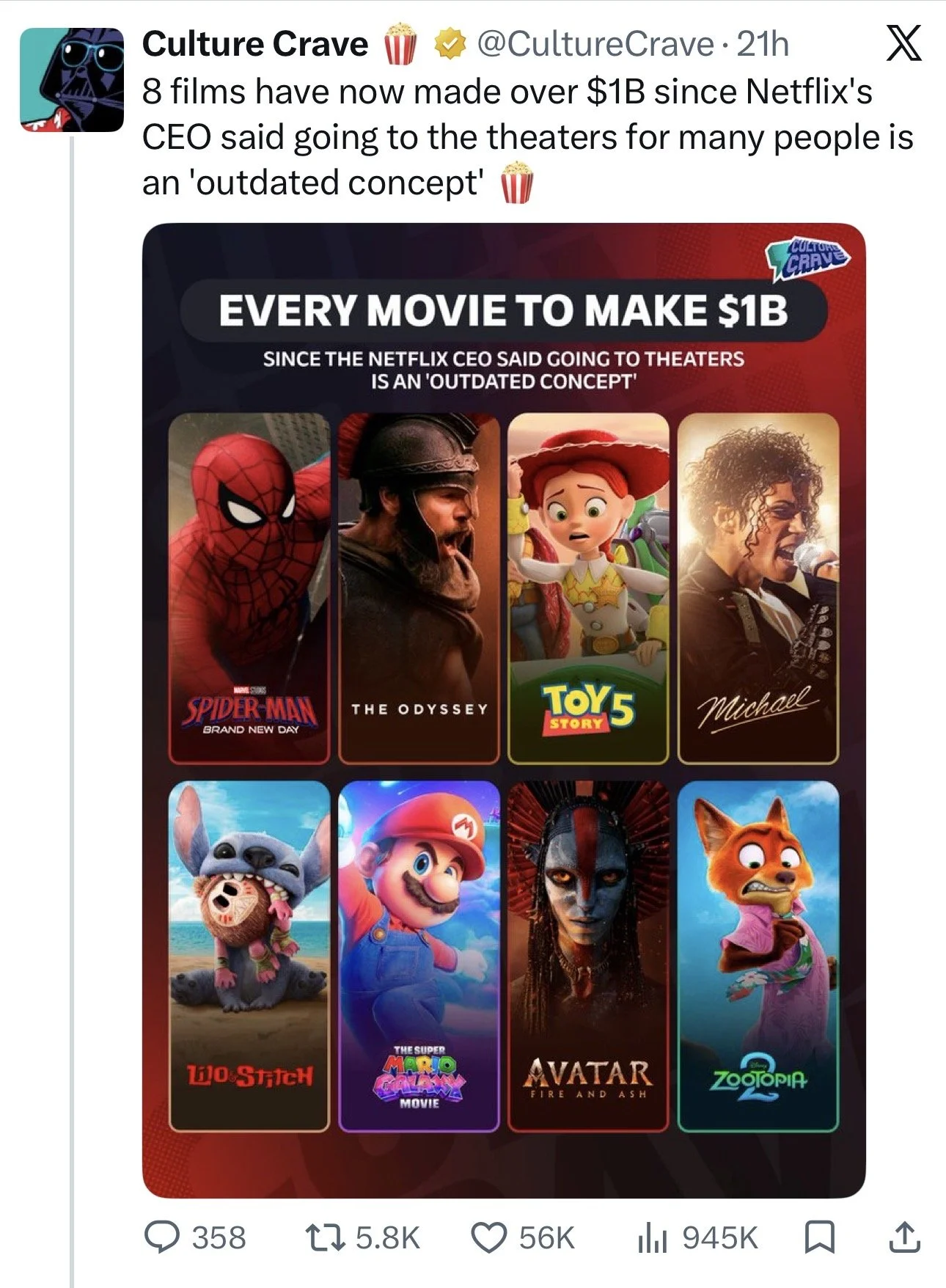
Ted Sarandos once called theatrical an “outmoded idea.” Now, Netflix is giving several of its biggest films four-, five- and even seven-week exclusive theatrical windows. Has this year’s box-office boom changed his thinking? It certainly feels like Netflix is paying more attention to the theatrical business than it used to.
And then there’s Apple, which makes Netflix’s strategy look even more interesting. Apple Studios has largely backed away from theatrical after a string of expensive disappointments, opting to put only one or two films a year into theaters. Netflix, meanwhile, appears to be moving in the opposite direction. Maybe it’s trying to prove its commitment to theatrical, hoping the Paramount-Warner Bros. deal collapses and positioning itself for the endgame. That’s another theory circulating out there.

“Tender Loving Care," Mike Leigh’s final film, took the Golden Shell, plus two more prizes: a Silver Shell for Best Leading Performance for Kate O'Flynn and the Best Screenplay award for Leigh himself.