





More than 9.1 million Australians aged 14 and over watched AFL on television either occasionally or regularly during Roy Morgan's 2023-24 research, roughly 40% of that age group. We love our footy, and plenty of us enjoy the extra spark that comes from following a market alongside a match. If you like that mix, a spinbet sports can give you a little more room to explore the markets while you learn how the numbers behave.
So here's a fair question. What happens when a betting method built around simple casino wagers walks into a sportsbook, where prices change from one game to the next?
That method is the Martingale, and it's one of the most recognised staking sequences going. It won't tell you who's going to win. What it can teach you is how odds, exposure and a few sensible limits fit together. Over the next few minutes, we'll cover how the doubling sequence works, why decimal odds change the sums, how AFL and NRL give us easy examples, and what to look for on a combined sportsbook and casino platform like Spinbet, which brings sports and casino play into one place.
The Double Act
The Martingale is famous because you can grasp it in seconds. You start with one unit. If a selection doesn't come in, you double the next stake. One becomes two, two becomes four, four becomes eight and so on until something lands.
Let's put real numbers on it. Start with A$1. Five losing steps add up to A$31 spent, and your next stake would be A$32. Bump your starting unit to A$5 and that same run costs A$155, with A$160 required next. The pattern grows quickly, which is the whole personality of the system.
Here's a way to see it laid out:
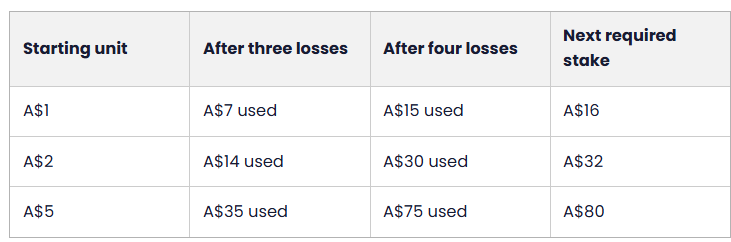
Those figures assume the classic doubling sequence and even returns, before any real sports prices get involved.
There's a neat way to flip the Martingale on its head. Instead of starting with a stake and seeing where the sequence takes you, start with a fixed amount you're happy to spend and work out how many steps it buys. Read backwards like that, the sequence becomes a budget map rather than an open-ended climb.
A 2026 University of Nevada, Las Vegas analysis of progressive roulette systems, using formulas and Monte Carlo simulations, found that changing the size and order of your bets alters the volatility and spread of results while leaving the game's built-in edge unchanged. Put simply, the way you stake shapes the rhythm of play. That alone makes understanding the sequence worth your time.
Of course, that tidy progression only holds while every winning bet pays back the same amount. Sports odds rarely stay that neat.
When Evens Leave the Building
On a casino table, a simple wager might return even money. In a sportsbook, prices move. A team might be 2.00 in one match and 1.85 in the next, and that difference rewrites the maths of any doubling plan.
Recovering earlier stakes plus a small target profit depends on the price you're getting. The stake you need is your accumulated losses plus your target, divided by the decimal odds minus one.
Say your first A$1 selection misses. At odds of 2.00, an A$2 follow-up recovers that loss and leaves your original A$1 target. At 1.90, you'd need about A$2.22. At 1.80, that climbs to A$2.50. Same idea, different price, different sum.
Think of it like two films in the same genre. They sit on the same shelf, yet one runs ninety minutes and the other closer to three hours. Two head-to-head markets can look alike while asking very different things of you, purely because their prices differ.
This is where seeing a range of markets helps. On a platform like Spinbet, you can browse different sports, fixtures and market types together, checking the decimal price in front of you before deciding whether a planned sequence still sits inside your budget.
Researchers József Gergő Pál and Csaba Bíró put these ideas to the test in 2025, running six football prediction models against five staking strategies, Martingale among them, across 539 matches played between March and May of that year. Their design produced 300,000 model-and-strategy runs. As they wrote, 'The findings provide insight into model performance [and] risk management'.
Which points to something worth remembering. The useful move in a sportsbook isn't doubling faster; it's pausing long enough to work out what the current price actually asks of you.
Once you accept that the price sets the stake, the next question almost asks itself: how far should the sequence be allowed to run?
A Limit With a Game Plan
A fixed budget, a small starting unit and a stopping point chosen in advance aren't restrictions on the fun. They're part of the plan itself.
Let's run one example. You set aside A$20 and pick A$1 as your base unit. Four losing steps account for A$15, and the next classic stake would be A$16. That would push you past your A$20 allowance, so the sequence ends right there, at the boundary you chose before kick-off. The decision was made early, so you're not weighing it up mid-match with your pulse doing the thinking.
This is where a bit of planning pays off on a platform like Spinbet sports, where you can view the market, the decimal price and your intended stake together before you confirm anything.
Our sporting habits make the examples easy to picture. Roy Morgan's market analysis found NRL and State of Origin accounted for 7.6% of Australian betting money, with AFL-related events on 6.8%; those figures were published in June 2022, so treat them as a historical snapshot rather than today's split. They're a handy reminder that both codes are familiar territory for most of us.
If the full sequence doesn't fit your budget from the start, does its first step really fit either?
Worth sitting with for a second. And it leads neatly into a bigger picture, because plenty of us now play inside one account that holds far more than a single sport.
One Screen With Two Sporting Worlds
Combined venues have an obvious appeal. One login, one balance and an easy hop between sports markets and casino-style games without hunting across different sites.
The scale behind this is notible. IBISWorld estimated Australia's horse and sports betting industry at A$7.4 billion in 2024, with growth of 0.2% that year. Both are commercial market estimates, since the full workings sit behind IBISWorld's subscription, so it's fair to read them as informed figures rather than audited totals.
Grand View Research projects Australian sports betting revenue could reach US$5.0968 billion by 2030, based on a forecast compound annual growth rate of 13.2% from 2025 to 2030. That's a projection, not a measured result, and it says nothing about how many of us use any particular staking method. What it does suggest is that clear, everyday explanations of odds and stakes will stay useful for a while yet.
Spinbet sports sits right at that meeting point, bringing sports and casino play together in one setting. The value for you is straightforward: your choices in one place, with a single budget kept front and centre.
Here's the thing about that convenience. When several kinds of play sit behind one login, your own boundaries carry more weight, not less. One overall allowance you can actually remember tends to serve you better than a scatter of separate limits set up piecemeal.
Which brings us back to where we started, and to the smartest thing a progression can offer you.
Play the Numbers Forward
The Martingale's lasting appeal is its clarity. Every step follows a rule you can see. Where you gain the real edge in understanding is by adding three things the casino version doesn't hand you on its own: the decimal price in front of you, a fixed overall budget, and a stopping point chosen before you begin.
A good film works because its scenes build toward an ending someone planned. A staking sequence reads the same way. It's far easier to follow when you already know its final permitted step before you take the first.
As Australian betting platforms keep developing, clearer displays of prices, stakes and markets give you more to work with when you're making a considered call. So calculate the whole sequence, account for the odds you're getting, and settle on the boundary before you place anything.
Author’s Bio: James McCallough is the founder of Cadmus Copy, an agency focused on scalable digital marketing. He works across SEO-optimised content, copywriting, content management and digital strategy.
Advisory Notice: Keep gambling in perspective; it's entertainment, not an investment. Decide your spending limit before you start and don't exceed it. Watch for signs like chasing losses or feeling you can't stop, and step away if either appears. Gambling Help Online provides free, confidential assistance whenever things stop feeling enjoyable

Snyder has mentioned in the past how “Sucker Punch “never really got finished correctly,” and that it was “not really the correct cut.” The extra footage is actually already shot.