
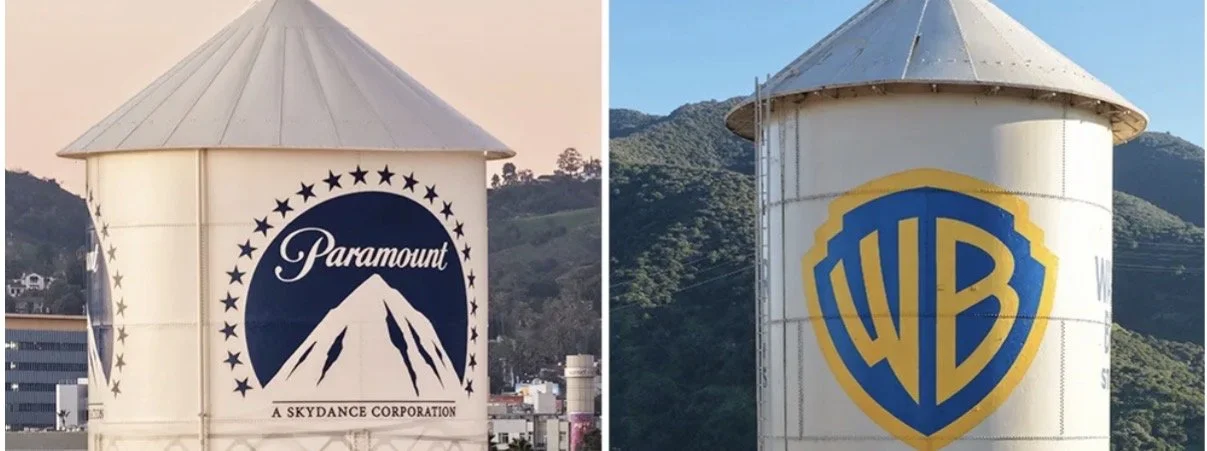
If you’re David Ellison, you need all the help you can get right now. Already up to his neck in court battles, he has reportedly had to postpone the Paramount–Warner Bros. Discovery merger—at least until the courts rule on the multiple lawsuits challenging the deal.
The real problem is that the merger cannot be delayed beyond September 30 without triggering a “ticking fee” of roughly $6.8 million per day, payable to Warner Bros. Discovery shareholders. Is Ellison really prepared to absorb that cost? According to a Bloomberg report, if the deal ultimately falls apart, Paramount/Skydance could be required to pay Warner Bros. Discovery shareholders $7 billion for their time and trouble. Yikes.
So, what’s a desperate Ellison to do? How about calling on a couple of his friends—two of Hollywood’s most powerful players—to help him out?
Yesterday, Endeavor CEO Ari Emanuel published an op-ed in The Wall Street Journal titled, “The Paramount–Warner Merger Could Save Hollywood,” offering his full-throated support for Ellison. I’ll save you the read—it’s mostly a gush fest, arguing that Ellison might just be the messiah Hollywood needs right now.
Today, AMC CEO Adam Aron has published his own op-ed, via Variety, fully endorsing the proposed Warner Bros.-Paramount merger. He argues that combining the companies would strengthen Hollywood by creating a studio with enough power to compete against giant technology companies, like YouTube, that increasingly dominate entertainment.
He calls the merger “a step forward that should be welcomed and celebrated,” emphasizing that the transaction has already received regulatory approval in dozens of jurisdictions. Aron warns that legal challenges by a coalition of state attorney general threaten to derail the industry’s momentum just as theatrical moviegoing is recovering.
Aron dismisses the attorney general’s claim that blocking the merger would protect theater chains such as AMC, arguing that the lawsuit “gets the economics of our business backwards.” In his words, “Thanks, but no thanks. Their complaint simply gets the economics of our business backwards.”
The real threat, according to Aron, is not a stronger studio but a weak film pipeline: fewer movies, shorter theatrical windows, and weaker marketing hurt attendance far more than studio consolidation. To bolster his case, Aron cites commitments from Ellison, who has pledged in writing that a merged Paramount–Warner Bros. would release “at least 30 theatrical films annually,” each with a “minimum 45-day premium video-on-demand window and a minimum 90-day subscription streaming window following theatrical exclusivity.” He describes these as “specific and measurable commitments.”
Aron concludes that competition should be judged by the number and quality of movies reaching theaters—not simply by the number of studios. He argues that audiences want more films, longer theatrical exclusivity, and better movies, all of which he believes a combined Paramount–Warner Bros. Discovery could deliver. Calling the merger “a big step in the right direction,” Aron says AMC is a “full-throated supporter” of the deal.
Aron and Emanuel carry considerable industry clout, but they must also be well aware that the opposition to this deal extends beyond traditional antitrust concerns. For many of the attorneys general challenging the merger—and many of its critics—the politics surrounding the transaction appear to be just as important, if not more so, than the competition issues themselves. They just won’t say it. The political backdrop is difficult to ignore.
The Ellison family has been associated with support for Donald Trump, and CNN’s future ownership is a central element of the merger. Many opponents, particularly those on the political left, fear that David Ellison could steer the network in a more conservative editorial direction. Whether those concerns are justified or not, they have become a central part of the debate—even if few are willing to acknowledge it openly.

The short version: "Woman Unknown" was a compromise. The jury deadlocked over "Possible Love" and "NAZA," not able to com to terms, fell back on their #3, May el-Toukhy's film.