

For much of the 20th century, filmmaking generally favored a more restrained editing style rooted in classical continuity. Directors often relied on longer takes, wider compositions, and edits designed to be largely invisible. The prevailing philosophy was that cuts should serve the story without calling attention to themselves—a stark contrast to what came next in the ’90s.
The biggest influence on modern-day filmmaking was MTV. Music videos changed everything. They introduced a new visual language built around rapid cuts, aggressive camera movement, and stylized imagery. What was once considered a format for short-form music promotion was turned into a two-hour movie, forever changing the rhythm and pace of mainstream cinema.
The filmmakers most associated with advancing this revolution—and it was a revolution—of “MTV editing” or “too many cuts” were Oliver Stone, Baz Luhrmann, Michael Bay, and Tony Scott. These directors embraced the hyperkinetic language of music videos and brought it to cinema: an over-the-top sensory assault built around rapid-fire editing, aggressive camera movement, and visual overload.
Now, that style is everywhere, to the point where even Christopher Nolan could be considered one of its biggest modern practitioners. We’ve adapted to this approach because our attention spans had little choice. It has become part of the language of mainstream cinema. Don’t get me wrong—sometimes a film’s frantic editing is integral to its emotional core, but other times it simply creates empty spectacle. At its worst, it becomes the sound and fury signifying the usual nothingness found in Michael Bay’s most excessive instincts.
Of course, one can make the — admittedly wobbly — case that Jean-Luc Godard’s groundbreaking use of “jump cuts” in 1960’s “Breathless” paved the way for all this, but the intent and execution were fundamentally different. Godard still allowed scenes room to breathe, giving moments of conversation, atmosphere, and character interaction time to unfold. The jump cuts were used to challenge traditional filmmaking, not as a constant assault on the senses.
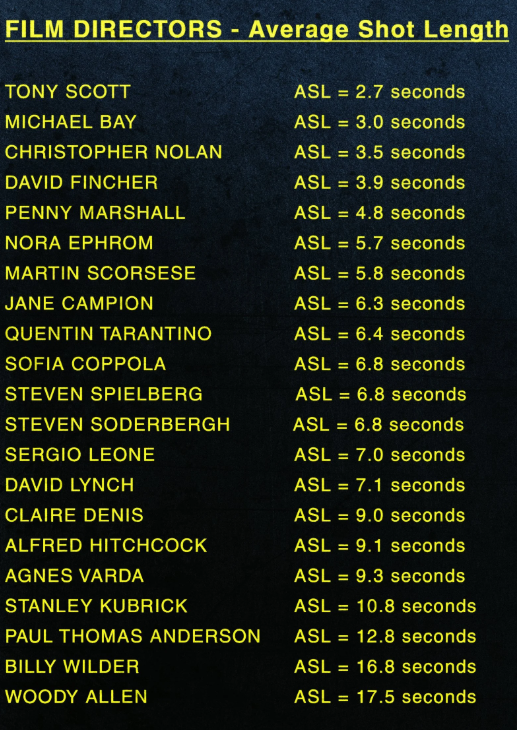
That said, with much of the recent discussion surrounding the frenetic editing style in “The Odyssey,” Vashi Nedomansky, a member of ACE (American Cinema Editors), has decided to share nearly two decades’ worth of research online. For the past 15 years, Nedomansky has manually dissected films from a select group of important filmmakers, counting individual shots and calculating shot count against runtime.
The results are fascinating, showcasing a medium that is continuously evolving its visual language and the ways in which stories are told. Where’s Baz Luhrmann on this list? I imagine he would rank near the very top if Nedomansky had analyzed his entire filmography.
As for modern-day “classics,” there isn’t much publicly available data on individual films. We know that Jonathan Glazer’s “The Zone of Interest” is an outlier, with an average shot length exceeding 10 seconds. “The Master” and “There Will Be Blood” both sit around 8 seconds, while “No Country for Old Men,” “Once Upon a Time in Hollywood,” and “The Irishman” are not far behind at roughly 7 seconds. Then you have “Everything Everywhere All at Once,” which averages just 1.5 seconds per shot—a striking example of how dramatically editing styles can vary among acclaimed modern films.
Through it all, Nolan has remained remarkably consistent. Despite being known for long-form storytelling, practical effects, and large-scale filmmaking, his films are often edited at a faster pace than many audiences might expect. “Dunkirk,” “Inception,” “The Dark Knight,” and “Oppenheimer” all average roughly 3 seconds per shot, placing Nolan closer to Luhrmann, Bay and Scott territory.

The Wall Street Journal reports that "Elden Ring" actually cost around $200M to make, nearly double what was floated when cameras started rolling in April. The film is still dated for March 3, 2028.