

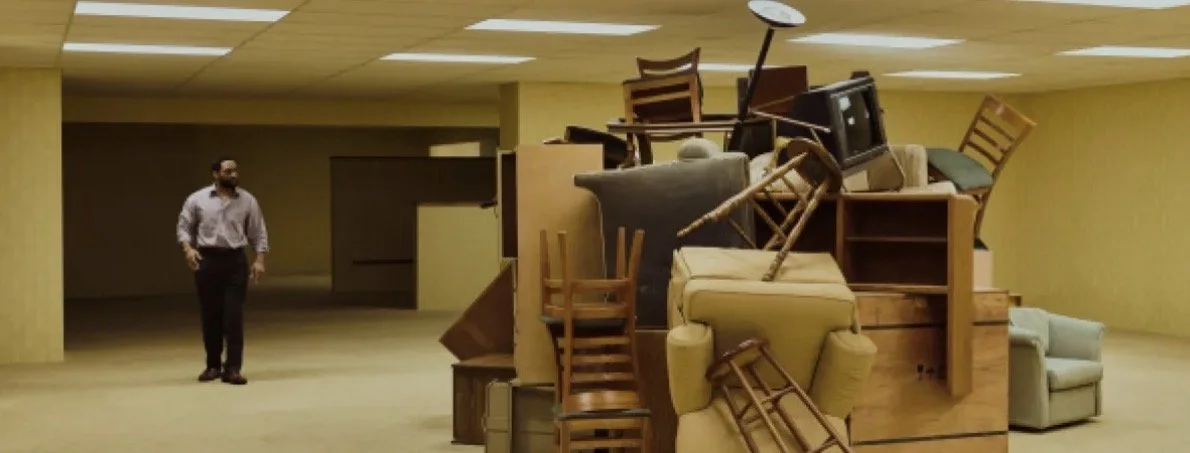
So, “Backrooms” somewhat successfully expands Kane Parsons’ viral YouTube series into a feature-length movie. There’s a lot of creativity here, and that’s the film’s strength — those endless yellow hallways and shifting rooms make for a visually unique experience.
That’s the thing about “Backrooms”: it’s driven entirely by atmosphere and surreal imagery, but there’s little beyond that. What subgenre is this anyway — spatial horror? It sits in the same category as “Cube,” though it’s less efficient than the 1997 Canadian horror film.
The review embargo has lifted, and reviews are mostly positive for “Backrooms,” which has a 87% on Rotten Tomatoes, and 74 on Metacritic.
Listen, Parsons himself is very young — he’s just 20 — and he’s obviously no Orson Welles, who was actually 25 when he started production on “Citizen Kane.” Parsons does not reshape cinema in any way here — he’s basically made a film that relies heavily on production design, especially the impossible architecture and disorienting hallways. Then again, some of the imagery he’s created — scenes involving endless corridors, floating furniture, and grotesque mutations — is truly haunting.
Performance-wise, you expect strong work from its leads, and although they’re given underwritten roles, they deliver. Chiwetel Ejiofor portrays Clark as a melancholic and increasingly unstable man trapped by personal failure. Renate Reinsve is the resilient one in the role of Mary. She’s a therapist searching for her patient (Ejiofor) after he disappears into a labyrinth of seemingly endless, logic-defying rooms hidden beneath his furniture store.
Now that I’ve gotten the good stuff out of the way, I have to fully admit that “Backrooms” sometimes loses itself in overcomplicated lore and thematic excess. We did not need the flashbacks involving Mary’s childhood trauma — they just interrupt the momentum. Parsons also didn’t need to overexplain the Backrooms psychologically. This is a film that works best when it simply immerses you in terror and confusion through its images rather than trying to explain things. Rookie mistakes.
I question whether this film is truly profound or just an exceptionally stylish horror puzzle. It’s certainly less frightening than Parsons’ lo-fi YouTube series — that’s what a bigger budget will do — but there’s something utterly impressive about not just such a movie getting made today, but audiences en masse flocking to see it. “Backrooms,” which is tracking for an insane $50M+ opening, could turn out to be a game changer: the legitimization of YouTube content creators invading Hollywood, backed by already built-in online followings and making sub-$10M movies that wind up earning ten — or, in the case of Obsession’s Curry Barker, a hundred — times their budgets.

The guy behind "Oculus," "Midnight Mass" and "Hush" (still his best) used to do his own thing. Now? "Carrie" is streaming, "The Exorcist: Martyrs" has a trailer, and two more King adaptations are on the way.