






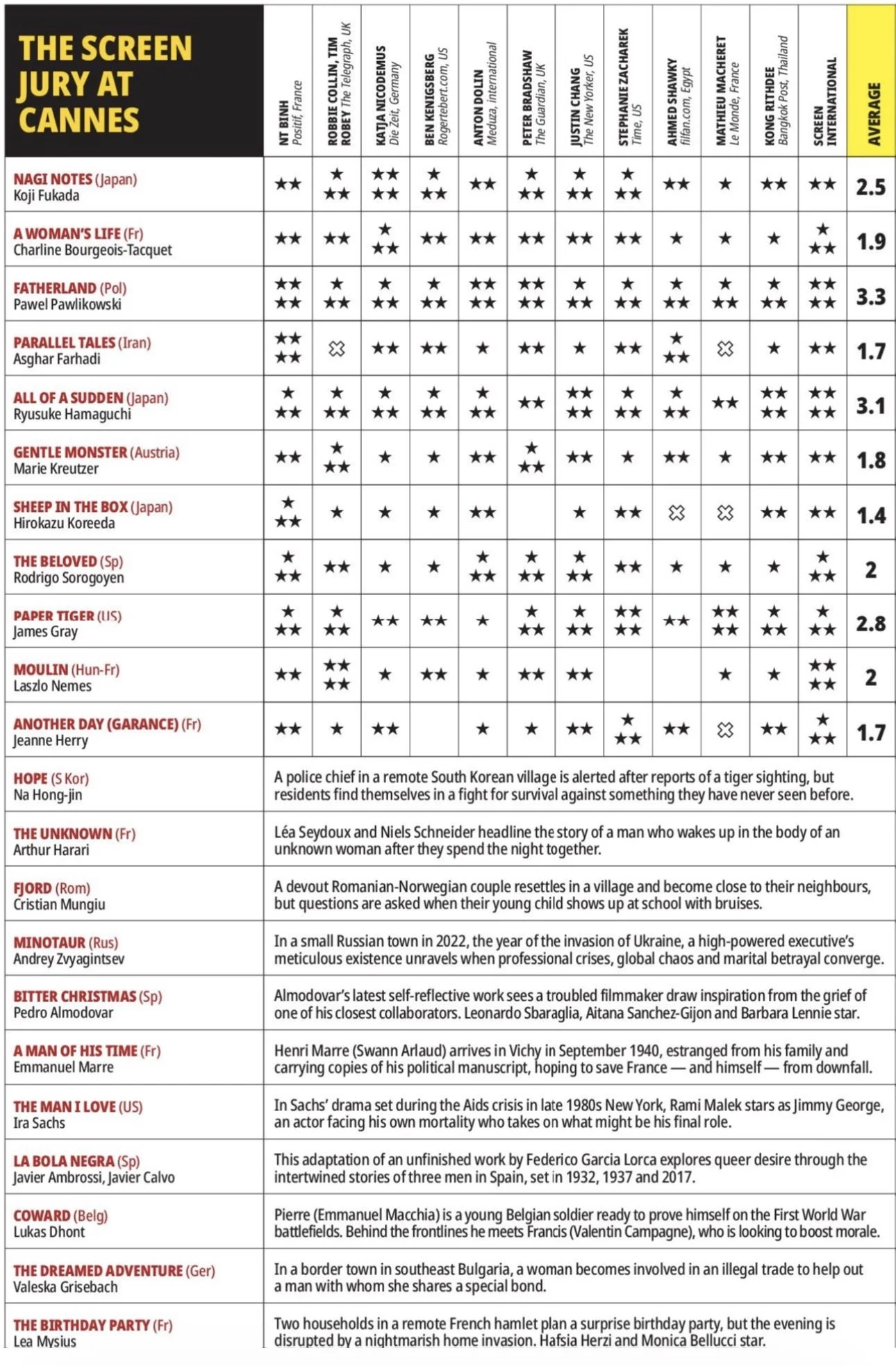
If you’ve ever wandered the Croisette during the Cannes Film Festival, dodging beachside photo calls and espresso-fueled critics, you might’ve seen a curious grid published by Screen International. It’s called the Screen Jury Grid, and it’s one of those festival rituals that feels both essential and oddly precarious.
A group of hand-picked international critics sit through every Competition film and assign it a score—up to four stars. The grid is then updated daily, printed in columns like horse-race odds, with films rising and falling as critics weigh in. What you’re left with is the critical temperature of the festival, taken in real time.
So far, only 12 Competition titles have screened at this year’s Cannes, with 22 slated to screen by the time the curtain falls on May 23. But already, one thing seems certain: we may have a weak edition on our hands.
Last year, seven films in total had a score of 2 or below; this year, with still 10 films left to screen, we’ve already hit seven. Hirokazu Kore-eda’s “Sheep in the Box” has the worst score so far, scraping together a 1.4 out of 4 stars—a score that suggests outright disdain. Asghar Farhadi’s “Parallel Tales” is the close runner-up with a 1.7 score.
Now, some might bristle at the idea of reducing a film—art, emotion, sweat—to a mere star rating, and I sympathize. But what the grid captures, in its own imperfect way, is that Cannes’ heartbeat this year is more subdued than usual. So far, only Na Hong-jin’s “Hope,” Ryusuke Hamaguchi’s “All of a Sudden,” and James Gray’s “Paper Tiger” have truly left a mark on me. I was not a fan of Pawel Pawlikowski’s “Fatherland,” which I plan to rewatch on Saturday, but it actually leads the Screen grid with a 3.3 rating.
The low-rated films deserve it, too. Charline Bourgeois-Tacquet’s “A Woman’s Life” (1.9) is a fairly pedantic take on a female doctor (Léa Drucker) navigating a midlife crisis while suddenly finding herself attracted to a woman. Marie Kreutzer’s “Gentle Monster” (1.8) misguidedly follows a woman, played by Léa Seydoux, stunned to learn that her husband traffics in online child pornography. Rodrigo Sorogoyen’s “The Beloved” (2.0) is a messy, inconsistent film in which Javier Bardem’s director character hires his estranged daughter to star in one of his movies. László Nemes’ “Moulin” (2.0) somehow starts off as a gripping spy movie before sadly devolving into a dull Nazi torture-chamber piece. Finally, Jeanne Herry’s “Another Day” (1.7) has Adèle Exarchopoulos playing a failed actress who spends most of the runtime consuming insane amounts of alcohol while refusing to acknowledge that she has a drinking problem.
Screen is rarely predictive of the Palme d’Or (and thank goodness for that), but it often tells us where the critical conversation is headed. Some years, a film no one expected breaks out; other times, a so-called “master” crashes to the bottom. The grid reminds us that cinema is alive and, just as importantly, that criticism is too.

The decision has reportedly been made, though David Ellison apparently hasn't delivered the news to them directly yet. Those calls are expected by Tuesday morning.