

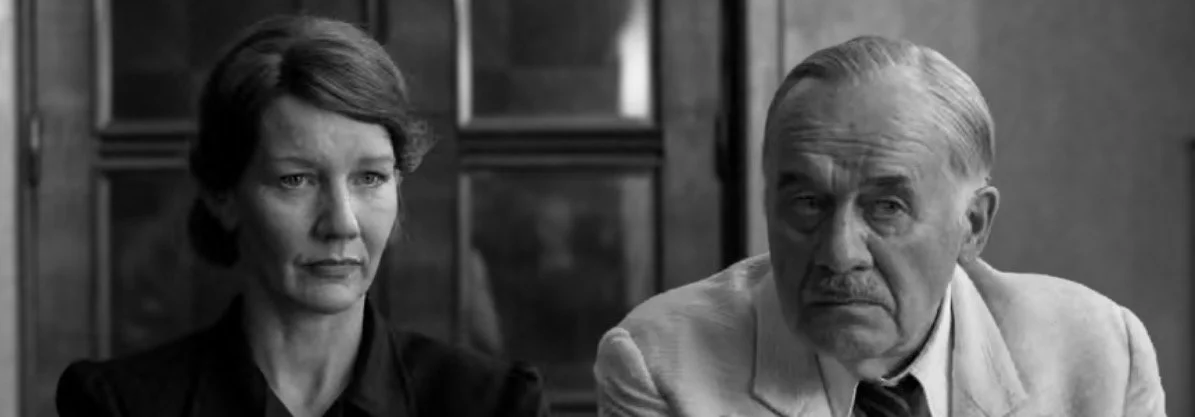
I walked out of “Fatherland” admiring it more than actually loving it, which has increasingly become my reaction to Pawel Pawlikowski.
The craftsmanship is undeniable. The atmosphere is immaculate. Every frame looks museum-ready. But the movie itself feels strangely slight, almost too delicate for the historical and emotional weight it’s trying to carry.
The reviews have been very good, so far — 94 on Metacritic is mightily impressive, but I’ve also bumped into more than a few critics who were mixed on it, or at the very least underwhelmed by Pawlikowski’s style over substance treatment. One look at the Letterboxd score, and it doesn’t quite match the critical raves.
Set in 1949, the film follows Thomas Mann returning to Germany after years of exile in America, traveling through the fractured remains of the country with his daughter Erika. What starts as a ceremonial visit tied to a Goethe celebration gradually becomes a road movie through a morally exhausted Europe. Mann wants to believe in culture as a form of redemption; Erika is far less willing to sentimentalize Germany’s recovery. Their relationship becomes the film’s emotional battleground, though “battlefield” might be too strong a word for a movie this restrained. Pawlikowski still operates almost entirely through implication, silence, and characters looking through windows, contemplating.
Sandra Hüller is predictably stellar, bringing an intelligence and frustration to Erika that keeps the film alive even during its more static stretches. However, despite the setup — postwar Germany, Cold War paranoia, generational guilt — the movie never fully deepens into something emotionally overwhelming. Scenes drift in and out with the kind of elegance Pawlikowski has perfected, yet the cumulative effect feels oddly … minor. You keep waiting for the film to crack open emotionally or politically, and instead it remains sealed inside its own impeccably crafted frames.
Visually, though, this is unmistakably the director of “Ida” and “Cold War.” The black-and-white cinematography, the perfectionist compositions, the negative space, the boxy academy aspect ratio — it’s all here again. At this point, Pawlikowski’s style is as immediately recognizable as Wes Anderson’s, just stripped of color and whimsy. One frame and you know exactly whose movie you’re watching.
The difference is that “Ida” felt revelatory when it arrived, and “Cold War” turned that aesthetic into an intriguing story. “Fatherland” seems to be missing something — a hook, probably. It just sits there. Like a beautiful painting.
That doesn’t make it bad. Far from it. There are moments here that linger: long silences in moving cars, ruined German landscapes, but “Fatherland” ultimately feels more like an extension of his cinematic language than a fully necessary film in its own right — a movie so controlled, so refined, and so aesthetically self-aware that it risks disappearing the moment it ends.

Hill, coming off the miserable reviews for this year's “Outcome,” now has yet another film destined for a long delay. This time, it's “Cut Off,” his third directorial effort, which was set to hit theaters this July