

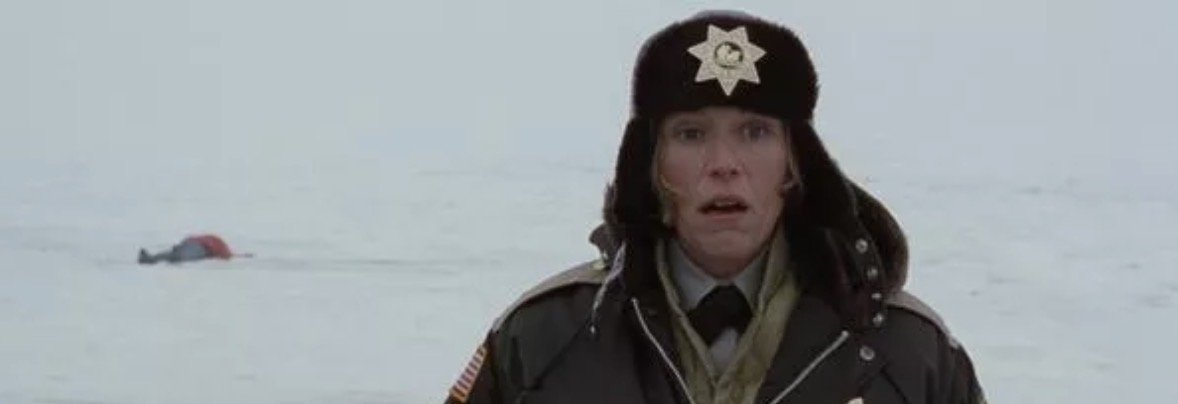
Thirty years ago on this day the Coen Brothers’ “Fargo” was released. The indie boom was in full swing, and American cinema was in the middle of one of its most creatively inspired periods. Studio filmmaking still revolved around movie stars and there was no shortage of prestige projects, but independent voices—many of whom had emerged from the early-1990s Sundance explosion—were beginning to reshape the landscape.
The indie boom indeed in full swing, some of the 1996 standouts included John Sayles’ “Lone Star,” The Wachowski’s “Bound,” Todd Solondz’s “Welcome to the Dollhouse,” David O. Russell’s “Flirting With Disaster,” Alexander Payne’s “Citizen Ruth,” Billy Bob Thornton’s “Sling Blade,” Doug Liman’s “Swingers,” Milos Forman’s “The People vs Larry Flynt,” snd Stanley Tucci’s “Big Night.”
“Fargo” itself quickly became one of the defining films of the decade. Joel and Ethan Coen’s snowbound crime story—about a desperate car salesman, a kidnapping scheme gone wrong, and a quietly determined Minnesota police chief—blended deadpan humor with shocking violence. Frances McDormand’s performance as Marge Gunderson earned her the Oscar for Best Actress and helped cement the film’s lasting place in American cinema.
At the 1996 Cannes Film Festival, British filmmaker Mike Leigh won the Palme d’Or for “Secrets & Lies,” a deeply moving drama about family, identity, and long-buried truths. The film’s extraordinary ensemble cast—led by Brenda Blethyn and Marianne Jean-Baptiste—delivered remarkable performances.
Although a truly great film, my pick for the Palme d’Or that year would have gone to Lars von Trier’s “Breaking the Waves,” an austere and controversial drama that won the Grand Prix. Set in a rigid religious community on the Scottish coast, the film follows a deeply devout young woman — played by an astonishing Emily Watson — who believes that sacrificing herself sexually for other men will somehow save her paralyzed husband. It’s a premise that sounds almost absurd on paper, yet von Trier stages it with such spiritual intensity and emotional conviction that it becomes devastating.
Another standout at Cannes was David Cronenberg’s “Crash,” a provocative adaptation of J. G. Ballard’s novel about car‑crash fetishists. Its premiere was divisive—audiences walked out, and critics were split over its mix of sex and violence. The jury awarded it the Special Jury Prize after reportedly bypassing president Francis Ford Coppola, who opposed giving it the Palme d’Or. Cronenberg has noted that Coppola wouldn’t even present the award, highlighting just how daring and boundary‑pushing the film was for the mid‑’90s.
Hollywood was going through a fascinating transitional moment. Grand, old-fashioned prestige filmmaking still held enormous cultural weight, exemplified by Anthony Minghella’s sweeping wartime romance “The English Patient.” The film would go on to dominate the Academy Awards, winning Best Picture and Best Director. Has it aged well? I haven’t seen it in over 20 years.
At the same time, a different kind of cinematic energy emerged with Danny Boyle’s “Trainspotting,” arriving like a jolt of electricity—fast, funny, disturbing, and stylistically audacious. 30 years on, Boyle still hasn’t topped the electricity he brought to this film.
Meanwhile, a young American filmmaker quietly made his feature debut. Paul Thomas Anderson’s “Hard Eight,” originally called “Sydney,” was a character-driven crime story that only hinted at the extraordinary career about to unfold. Though modest in scale, it was an effective start to a career that would make a mark on cinema — and character actor legend Phillip Baker Hall one of his best ever roles, a lead role.
Yet, the blockbuster machine was also roaring. Was it ever. Roland Emmerich’s “Independence Day” became a global phenomenon, delivering massive destruction, cheesy speeches, and exploded the White House. Will Smith was now a major movie star.
Another franchise also began its long life that year. Brian De Palma’s “Mission: Impossible” brought the classic television series to the big screen. This was a sleek, suspenseful espionage story, far removed from the bombast that would dominate this franchise. Its iconic suspended-from-the-ceiling heist sequence still makes you sweat.
The Best Films of 1996
Breaking the Waves
Fargo
Secrets & Lies
Lone Star
Trainspotting
The People vs. Larry Flynt
Bound
Citizen Ruth
Welcome to the Dollhouse
Flirting with Disaster
Notable runners-up include Irma Vep, Pusher, Paradise Lost: The Child Murders at Robin Hood Hills, Shine, Sling Blade, When We Were Kings, Primal Fear, Mars Attacks, Swingers,The Long Kiss Goodnight, Big Night, Mission: Impossible, The Birdcage, Beavis and Butthead Do America, Crash

The Wall Street Journal reports that "Elden Ring" actually cost around $200M to make, nearly double what was floated when cameras started rolling in April. The film is still dated for March 3, 2028.