
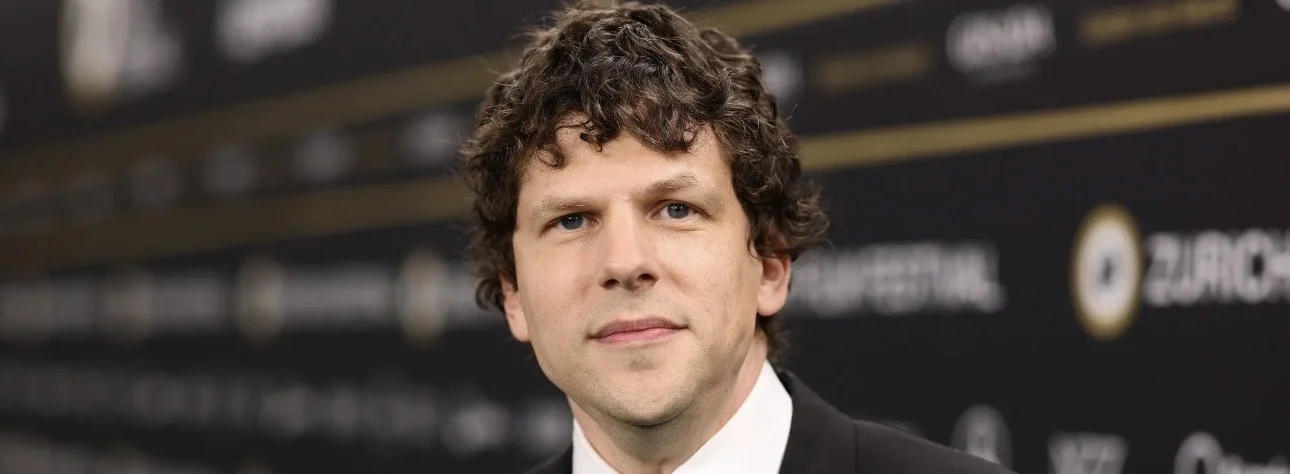
Jesse Eisenberg's twitchy Lex Luthor was one of the more polarizing parts of Zack Snyder's "Batman v Superman: Dawn of Justice." Ten years later, the actor says the backlash, and the Razzie that came with it, changed the course of his career.
At a screen talk Sunday during the BFI London Film Festival, Eisenberg said the worst supporting actor Razzie made studio parts dry up. "I couldn't get into movie studio parts anymore because I had won a Raspberry Award from [being in the] 'Batman' movie … and I saw the trajectory," he said, adding that the pivot to writing and directing "just came from fear."
He didn't sugarcoat how he sees the business. "Acting is just this unstable, awful industry where you are either on the treadmill and you're doing okay and you're running up or you are yesterday's news," he said. His conclusion: "I've got to direct movies. That's why I started writing them, just to kind of keep my career afloat, really."
Here's the thing, though: the Razzies are a joke, and "Batman v Superman" made $873M worldwide. Still, Eisenberg clearly took the hit personally. Here's a quick look at what he's done since 2016:
"The Hummingbird Project" (2018): a high-frequency-trading drama opposite Alexander Skarsgård
"The Art of Self-Defense" (2019): Riley Stearns' pitch-black comedy and one of his best performances
"Vivarium" (2019): an eerie suburban nightmare with Imogen Poots
"Zombieland: Double Tap" (2019): the Sony sequel, a studio movie after all
"Resistance" (2020): he played Marcel Marceau in this WWII drama
"Fleishman Is in Trouble" (2022): the FX/Hulu limited series, which earned him an Emmy nomination
"Manodrome" (2023): a dark drama about manosphere radicalization
So, save for the "Zombieland" sequel, was he "frozen out" of major studio movies? He's not wrong. But the real story of the last decade is that he became a filmmaker, and arguably a better one than anyone expected, with "When You Finish Saving the World" (2022), "A Real Pain" (2024) and "The Debut" (2026).
Funny how a Razzie may have been the best thing to happen to him.

Under Lin, the quality of Netflix's movies got worse. The Lin era was defined by mid-budget, algorithm-friendly fare and a wobbly relationship with the filmmakers who actually gave Netflix its prestige.