

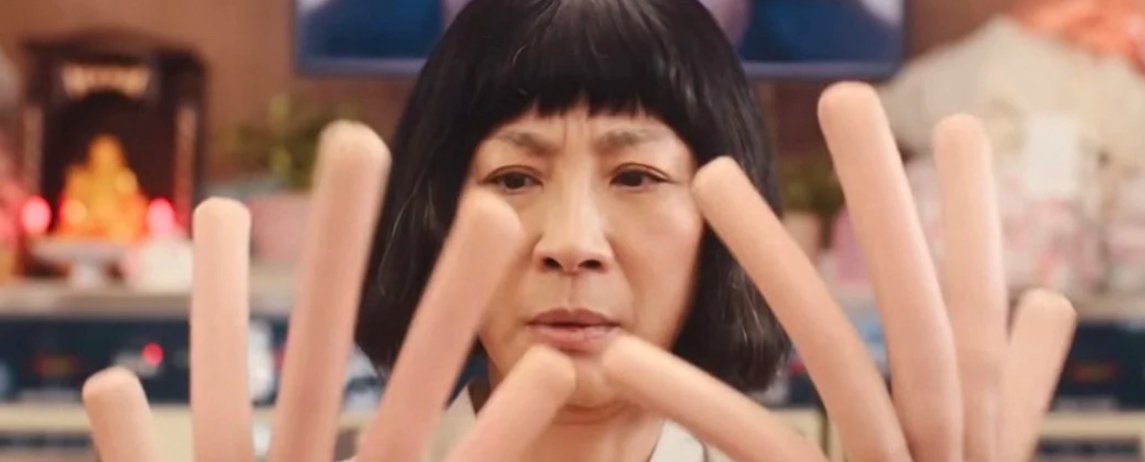
I recently tried rewatching Daniel Kwan and Daniel Scheinert’s “Everything Everywhere All at Once,” and honestly, still not a fan. Has it aged well? Certain corners of the internet seem to have turned against it, yet its most passionate fans remain as ardent as ever. It even managed to crack the New York Times’ recent 100 Best Films of the 21st Century Poll—an expansive survey of industry people and critics —landing at 77th, with only five films from this decade placing higher.
I understand those who connected with EEAAO, because clearly it struck a chord I just couldn’t hear. Is it an age-gap divide? Maybe. During the film’s peak moment, the “three amigos”—Cuarón, del Toro, and Iñárritu—had a conversation where “Everything Everywhere” inevitably came up. Del Toro remarked on how deeply it resonated with his kids’ generation, comparing their attachment to his own experience with “The Graduate”:
DEL TORO: “When I see a film like ‘Everything Everywhere All at Once,’ and I realize how much it is impacting the generation of my kids, and how they embrace it in the same way I embraced ‘The Graduate’ when I was their age, I love that. I love that people can be so passionate about a movie that reflects something to them even if the older generation doesn’t get it. That movie has become a landmark for one generation to be able to say forever, ‘That was my voice at that time.’”
CUARÓN: “I think it happened the same way in the ’90s with the films of Tarantino, or with ‘Trainspotting,’ where it felt like there was a huge new injection of energy into cinema, and it’s exactly the same thing for this generation with ‘Everything Everywhere All at Once.’”
Younger millennials and Zoomers fell hard for “EEAAO,” but so did a wide enough range of older viewers, as reflected in the film’s near sweep of the Oscars. However, it’s worth noting that more highbrow publications—such as Film Comment, Sight and Sound, and CinemaScope—were far less enamored. Furthermore, the likes of The Guardian, The New Yorker, and Time disapproved.
It’s been called the first superhero film to win the best picture Oscar. Its fans celebrated this victory (seven Oscars!) with unbridled glee, while the more agnostic – myself included – offered a cautiously polite nod. Then again, the Oscars have always had a curious habit of rallying around a single film—some of which have aged gracefully, others less so.
My take: “EEAAO” may be boldly original in form, but it plays like a relentless, ADD-fueled barrage of sights and sounds. Daniel Kwan has even admitted to writing the film as a way of grappling with his then-undiagnosed ADHD—and you can tell. The film often feels like a two-hour music video, drenched in confetti, hyper-stylized action, silly gags and flamboyant costumes.
Yet beneath the chaos lies a surprisingly old-fashioned core. The movie portrays a meaningless, chaotic universe where social progress or ambition proves useless—unless you embrace love and family as your true guiding forces. It’s a soapy, sentimental message, delivered through The Daniels’ maximalist style.
About The Daniels, four years since EEAAO, and they still haven’t followed it up. Their next project keeps getting delayed with a shoot now being eyed for next year, after initially aiming for 2024 and then 2025. How do you follow up such a film? Especially after the duo won the Best Director Oscar.
For many, “EEAAO” has become a litmus test. If you’re younger, you may see it as bold, innovative, deeply moving. If you’re older, you may be more likely to see it as chaotic, overpraised, or shallow beneath the spectacle. It reflects how cinema is evolving in an era where attention spans, online culture, and identity politics intersect — a kind of everything-all-at-once mode of storytelling that might alienate some but feels natural to others.
Still, three years on, the fact that a film this chaotic and unconventional became such a cultural phenomenon—and even won over the Academy—is remarkable. A new generation found the movie that defined their world, one that spoke to them in ways I may never fully connect with.

Criterion's December lineup has some great additions to the library, but the title that jumped out at me is Werner Herzog's "Grizzly Man," which officially joins the Collection on December 8.