
I don’t tackle TV much these days, but with Philip Barantini’s “Adolescence,” and Seth Rogen’s “The Studio,” two of the most acclaimed shows of 2025, mainstreaming the long take, it’s time to go back to the roots.
Briefly, a long take (or oner) is a single shot filmed without any cuts or edits for a prolonged period of time. It allows the camera to capture an extended scene, often creating a sense of real-time continuity. Although not extremely uncommon, a long take is rare enough to warrant recognition—if done right. Regardless, it’s a challenge to pull any of these off due to the level of coordination, precision, and timing required from the actors, camera operators, and entire crew.
Robert Altman’s “The Player” has an opening shot that took over 15 takes to perfect; the resulting scene lasted nearly eight minutes. His brilliant use of overlapping dialogue smoothly tracks the scenery, allowing the storylines to unfold on top of each other.
Orson Welles’ “Touch of Evil” opens with a three-minute, twenty-second tracking shot. On the U.S.-Mexico border, a man plants a time bomb in a car. A man and a woman enter the vehicle and make a slow journey through the town to the U.S. border. Newlyweds Miguel Vargas (Charles Heston) and Susie (Janet Leigh) pass the car several times on foot. The car crosses the border and then explodes on site.
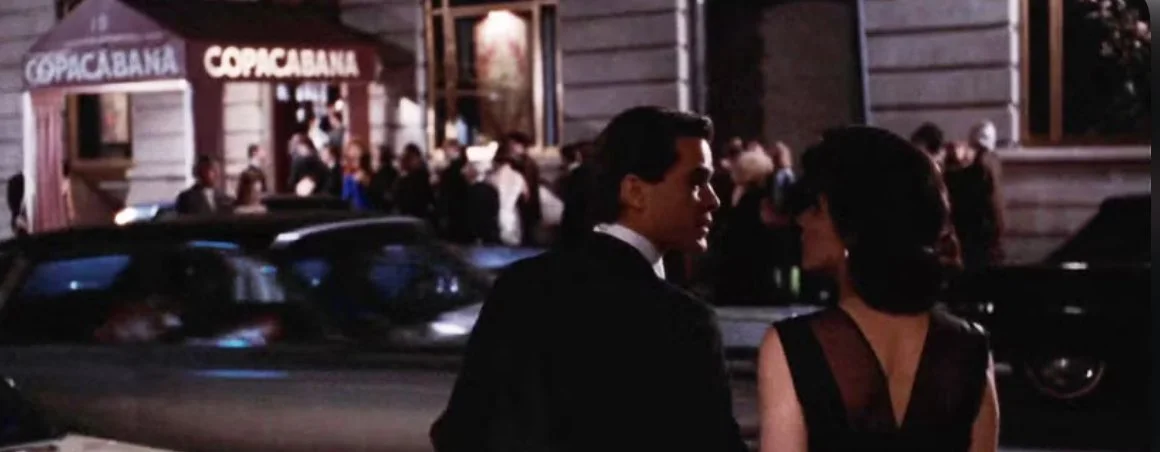
If “Touch of Evil” is the grandfather of long takes, then Martin Scorsese’s “Goodfellas” represents its evolution. The iconic three-minute scene in which Ray Liotta escorts Lorraine Bracco into the Copacabana club pulls the audience deeper into the world of organized crime. At the time, this was the longest scene shot on Steadicam. Filmed over eight takes, Scorsese had no choice but to shoot this way, as the club refused to let the crew enter through the usual route. The result was cinematic history.
In recognition of “Adolescence,” “The Studio,” and all the examples cited, IndieWire recently compiled a list of the 10 best long takes in cinema, and it’s a strong lineup—you’ll find most of the iconic shots included:
“Rope” (Hitchcock) — Any scene
“Touch of Evil” (Welles) — Bomb in the Trunk
“I Am Cuba” (Kalatozov) — Funeral Scene
“Goodfellas” (Scorsese) — Copacabana
“The Player” (Altman) — Opening Shot
“Hard-Boiled” (Woo) — Hospital Shootout
“Russian Ark” (Sokurov) — Any scene
“Old Boy” (Park) — Hallway Hammer Fight
“Children of Men” (Cuaron) — Car Attack
“Atonement” (Wright) — Beach Scene
What’s missing? “Creed” has a phenomenal oner. The climactic scene of “True Detective” S01E04 is breathless in its frenzy. “Magnolia” and “Boogie Nights” have a few standout sequences as well, stemming from an era when PTA proudly showcased his Scorsese and Altman influences. Wright’s “Hannah” includes a dazzling subway fight. How about the first nine minutes of De Palma’s “Snake Eyes”? Godard’s “Weekend” features a chaotic eight-minute tracking shot through a traffic jam. I also love the penultimate seven-minute shot in Antonioni’s “Weekend,” which moves wondrously—and ever so patiently—from interior to exterior.
Rarely do you see a film shot entirely in one long continuous take. “Victoria” (2015), “Russian Ark,” and “Rope” immediately spring to mind. Whereas some films are edited to appear as one shot, “1917” and “Birdman” are the most blatant examples.

Snyder has mentioned in the past how “Sucker Punch “never really got finished correctly,” and that it was “not really the correct cut.” The extra footage is actually already shot.