




On Monday, Christopher Nolan hosted a special screening event for Ryan Coogler’s “Sinners.” This was part of the film’s Oscar campaigning, which has picked up steam in recent weeks.
During his conversation with Coogler, Nolan pointed out the scene where the movie’s antagonist, Remmick, and his newly turned vampires perform to the Irish folk song “Rocky Road to Dublin.”
“It’s a wonderful film in a lot of ways, but it deals in very stereotypical tropes of Voodoo about what constitutes the darkness of the human soul — how it’s expressed in anthropological terms,” Nolan said. “When I saw your film, the Irish River Dance, it was so chilling. It’s really the most spectacular musical inversion since Kubrick’s ‘Singin’ in the Rain,’ [from ‘A Clockwork Orange.’] I mean, what did we [Irish] ever do to you?”
There are a few scenes in “Sinners” that truly stand out, and that is certainly one of them. The scene occurs near the end of the film when antagonist Remmick leads a group of newly turned Black vampires into a traditional Irish-style dance — specifically a kind of step-dance/jig. It’s a visually striking moment: the dance literally becomes part of the horror. The celebratory energy of the jig is wild.
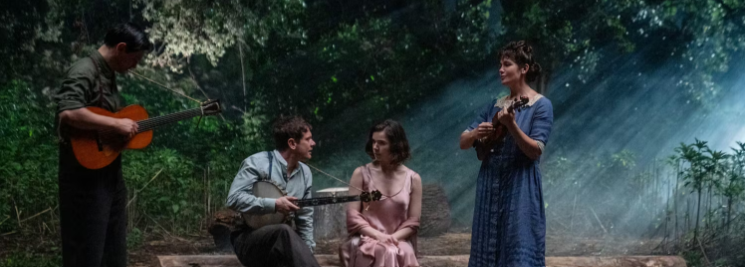
The other major scene in “Sinners” would be the juke-joint musical sequence, which many consider the central “heart” of the film. When Sammie plays music in the juke-joint, the film shifts into a phantasmagoric blend of eras — African drummers, blues guitar, even echoes of future musical styles — creating a powerful vision of Black cultural memory, ancestry, and musical legacy. It’s pure visual surrealism.
I really liked “Sinners,” especially the build-up: scenes showing the return of the twin brothers to their hometown, scenes of them rallying local characters, which establish a real sense of community and intrigue. It’s wonderful, and it gets even better with the two musical scenes mentioned above. But once the vampire stuff comes in during the last 20 minutes or so, the film loses its sense of purpose, turning into a violent, Tarantino-infused bloodbath. I did love the epilogue with blues legend Buddy Guy — another great scene in a film with more than a few of them.
“Sinners’ seems to be first and foremost an American phenomenon, both with critics and audiences. It wasn’t nearly as big of a hit overseas, and critical reception, although still positive, didn’t reach the level of acclaim it received in the U.S. Take France, for example. Among the French audience, the majority reaction seemed favorable (3.4/5 on AlloCiné), but there were also a fair number of dissenting voices, especially from those who found it uneven.
Still, “Sinners” is a bona fide Oscar contender. Only “One Battle After Another” has appeared on more top-10 lists this year, and the way “Sinners” became a commercial success is nothing but good vibes for an industry that was in desperate need of an original, non-IP box-office hit.

Very sorry to hear about Tom Skerritt's passing today. He was 93. If you grew up watching movies from the '70s and '80s, Skerritt was simply there, the guy with the mustache and those calm eyes.