
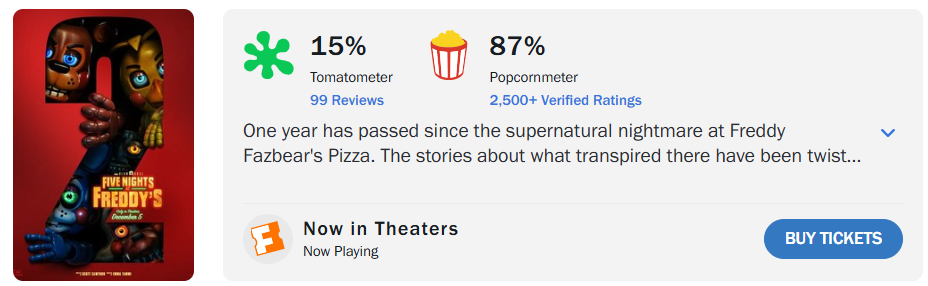
“Five Nights at Freddy’s 2” has become a huge hit for Blumhouse, having racked up $64M domestically over the weekend against a reported budget of $36M.
As with most video game adaptations that became box office behemoths (“Minecraft,” “Super Mario Bros. Movie”), the film has not done well with critics, but audiences seem to disagree with the critical consensus — they like it a lot. So much so that this divide, according to Forbes, has set a Rotten Tomatoes record.
We’re witnessing what may be the largest critic–audience gap ever recorded. “Five Nights at Freddy’s 2” has a 13% on Rotten Tomatoes, yet its 87% audience rating hints at vehement audience disagreement. That’s a 75% split. Then again, that “B” CinemaScore and 5.8/10 on IMDb are nothing to brag about.
The single highest critic-audience divide that could be found is a 65% split for “The Boondock Saints,” the cult classic 1999 action film, 26% critic to 91% audience. “Five Nights at Freddy’s 2” just overtook it.
For many decades, critics’ tastes have not always aligned with what audiences wanted to see. A film like, say, “Memoria” might earn high praise from critics, but its 40% RT audience score sticks out like a sore thumb. Some of the more critically heralded films of the past few years with low audience ratings include “Tree of Life” (59%), “Uncut Gems” (52%), “I’m Thinking of Ending Things” (50%), “The Souvenir” (36%), “Ad Astra” (40%), “Under the Skin” (55%), “The Green Knight” (50%), “The Master” (62%), and “Zama” (55%).
I could also list hundreds upon hundreds of films that audiences loved but that critics dismissed. Regardless, you get the point. It’s also worth noting that these contrasting opinions have always existed, but with Rotten Tomatoes, they now play out on a much larger stage. And that is both good and bad. Discussions and conflicts are 100% necessary in the world of film; it’s a subjective industry that wouldn’t exist without them.
We have, however, reached a point where a majority of mainstream audiences are just happy to watch whatever is put in front of them. The Netflix Top 10 is a perfect example, usually filled with nothing but dreck, and I’ve long suspected that a large portion of viewers watching these popular titles on the streamer are doing so while scrolling on their phones every few minutes.
The same goes for theatrical releases; just one look at this year’s top grossers, and you start getting depressed: “A Minecraft Movie,” “Lilo & Stitch,” Jurassic World Rebirth,” “How To Train Your Dragon,” and many more.

Marvel's "Ghost Rider" just hired one of the best cinematographers working today. Linus Sandgren will serve as DP on Shawn Levy's MCU flick, and, most notably, the project will be shot on film.