

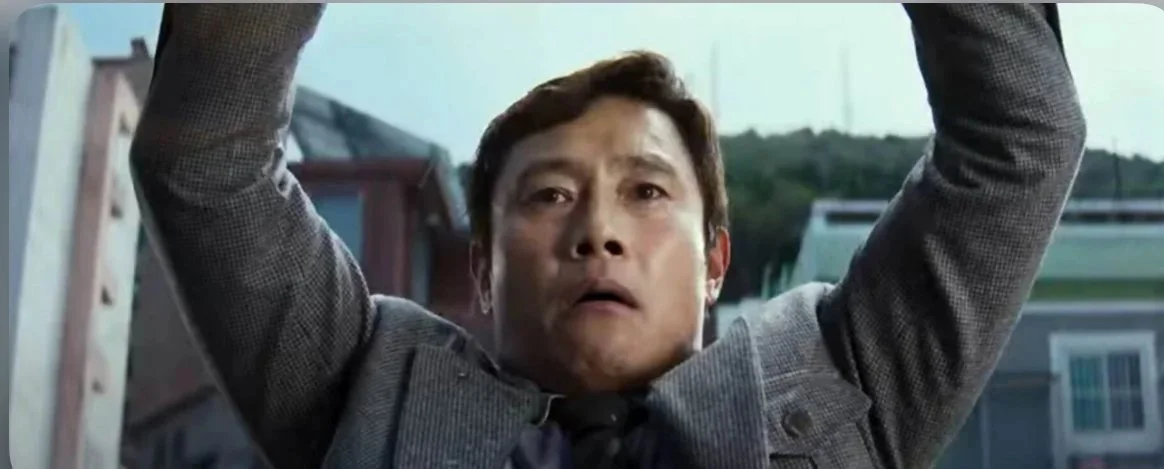
In the summer I had posted the Korean trailer for Park Chan-wook’s “No Other Choice,” and today the official Neon-backed trailer was unveiled.
The distributor will debut the film in select theaters on Christmas Day, giving some audiences a chance to see it during the holiday season, before rolling it out nationwide in January. The strategy suggests confidence not only in the film’s commercial reception but also in its awards-season potential.
The film is adapted from Donald E. Westlake’s 1997 satirical thriller The Ax, a project Park has dreamed of bringing to the screen for decades and one he dedicates to the late author. At its center is Man-su (played by Lee Byung-hun), a paper factory manager who loses the job he has held for 25 years. Shaken and humiliated by the blow, he becomes consumed with the need to restore his dignity and secure his family’s future before his home is lost. This premise gives Park a rich foundation to explore survival in a world governed by ruthless competition.
As the narrative unfolds, Park uses the story to juggle a range of genres. “No Other Choice” moves between satire, thriller, dark comedy, melodrama, and absurdist farce. Subplots emerge—Man-su’s wife finding new work, his stepson entangled in small-town trouble—and layer upon the central plot of a man driven to extremes.
From its very first frames,” No Other Choice” is unmistakably a Park Chan-wook film. His signature style is stamped across every sequence—the tonal shifts, the rhythmic pacing, the visual compositions, and the dazzling editing. It carries the hallmarks that longtime fans of Park will instantly recognize.
Park’s last feature, 2022’s “Decision to Leave,” was widely celebrated by critics but overlooked by the Academy’s International Film committee, suggesting they might not be as big on Park as critics. While ‘Decision’ may have been seen as too subdued or too enigmatic for broader appeal, “No Other Choice” feels like something different. It is more entertaining, and more topical—its satire placing it closer in spirit to “Parasite.”
With that said, I don’t think “No Other Choice” is a career-defining film for Park, his landmark achievements remain “Oldboy” and “The Handmaiden.” The screenplay, credited to Park, Don McKellar, Lee Kyoung-mi, and Lee Ja-hye, falters by attempting to juggle too many genres—satire, thriller, family melodrama, and farce—without fully committing to any of them. This narrative overreach, although resultingly entertaining, leads to a film that feels disjointed and overstuffed, lacking the focused intensity of Park’s previous works.
For Park, however, the project is far more personal than a bid for acclaim. He has described the adaptation as his “lifetime project,” a story that has lingered in his imagination for decades.
NEON enters the awards race this year with an impressive lineup, already with Cannes winners Jafar Panahi’s “It Was Just an Accident” and Joachim Trier’s “Sentimental Value.” Yet, “No Other Choice” has quickly established itself as one of the buzziest films of this year’s fall fests.

Marvel's "Ghost Rider" just hired one of the best cinematographers working today. Linus Sandgren will serve as DP on Shawn Levy's MCU flick, and, most notably, the project will be shot on film.