
Great Moments That Shaped 2015


1. The Revenant (Alejandro González Iñárritu, 2015), The Bear Attack
Yes, every single word of praise you've read and/or heard is true. One can't escape talking about The Revenant without mentioning its pièce de résistance: a bear mauling that seems to be a moment of truth not only for Leonardo Dicaprio's Hugh Glass but for the audience itself. Once you go through that sequence, you will know whether you'll be able to handle Alejandro González Iñárritu's mesmerizing but brutal film. In the sequence--and really throughout the film-- Emmanuel Lubezki’s protracted Steadicam shots make you speechless, but nowhere more so than in this frightening sequence. The setup is quite simple as our hero Hugh Glass walks through the woodland to hunt for food. Glass appears to see baby cubs at a far distance, and a moment of relief appears on his face, that is until he turns around and notices the mother bear right next to him. For a fraction of a second she horrifically investigates him, but then jumps and mauls him to near death. Lubezki makes it a long take as the CGI beast tosses DiCaprio around like a toy. Glass tries to shoot, stab, and shove his way out of the ordeal, but it only makes the bear more aggressive. The final shot of the dead bear on top of glass is both frightening and surreal.

2. Phoenix (Christian Petzold, 2014), Speak Low
The film takes place at the end of World War II, and Berlin is nothing but a city of rubble. Nelly looks at herself in a mirror and sees a stranger. She can't fathom or accept her looks after being disfigured during the war and undergoing massive plastic surgery. The only thing that tethers her to reality is her love for her lost husband. She eventually does find him at the Phoenix cabaret, and from there starts an obsession. He, of course, doesn't recognise her but acknowledges a somewhat passing resemblance to his allegedly dead wife. Heartbroken, Nelly fails to find the words or courage to tell him that she's his wife, since this is the man that might have betrayed her to an almost certain death. By the last few minutes of the movie, all of the events have unfolded and we are left with Nelly performing Tony Bennett's 'Speak Low' in front of her husband and friends. This final scene is downplayed in a manner that would have made Alfred Hitchcock giddy in excitement. It is one of the most satisfying final scenes in quite some time. By the end all you're left with are the words "The curtain descends, everything ends, too soon, too soon".

3. Creed (Ryan Coogler, 2015) Long take
As an incredibly cinematic sport, boxing films are often rife with clichés. So then, what a welcome surprise it was to have a Rocky movie that actually delivered the thrills and goosebumps that made the original 1976 film such a great film. Although the story might be familiar, the movie has the freshness and vitality that only a young, talented filmmaker and actor can bring. Cue in Ryan Coogler and Michael B Jordan, fresh off their debut triumph just two years ago with Fruitvale Station. They've infused Rocky with 21st century modernism and style that Stallone would have never been able to pull off if he were writer-director. It's around the film’s midpoint that we are given the game changer: an audacious sequence that reinvents the boxing match. Composed as a single unbroken shot, the scene follows Jordan's Adonis Creed as he squares off against Leo Sporino (Gabe Rosado) in the ring —both boxers are undefeated and ready to prove themselves to the world . The way Coogler’s camera circles its way through the ring is ground-breaking; never has a boxing match felt more intimate or gut wrenching than here. The camera, swirling in and out of the action, occasionally pans over to catch the reactions of the fighters’ trainers, but the main selling point here is making the stakes feel immediate. You feel every punch in the fight.

4. Sicario (Denis Villneuve, 2015), Mexican Border Crossing
Québécois filmmaker Denis Villeneuve and genius cinematographer Roger Deakins can really shoot the living hell out of a scene. Sicario, their latest outing, has a slew of sequences that redefine the way action and atmosphere can go hand to hand in movies. The film opens with a DEA mission that goes awry, and at the climax there is a night vision tunnel sequence that feels like something out of a tense 1970s horror film. However, the sequence that had everyone talking about the film's virtues had to do with a Mexican border crossing that takes advantage of the tension that a stop-and-go traffic jam can offer in the most dire of circumstances. Hundreds of cars are lined up at the U.S.-Mexico border, while FBI agent Kate Macer (a never better Emily Blunt) and her team try to avoid the chaos that we know is inevitably going to occur. That every vehicle is utterly trapped in its current location only enhances the feeling of dread. Eventually, a full-blown shootout occurs, with Villeneuve and Deakins offering claustrophobic, almost surgical preciseness with every single one of their shot selection. Make no mistake about it, these are pros at work here and they know how turn the screw on this most tightly knit of action sequences.

5. Anomalisa (Charlie Kaufman, 2015), Stop-Motion Sex Scene
When we heard that Charlie Kaufman's latest meta-physical endeavor was going to be a puppet movie and that it was going to include a graphic sex scene, our first thoughts went back to 2004's Trey Parker and Matt Stone romp Team America: World Police and the hilariously over the top coitus featured. of course this being Charlie Kaufman, we should have known better, and what we got instead was Anomalisa -- a beautifully rendered, personal film about loneliness, depression and the connections we make. The sex in Anomalisa is both believable and heartbreaking, with two lonely strangers trying to find comfort and resolution to their never-ending problems. Our depressed hero Michael Stone (voiced by David Thewlis) seems to have lost faith in humanity, but finds resolve in Lisa -- indelibly voiced by an Oscar deserving Jennifer Jason Leigh. She's a shy, self-conscious woman staying at the same hotel as Michael. He first notices her by her unique voice -- the only one not voiced by Tom Noonan-- that stands out compared to every other mundane noise he hears on a daily basis. That one night they talk, have laughs, have tears and finally have sex. The scene itself is graphic, but never over the top or objectifying to its characters; instead, it's actually quite romantic - a moment when two lonely souls connect and their daily problems seem to take a pause for the most personal of connections.

6. Room (Lenny Abrahamson, 2015), Jack Escapes
Why wouldn't this be on our list? The game-changing moment of Lenny Abrahamson's Room arrives at around the 50-minute mark. It's a breathless, life-or-death escape, as our 5-year-old hero Jack (an incredible Jacob Tremblay) escapes captivity and sees his first ever glimpse of the sky. Before that, Jack, his mom (Brie Larson), and we the viewers were held captive in the most claustrophobic of environments. As we held our breath and bit off what was left of our fingernails, Jack rolling himself out of a rug in the back of a pick-up truck was enough to give us a heart attack, and if that wasn't enough, the villainous captor is right on his trail a mere few seconds away from getting him back. Helped by the kindness of a stranger Jack's escape proves to be successful. The most harrowing image of the scene is that of unequivocal freedom as the frame pans to what this wonderboy ends up seeing once freed: the sky, the trees, bewildered pedestrians - all very new things to him, and seen with the freshest of eyes by an audience enthralled by a scene that can make them look at the world in a new light.

7. Bridge of Spies (Steven Spielberg, 2015), Opening Scene
Steven Spielberg’s understated gem Bridge of Spies resembles more the dialogue driven brilliance of Munich and Lincoln than it does Indiana Jones: it's a film obsessed with the art of negotiation. If there is an action set-piece in the film, it's the brilliant opening that actually features barely any dialogue. We follow Rudolf Abel (Mark Rylance) through what seems to be his daily morning routine, however we come to realize that he is actually a Soviet spy as he exchanges what seems to be a coded message underneath a park bench. Enter the FBI, hot on his trail and subtly pursuing him through the streets of New York City. The whole thing is shot like the opening of a 1970s paranoid thriller, think the Parallax View or Three Days In Condor, with Spielberg and his long-time cinematographer Janusz Kaminski acing every subtle gesture or movement of this cat and mouse game. The FBI storms Abel's apartment and arrests him, but not before he brilliantly finds a way to destroy the encoded message right in front of their very eyes with something as simple as a stroke of his paint brush.

8. Max Mad: Fury Road (George Miller, 2015), The Whole Movie
 Max Mad: Fury Road single-handily redefined what an action movie could do this decade. George Miller worked on his baby for the better part of 30 years and his vision was finally unleashed on screens this summer to the ravest of rave reviews. Which scene could we choose? The answer: All of them. Max Mad: Fury Road flows so effortlessly and in such stunningly synchronous fashion, that it's quite literally impossible to choose a single moment that stunned us. Fact of the matter is, every single scene wowed us, even the rare quieter moments where out characters take time to ponder the world's end. When the movie was done all I could think of was how all these young, hip, new superhero movie directors coming from the indie scene just got schooled on how an action movie should be made…by a 70-year-old filmmaker. You can’t deny the sheer impact of Max Mad: Fury Road . Director George Miller’s Fourth installment of the film franchise is proof that not all blockbusters should be greeted with an indifferent shrug. If anything, this brutal action film is even more intense and exciting than its predecessors. With its nihilistic outlook on human nature, and a nasty, in-your-face style, this is Miller’s triumph through and through. The amount of detail that he brings to every frame is as obsessively meticulous as any Wes Anderson picture I’ve seen, as is the editing by Margaret Sixel, which – as we stand – is most deserving of next year’s Film Editing Oscar. Edited at breakneck pace and staged with manic fury, Sixel is the unheralded hero here. The celebrated one is of course Miller, whose passion and vision comes through in every frame. The total control he must have had with this project to pull off what he did on screen is unheard of, which is good for him and great for us.

9. The Walk (Robert Zemeckis, 2015), The Stunt
You can easily nitpick the flaws of Robert Zemeckis' The Walk - and there are plenty - but once all the phony French accents and abysmally lengthy setups have been dealt with, what we are left with is an extraordinary, unhurried 17-minute scene that uses 3D to its fullest potential, making you feel like you're right there walking the tightrope with Phillipe Petit. That is the only thing the film does better than the great 2008 documentary Man On Wiree, for which this movie is based on. It is the best possible recreation of a stunt so absurdly dangerous that it crosses every line in the book and becomes a beautiful work of performance art. Joseph Gordon-Levitt's Petit walks on the one-inch steel braided cable with the elegance of a dancer high on his abilities to perform. An audience gathers around the front entrance of the World Trade Center, amazed, and in awe. The movie audience is right there with him every step of the way. Peeking down at the 110 stories that separates the rope and the ground, one can easily get the feeling of queasiness or nausea, and in fact some screening reports have mentioned people getting physically sick during the film. The rest of us sat there amazed and the sight and touched by the extraordinary things a human being can achieve.

10. Mission Impossible - Rogue Nation (Christopher McQuarrie, 2015), The Vienna Opera
You can always count on the Mission Impossible movies to deliver much needed jolts during the summer movie season. It helps tremendously that Tom Cruise, playing Ethan Hawke, always wants to do his own stunts, which brings an authentic feel to the set pieces that many summer blockbusters would lack in their CGI-filled action. Ghost Protocol had Tom Cruise hanging on for dear life on the Burj Khalifa skyscraper. In Mission Impossible - Rogue Nation , one of the chief pleasures is how director Christopher McQuarrie can shoot the living hell out of an action sequence. The Vienna State Opera House scene is the highlight, bringing in a Hitchcockian vibe to the film. The setup has Ethan Hunt, Benji Dunn (Simon Pegg), Ilsa Faust(Rebecca Ferguson), and a menacing bad guy knock around the opera sets, the rafters, and the balconies—as Hunt attempts to find a terrorist and prevent an assassination. McQuarrie was clearly inspired by Hitchcock, as he uses shadows, darkness and flashes of color to grab the viewers attention and bring a little clarity to a logistically complicated series of fights and chases, measures and counter-measures. Its 12 minutes or so are as terrific a bit of pure filmmaking as anything in the series and might only be rivaled by another sequence in the film -- an underwater stunt that has Cruise holding his breath for nearly 6 minutes. You can never fault Cruise for not trying to entertain us with these movies.

 11. Magic Mike: XXL (Gregory Jacobs, 2015), Richie's Mini-Mart Striptease
We are lucky to live in a time whenMagic Mike: XXL can actually be accepted by the mainstream. Just a decade ago it might have been shunned off, but Gregory Jacob's sequel to the 2012 original turned out to be a fantastic treat. By far the best--and most talked about--moment exemplifies the smarts that come with Jacobs' astute direction. During a mini-mart pit stop, Mike (Channing Tatum) challenges Big Dick Richie (Joe Manganiello) to make the day of the frowning clerk at the cash register. She seems to not be having a good day, but as the Backstreet Boys’ hit ballad “I Want It That Way” starts playing on the radio, Manganiello joyously improvises a striptease with whatever is at his disposal at the store -watch out party snack and soda pops. While the audience laughs in hilarity and our young cashier watches in stunned amazement, Manganiello's dedication to turning the cashier's frown upside down symbolizes something deeper. Men can learn a lesson or two from this scene, primary among them is that sometimes a woman just wants to feel special. The smile that appears on the cashiers face at the end of Manganiello's private show says it all.

12. Carol (Todd Haynes, 2015), The Dinner Scene
Of all the great romantic, wordless, understated and invigorating scenes director Todd Haynes delivered in his masterpiece Carol, the dinner scene that opens and closes the film is the piece de resistance. So much of the romance at the center of Todd Hayne's s film is challenged by the crushing weight of oppression that when the words " I love you" finally get delivered it's like a moment of release. The cruel society that surrounds Carol (Cate Blanchett) and Therese (Rooney Mara) has made it impossible for them to be in love, yet all throughout the film's 2 hours they try to fight back these odds. This scene which opens and closes the film (and ultimately turns out to be a flash-forward in its chronology), is seen in two totally different contexts. The first time we are emotionally unattached and on the outside, but the second time when the words "I love you" get uttered and you gloriously melt in heartbreak. It all plays out in a pair of precise, smoky framings. When the scene replays at the closing Haynes has changed a few minor things, but the pain and longing largely suppressed up to that point comes out into a sharp, devastating focus.

Interview: Mark Rylance


Interviewing Mary Rylance earlier this year I would have never suspected that I'd be talking to a major 2015 awards contender. He was promoting The Gunman, a no frills action movie starring Sean Penn. Rylance's supporting work in the film was unsurprisingly one of the -rare- great moments of the film. For an actor that's always shied away from the Hollywood spotlight and opted for the rush of theatre plays , Rylance surely did not expect the storm that was about to happen for his role as Rudolf Abel in Steven Spielberg's Bridge of Spies. Then he's a legend in his own right. Gaining the reputation as one of the great Shakespearian actors of our time, Sean Penn has said that Rylance is "probably the closest thing to a magician we have in the field”, Al Pacino has chmed in with the upmost respect for the guy "“Rylance speaks Shakespeare as if it was written for him the night before.” said Pacino a few years back and even Steven Spielberg chimed in by saying Rylance was “one of the most extraordinary actors working anywhere”.

 In 1987 Rylance famously turned down a role in Steven Spielberg's "Empire of the Sun" and instead opted to follow his muse for other more personal projects. "I met my wife by turning him down," says Rylance, smiling Meeting the actor you'd never think for one second that you're talking to a three time Tony winner and future Oscar nominee, Rylance is the gentlest most sincerely humble interviewee I've had the chance of meeting this year. His bushy eyebrows and calming eyes don't necessarily stare at you as much as wander around the room and then look back. A very spiritual man, an animal rights activist that told the Guardian earlier this year “And on the news the other day there was this amazing thing about dogs smelling prostate cancer in urine! And cats being trained to detect breast cancer in women! Maybe in 50 years they’ll just see not only how cruel we were to torture and kill and eat animals, but how foolish not to develop a healing relationship with them.”

 In the late 80's Rylance met composer Claire van Kampen, then married with two small daughters, Nataasha and Juliet. Rylance became the father figure for those two girls, but tragedy struck when Nataasha died suddenly, aged 28, of a brain haemorrhage on a flight in July 2012. “To some degree, all my principles went out the window when my daughter died. I couldn’t quite see the point of anything. It seemed like nothing really mattered. Why the fuck does it, you know? So I’m only kind of recovering my sense that what I do makes a difference.” I stutter condolences. “Well, lots of people have very difficult things happen.” He's good friends with the Coen Brothers and almost got the lead role in their 2009 classic "A Serious Man", the experience of not getting it was "upsetting" and a role in the 2011 Jason Statham vehicle Blitz sealed the deal "I've made some bad films, too, that have not been enjoyable, At a certain point after one of them I did a few years back, I said, 'That's it. I'm not interested in this anymore ... I was done, I fired my agent and I decided to concentrate on theater ... I had forgotten how satisfying it was being a theatre actor and this venture I had was just greediness"

For Rylance it was a challenging time "I thought: I need to be happy with who I am, where I am. That can be the kind of miners' dust of being an actor," he says. "For an actor, being dissatisfied with who you are can be the reason for becoming an actor, but it can become an illness." Then came Spielberg, reigniting a cinematic interest in Rylance. "I wanted to work with Spielberg. I'd seen his Lincoln and I bumped into Daniel Daniel Day-Lewis for the first time in 20 years and he spoke so warmly about working with Steven. I think he got me the job." Spielberg was urged to see Rylance in "Twelfth Night by Daniel Day-Lewis. "He sent Steven along to see me in Twelfth Night; Steven came backstage and, later, offered me the part." He calls him "a shape-shifter, a man of a thousand faces and voices who can play any part." Two weeks into shooting Bridge of Spies, Spielberg asked Rylance if he would be interested in taking the leading role as the titular giant in next year’s The BFG. 'Seldom has an actor been around for so many distinguished years on the stage and yet had not been fully discovered for the screen,' said Spielberg by email “Mark understands that the camera records stillness better than in any other media. His transition from the stage to ‘Bridge of Spies’ was graceful and invisible.”

Set at the height of American/Soviet paranoia in the early 60's, Bridge of Spies has Rylance playing Rudolf Abel a Russian spy caught in New York and put on trial. Tom Hanks plays his lawyer James B Donovan in a perfectly delicate performance that only Hanks could pull off. The powers that be – prosecutors, judge and the CIA – want the death penalty, and a short-sharp trial with a sure guilty verdict. After everything that's been mentioned it is no surprise that the screenplay is by the Coens and Rylance gives a beautiful performance that could well bag him his first Oscar nomination.

Perfectly explaining Rylance's real-life persona when Hanks’s character asks Abel why he’s not worried, he replies: “Would it help?” The same exchange gets repeated three times throughout the movie “That sense of shrugging the shoulders, that sense of nihilism ... why get worked up about this?” comments Rylance. “It feels like that’s a part of the Russian character.” "Tom's character takes an ethical stance," explains Rylance. "His character says: The only thing that makes us Americans is the rule book." "What are you fighting for," wonders Rylance, "if you're not fighting for the standards that define you as a nation? "I surprise myself – on a few occasions; I frighten myself, maybe. I'm more ashamed of myself; I suffer shame – I’ve been ashamed at how angry I can get with people.” he loves a story and his 'story' is that he rescued me from theatre and brought me into film.

The Case For 99 Homes


It's 2010 and we open in the bathroom of a modest, suburban home. Reflected in the mirror is a leg hanging over the bathtub's edge and blood splattered on the wall. A left camera pan gives us a brief, but shocking glimpse of a dead man's body before the camera tightly focuses its grip on real estate agent Rick Carver who seems un-scarred by the scene and all business. In this single, beautifully unedited shot the world of 99 Homes is established and you'd be hard pressed to not remember this world. It is a world just after the housing bubble burst in which horror scene after horror scene was not uncommon and the government bailed out the big banks with little thought for the individual families affected by adjustable rate loans and easy-to-get second mortgages who were dumped onto the streets or into seedy motels with little monetary resources.
Here's the deal with 99 Homes: It made the festival rounds in 2014 showing up at Teluride, TIFF and Venice -among many other fests. Michael Shannon, Andrew Garfield and the film itself were very well received. Not too long after that Broad Green acquired distribution rights for the film and set it for release in 2015. My review from TIFF 2014 for AwardsDaily read as follows: “99 Homes” is not a perfect movie but the artistry is major and director Ramin Bahrani creates a movie that you’ll keep thinking about for days on end" - I was right, more than 15 months later I'm still thinking about the film. Whenever a movie is released almost a year after its film fest premiere doubts starts to emerge, why was it delayed for so long? The ultimate answer is only in the hands of the Broad Green team, but that hasn't stopped the critics from showering the film with praise. Its 91 percent RottenTomatoes ascore speaks volumes about how this film truly hits home.


Michael Shannon has also emerged as a very viable Best Supporting Actor threat with a Golden Globe nod and an L.A. Film Critics Association win. Here's an actor that is among one of the very best of his generation with incredibly masterful turns in Revolutionary Road and Take Shelter among others. Ramin Bahrani’s tense, but terrific film stars Andrew Garfield as Dennis Nash, a man whose family home gets foreclosed by arrogant, money-hungry real estate mogul Ray Carver, devilishly played by Michael Shannon. Circumstances lead the desperate Dennis to work for Carver to get his home back. Both are excellent, and Laura Dern as Dennis’ mother is heartbreaking in an exceptionally resonant role, showing us the immense talents this underused actress possesses. It all plays out like an unrelenting tragedy One that plays like an action film with its episodic structure of different homes being foreclosed and the families heartbreakingly powerless to authorities. Bahrani brings an authentic documentary-style feel to the whole thing, using handheld cameras to swerve with the characters and raise the tension.

This is about a society gone astray (hell, a country gone astray) and a poisonous system that doesn’t just seem unfair, but criminal. This is a movie for its time about its time, that is frighteningly urgent and has more than enough relevance to pack a punch. Though laws and regulations have helped repair the real estate market in America, there is still a rapidly growing. Every setting in the film holds illustrative significance; Carver's posh estate for his three daughters is built off the robbery of other families' homes, and the unfurnished mansion were Craver and Nash meet speaks to the former's emotional detachment and suggests the latter's fruitless departure from his honest carpenter days.

Bahrani never lets you forget the dooming decisions that are constantly made. Sparse injections of snappy vulgarity fail to humorously cultivate within Shannon's sphere of authentic monotone character mentality. His Craver preaches, "Don't get attached to real estate." But, of course, you do. How could you not? Any right-minded person with a heart would cringe at every family desperately pleading to keep their homes. On the surface, it seems like a typical good versus evil story against corrupt business. It is, but the film's convention plays this a little different. First of all, Michael Shannon not only makes Rick's despicable character a love-to-hate guy, but we do get an insight into his profession and how the housing crash worked to his playing field. The film establishes that he had the personality to pull this off, not many could have the stomach of watching the sheer desperation of people when it comes to this situation. Their livelihood is at stake and all that Craver does is watch from aback as authorities force their way into the homes and kick out the tenants. 

In its entirety 99 Homes is an absolutely devastating film, one of the saddest, yet most relevant, I've seen of this decade. Its narrative essentially operates on a field of landmines. Much credit must go to Director Bahrani, whose previous films were as low-budget as professional indie filmmaking could get. Check out his 2009 film Goodbye Solo if you feel like watching an unheralded masterpiece. Late film critic Roger Ebert was a staunch supporter of Bahrani’s films and for good reason despite some of the concessions that had to be made for a big studio movie -primarily a tacked on "action" finale- the artistry is major in this film and Bahrani creates a movie that’ll give you nightmares.

Important LGBT flicks on NETFLIX

There are countless LGBT movies available on Netflix, and they encompass all sorts of topics and thematic ground, from married lesbians to gay cowboys to bi-sexual femme fatales. We happen to love them all; the writing is great and the feeling real. We’ve scoured the streaming selections on Netflix to bring you our picks for the 10 best LGBT films on Netflix. The movies here are full of iconic directors (Ang Lee, Peter Jackson, Todd Haynes, The Wachowskis, Mike Nichols) and, of course, stars that love to take risks (Heath Ledger, Jake Gyllenhaal, Kate Winslet, Julianne Moore). These aren't just films from the U.S. – some of the very best LGBT films hail from other countries, where the openness – or closetness – of the culture ends up making for a fascinating depiction of the LGBT community in their neck of the woods. Here are the 10 best LGBT Movies Streaming on Netflix.

Brokeback Mountain
Ang Lee's immaculate depiction of masculinity in the Western genre is a classic that broke barriers in Hollywood. Even though the film lost the Best Picture prize to Crash, it has become the better movie between the two and an all-time LGBT classic. The story of Ennis Del Mar and Jack Twist's forbidden romance in the outskirts of the Wyoming fields turned more than a few heads when it came out. It tackles the most manly, American genre in cinema and decides to ignite it with homosexuality – something that would almost be thought of as blasphemous just a decade ago — showing how far we've come. The sex scene involving the two cowboys is raw, intimate and riveting enough to have sparked major condemning fireworks in red flag states. Based on Annie Proulx's 1997 short story, the film features what might quite possibly be Heath Ledger's greatest performance as Ennis, a man of few words who can convey the deepest of emotions with just the raising of an eyebrow, but cannot bear to show his love for Jack in the outside world. He longs for him, but lives in a time and place where showing his true feelings might get him killed. Jack Twist is played by Jake Gyllenhaal in a career best performance that is as free-wheeling as it is tragic.
Blue is the Warmest Color
This one needs no introduction as it has taken countless prizes including the Palme d’Or. Its French title is La Vie D'Adèle (Adele's life), which couldn't be more apt because this is very much a movie about a girl growing up and finding her true identity. Adèle — played by the seductive Adèle Exarchopoulos — becomes attracted to blue-haired vixen Léa (Léa Seydoux). Adèle is on an experimentation phase and falls in love hard. It's her first real romance and the high is contagious. The two lovers embark on a sexual journey, which includes a close to 10 minute graphic sex scene, but also an experience that will change them both as they grow up and find their identities in life. It is a simple and very well-told story of love and its decay. Adèle sees the color blue everywhere, and director Abdellatif Kechiche makes sure we do as well by inserting it into the most beautiful of frames. I think it could have been a little shorter than the three hours it runs, but pinpointing what could have been cut is very difficult, as each scene, especially the mundane ones, allow one to feel as if present alongside the characters. Exarchopoulos’ sublimely engrossing acting is astounding. She certainly has an illustrious career ahead of her. Moreover, she was a great choice for Kechiche’s exploration of female sensuality (the shower scene among many is a visual masterpiece). While the sex scenes seemed a little over the top, one must remember they are unique in cinema’s depiction of sex (be it same-sex or not).
The Kids Are All Right
Julianne Moore and Annette Benning play a married couple that go through the same issues any other heterosexual married couple would go through. Benning with her devious yet honest smile is a tour de force as Nic, a woman who only wants the best for her children, even when she can sometimes come out looking harsh and too honest. Julianne Moore, playing Jules, is her wife. Jules feels isolated and resorts to an affair with their kids’ sperm donor Paul, magnificently played by Mark Ruffalo. The scenes between Moore and Ruffalo are tremendous, sexy, touching, and extremely honest. Much credit must be given to Writer/Director Lisa Cholodenko, who infuses realism and indie spirit to the film. Cholodenko — 36 at the time — hit a career peak with the film. While her first two features (High Art and Laurel Canyon) had potential, The Kids Are Alright shows the after effects. Born and raised in California’s San Fernando Valley, Cholodenko makes high art out of family manners. Her personal life — she also had a kid through sperm donation with her long-time partner Wendy Melvoin — made this a personal and rewarding independent effort.
Heavenly Creatures
This understated gem by Peter Jackson brought the director's career to its highest peak. Best friends Pauline (Melanie Lynskey) and Juliet (Kate Winslet) create an intense fantasy life together — so intense that their parents start to worry about them and suspect that it's more than just fantasy. The girls vow to never let anyone crash the world they've created and go to extremes to protect it. Jackson's disturbing story is first and foremost a love story of the highest order, encompassing a whirlwind of emotions in a fantasy story that feels all too raw and real. It doesn't depict the love between these two girls in an outright obvious way, but the small touches and gestures make the viewer realize that this is more than just an intense friendship. It’s as much a horror movie as it is a fantasy or love story: a murder occurs, but the blindness of being in love in a world that cannot acknowledge that makes the girls shun the outside world. The film wouldn't be the masterpiece it is without Winslet and Lynskey's chemistry, which at times can veer towards the intensely scary. It is a perfectly cast film that has aged like fine wine over time.
Beginners
Christopher Plummer won a much deserved first Oscar at the tender age of 82 for his role as Hal Fields, an elderly man who finds out he has terminal cancer and decides to tell his son Oliver (Ewan McGregor) that he's actually always been gay and has a lover. Oliver, a graphic artist, tells us the story through his viewpoint, from his childhood and the problematic relationship of his parents all the way to the outing of his dad and his subsequent death. Plummer is charming but devastating as a man who finally opens up to the world and feels a freedom that he quite clearly never had throughout his adult life. Director Mike Mills' film is a personal project as he went through the same story that the film depicts. This is very much a love letter to his dad who learned to live and enjoy life just when it was too late. It's a touching and poignant story that deals with real-life topics and can't help but hit us on the most personal of levels. The fact that stories like this do happen in everyday life only enhances the melancholic sadness of the surroundings.
Velvet Goldmine
Todd Haynes' film, Velvet Goldmine, is a masterful tribute/love letter to the glam/glitter rock movement of the 1970s. All the audience really knows of Velvet Goldmine's idols is what any fan would know. We experience the story through interviews and musical performances, and that astoundingly provides us with enough information. It's the aesthetic of "man's life is his image"– that superficial beauty expressed through art reveals so much more than at first glance. Glam rock superstar, Brian Slade (based on David Bowie), is played by Jonathan Rhys Meyers to perfection with his thin, effeminate looks and swaggering. Haynes has great fun with the notion that there was a time in popular culture history that androgyny and bisexuality were seen as a cool fad. Velvet Goldmine's main story is Brian Slade's rise to and fall from fame. Slade's cold and calculating ways accumulate in the hoax of his own assassination — the ultimate symbol for the death of glam rock. His most sympathetic side is revealed during his affair and subsequent break-up with punk rocker Curt Wild. Ewan McGregor plays Curt Wild by feverishly emulating Iggy Pop — although the history of Wild having electroshock therapy to cure his homosexual leanings is straight from the life of rock icon Lou Reed. Both Rhys Meyers and McGregor do their own singing for their characters. Upon seeing Wild's performance, Slade is obviously envious of him and attracted to him. Inspired, Slade takes his music to the next level.  Velvet Goldmine depicts the theme of the permanence of art. Todd Haynes shows that this music — and this movie — is much more than disposable pop culture, but rather akin to the works of Oscar Wilde and the movie Citizen Kane, both which he references throughout, and that art is kept alive through the appreciation of it by the audience. 
Bound
While this film is best known for being "that lesbian gangster movie", it is far better than that tag might suggest; it is exciting, stylish, and occasionally horrifying. Caesar is a money launderer for the Chicago mob and Violet is his girlfriend who has been with him for the last five years. Caesar has no idea that the arrival of female painter/plumber (and ex con) Corky to work in the neighbouring apartment will have such a dramatic effect on his life. Violet, however, notices Corky immediately and soon sets about seducing her by asking for help retrieving an earring that she has "accidentally" dropped down the sink. Even when Caesar returns home and sees her looking somewhat dishevelled he regains his calm when he sees that the other person present is a woman and thus not a threat to him.  Violet and Corky hatch a plan to steal Caesar’s money, trying to figure out how they can take the money and make Caesar think it was stolen by Jonnie. Of course the scheme doesn't go according to plan, when instead of running, Caesar decides to confront Jonnie about the theft. Unlike a lot of thrillers this contains no exciting stunts or exotic locations. In fact, it is set almost entirely in Caesar's apartment and the one next door. Rather than limit the film, though, it provides a sense of claustrophobia so that we can see why Violet wants out. The acting is excellent throughout and the direction is stylish without being overly so. Sexy, violent, and brutal, Bound is directed by The Wachowski Brothers, just a few years before they'd set the world on fire with The Matrix.
 The Birdcage
A gay couple (Robin Williams, Nathan Lane) have to play it straight when their son (Dan Futterman) wants to marry a girl (Calista Flockheart) who has ultra-right-wing parents (Gene Hackman, Dianne Wiest). The Birdcage is a virtual word by word remake of a very funny 1978 French movie called La Cage Aux Folles. The French film was hilarious and (in its time) daring. Some of its views are dated, but not offensive. The Birdcage follows the original script VERY closely and adds its fair share of funny lines. Of course as a studio film from the 1990s it does throw many gay stereotypes at its audience: there's the lisping, queeny maid (Hank Azaria), the EXTREMELY effeminate man (Nathan Lane), and his mincing, swishy partner (Robin Williams). The film encourages you to laugh at their mannerisms again and again. It can sometimes be a little too much, but given that it's a product of the 1990s, it is understandably a little behind today's times. That doesn't stop it from being an LGBT classic that many from the community have adored for a few decades. Williams is a bit too swishy but, basically, underplays nicely. Lane is the reason to watch this playing a WAY over-the-top and very loud prima donna. However, Hackman and Wiest are a scream as the couple, and Christine Baranski shows up and brightens up the movie. The film is very colorful and there's plenty of buff guys and gals wearing next to nothing to get your attention. It's kitsch, but kitsch done right with quite a few laugh-out-loud moments that do stand the test of time.
Stranger by the Lake
The Certain Regard directing award in Cannes went to this movie, which is usually a sign of something innovative. I failed to do my research before going to the theatre for this one, so let me warn you. There is a lot of very graphic man-on-man sex, but as long as it is not a total surprise for you, the sex scenes actually add to a certain raw suspense. Just do not watch it with any squeamish homophobes. The plot is very simple: Franck, a young man looking for love, finds lust on a summer beach in Michel, a man who — Franck witnesses — has just drowned his lover. It would not be completely true to say that fear was the turn-on, and yet, Franck (played by Pierre Deladonchamps, who won the Cesar for most promising actor) continues to see Michel. At 97 minutes, it is a short movie that nevertheless feels like it takes its time to unfold, and I, for one, went from being slightly bored to being on the edge of my seat scared as hell. The last several minutes I must have been holding my breath too, because I distinctly remember breathing out as the credits started rolling. If you are looking for an uncomplicated thriller, and are not afraid of gay pornography, see it.
Longtime Companion
Longtime Companion was perhaps one of the very first movies to put a face, heart, and soul to the epidemic of HIV/AIDS at a time when movie makers, as well as society as a whole, ran away as fast as they could from not only the disease itself, but also those that had it. For that alone it should be congratulated and celebrated. Essentially, Longtime Companion is the story of how life takes a sudden change for a group of gay friends from the very onset of the whole HIV/AIDS crisis in 1981. Back then The New York Times carried an article that mentioned an outbreak of a "rare cancer" in the gay community, often termed "gay cancer", which was tragedy in itself, as it shielded the actual method of transmission of the illness that was spreading with alarming speed.
The movie divides itself in chapters, focusing on the appearance of the infection and how it crept its way into social consciousness as a fearsome, four letter word we now acknowledge as AIDS. We're introduced to a variety of characters, all realistic in nature, and confront their issues that are commonplace. Friendships are formed, love is exchanged, and all the while bonds are tested as this "thing", this invisible character, becomes almost omnipresent in every sense of the word. A very grim, yet real scene early in the film is one that can't be denied: at a hospital visit, one character (played by Campbell Scott) immediately washes his hands in restrained disgust after greeting a sick friend (Dermot Mulroney) because of the fear of contagion. Counterpointed is a much later, extremely emotional scene involving Bruce Davidson as he says goodbye to his lover and allows him to "let go". It's two sides of the coin, but Norman René creates a haunting experience that remains indelible to anyone who has been in those situations. It's one of the finest films about gay men ever done, and it's a must for anyone getting into queer cinema.

7 Great Docs of 2015


Just as fiction has been expanding the narrative barriers and experimentations this decade, so has non-Fiction – maybe even more so. With the advancement of social media comes a generation of people with the need to capture each and every key milestone of their lives on their phone or tablet or device. As such, the wealth of first-hand material we will be getting in the years to come will no doubt facilitate and advance the way documentaries can tell a story and shape their narratives. Everyone at the moment is working on their own little documentary of their lives, many without even realizing it, and the wealth of media that one person from this generation can amass in a lifetime will be very much part of the trajectory that fiction and non-fiction films will get into in the next 30-40 years. This is why a documentary like "Amy" or a movie like "Tangerine" – shot on an iphone – might just represent the most ground-breaking film events of the year. They will no doubt inspire many to follow in their footsteps. The following seven 2015 docs are one of many examples of the extraordinary year in non-fiction cinema.


The Look of Silence
“The Look of Silence” is Joshua Oppenheimer’s sequel to “The Act of Killing,” and he once again addresses the Indonesian genocide of the mid-1960s that killed millions. If the first film dealt with the perpetrators this one is about the victims, as a man who lost his brother in the killings tries to track down the perpetrators through research and in-your-face interviews. The truth isn’t easy and a final confrontation had me almost looking away, but the interviews are the highlights as they bring back a past that most of the perpetrators are in denial about. If there is a more important, contemplative, and meditative film about human nature this year, I sadly haven’t seen it. This isn’t an easy watch, but it’s an essential one. It represents one of the reasons I hope we all go to the movies — to face hard truths and cold facts that might otherwise be forgotten. Oppenheimer is quickly becoming a world-class filmmaker with these important films and the potential significance they bring to society is almost beyond words. The Indonesian genocide that took place in the 60's is such a layered, sprawlingly controversial part of history  that these two films will no doubt be seen as historical documents for the years to come.


Amy

“Amy” is virtually the first of its kind, a tragic examination of the late singer’s life, composed entirely of footage shot by Amy and her friends and directed and assembled with immeasurable passion by Asif Kapadia. The late 27-year-old singer/songwriter was an unmatched talent but tormented by the most torturous inner demons imaginable. This compulsively watchable film exemplifies the next evolution in documentary, one in which each key milestone of a life is recorded with phone or camcorder by the subject herself, and then this wealth of first-hand material is shaped by a talented director into a touching portrait. Kapadia doesn’t show talking heads as they’re being interviewed; instead he lets us listen to the interviewee while Amy’s personal footage plays in counterpoint onscreen. Don’t be surprised if we get more of these kind of documentaries in the years to come, as we seem to be part of a generation that wants everything recorded and instantly mementoed. In fact, two other films on this list have used the same approach. "Amy" is quite simply the best of the three and a serious Oscar contender for Best Documentary.

Heart of a Dog
Heart of a Dog is Laurie Anderson's ode to life, which to tell you the truth results in a much more absorbed and pondered contemplation than most film-makers would care to deliver. Anderson is the definiton of an artist, always pushing boundaries and always looking for different ways of expression. Here she uses all kinds of modern media to create something wholly original: a meditation on life and death that is meant to relax and open up your thoughts. The project started out as memories and thoughts about her rat terrier Lola Bell and her mother, both of which passed away rather recently. Then her husband, the rock musician Lou Reed, died as well- which seemed to have pushed Anderson further down the spiritual path of healing, which then explains why the topic of death seems a very natural one for, not only her, but the film she decides to make. This hard-to-describe, almost unexplainable film also needed the soothing sound of Anderson's very soft singsong voice to narrate this tremendous achievement. Her narration is so important to the surroundings that the film would quite simply just not work if she hadn't lent her voice to it. 
In Jackson Heights
Frederick Wiseman is a national treasure, a non-fiction filmmaker that deserves to be considered among the greatest documentary filmmakers of all-time. "Jackson Heights"  -his 43rd film- explores the fascinating story of Jackson Heights located in Queens, New York City - one of the most ethnically and culturally diverse communities in the United States and the world. Given the current climate and the backlash happening in this country over the Syrian refugees, a film such as this one is a much needed wake up call. In Jackson Heights there are immigrants from every country in South America, Mexico, Bangladesh, Pakistan, Afghanistan, India and China.  The film mentions the stunning fact that more than 167 languages are spoken in this crowdedly diverse sector of New York. Some are illegal, some aren't, but all try to integrate into american society by any which way possible. It's through this ethnic diversity that we as viewers watch in amazement at a fascinating stronghold of American culture. The issues raised are important and relevant : assimilation, integration, immigration and cultural and religious differences figure prominently into the picture that Wiseman tries to paint. It's not only a fascinating film, but also one of his very best.

Going Clear: Scientology and the Prison of Belief
Alex Gibney's tough inspection of Scientology might be the most effective horror movie of the year.  Documenting the inner-working of the Church of Scientology, "Going Clear" is the definitive look at the history and rise of an organization from a cult to new religious movement. It documents its belief system, the role of celebrities who are part of it, and its long- standing allegations of psychological abuse & exploitation that occur within the church. Gibney uses archive footages & interviews from former Scientologists who describe their very own horrific experiences when they were part of the religion to uncover the disturbing secrets of this new religion that still remains shrouded in mystery. What struck me the most though is what the movie says about the absurdity & dangers of blind faith by illustrating easily people can be manipulated as a solution to all their problems.  There will be those that will mention the film as being a very one-sided affair, but the data and evidence Gibny gives the viewers is more than enough to put a clear and concise argument against Scientology at the table. It will be interesting to see if Gibney's impeccable direction and cleverly told expose will lead to a Best Documentary nomination come Oscar night, protesters be damned.
Kurt Cobain Montage of Heck
Director Brett Morgen, who gave us "The Kid Stays in the Picture" back in 2002 gave us this fascinating dissection of Kurt Cobain. If a theme kept popping up in non-fiction films about deceased artists this year it was the word "Intimate", which perfectly explains Kurt Cobain: Montage of Heck hook. It's a vivid and detailed account of the Nirvana lead singer's life, rise, demise, and untimely death.  Morgen compiles most of his film with details from Kurt's notebooks, drawings, audio recordings and self-made video footage. It's a fascinating -warts and all- depiction of a complicated, misunderstood musical legend that went haywire when fame came knocking at his door. The part of the movie that most people will be talking about -understandably so- is when we see home video footage of Cobain and Courtney Love, most of the time, strung out on heroin, nicotine, and alcohol. This is all going on even while Love is pregnant with their child, Frances. This is where the intimacy really takes on a new life; 
At one point Kurt proclaims he'd make himself miserable to make her happy and even "abort Christ for her". It's a chilling moment that only gets enhanced when Morgen interviews Courtney Love and gets her side of the story. No matter who you believe, it's impossible to leave "Montage of Heck" unshaken by what you've witnessed. 
Listen to Me, Marlon
Just like the above mentioned docs about Amy Winehouse and Kurt Cobain, the subject of "Listen to Me, Marlon" was an enigmatic cultural figure that seemed to defy description.  
You'll get numerous accounts about how beautiful, compassionate, difficult, weird, crazy, tragic, bizarre, provocative, secret, shy, he was. These are all contradictory ways to describe him in his own right, but maybe they were all true and THAT is what might make him the most fascinating Hollywood figure to come along, maybe ever. Brando also had the knack for personally audio recording a lot of himself, a sort of self-therapy that becomes god-sent and effectively used in"Listen to Me, Marlon". Brando as he spoke into a tape recorder for many years, whether it was preparing for a role (as we hear for Apocalypse Now and Last Tango in Paris), self-hypnosis (he had to meditate a lot one can see), and just stuff to leave behind for his kids. Riley found close to 198 hours of Brando mumblings on recording. He's on record here of saying things that -as mentioned before- might contradict one another, but they are such fascinating, thought provoking ruminations that you just listen in awe at a legend having a go with himself. 

2015


It Follows
Ex-Machina
Mad Max: Fury Road
Inside Out
Amy
Tangerine
Straight Outta Compton
Victoria
Carol
Star Wars: The Force Awakens
Son of Saul
The Revenant
The Hateful Eight


Mustang
Anomalisa
Joy
Creed
Crimson Peak
99 Homes
Predestination
Mommy
Infinitely Polar Bear
Grandma
The Second Mother
Irrational Man
Room
Shaun the Sheep Movie
Steve Jobs
Brooklyn
Wild Tales
Sicario
'71
The Gift
While We're Young
Mississippi Grind
The Walk
The Hunger Games: Mockingjay Part 2
Me, Earl and The Dying Girl


Love and Mercy
Eden
The Intern
Burnt
James White
The Night Before
The Big Short
Spotlight
Beasts of No Nation
Bridge of Spies
The Martian
The Diary of a Teenage Girl
Cop Car
The End of the Tour
Mission: Imposssible - Rogue Nation
Run All Night
Trainwreck


Sisters
Where to Invade Next
Daddy's Home
45 Years
The Danish Girl
Entertainment
Spectre
Our Brand Is Crisis
Taxi
Freeheld
Pawn Sacrifice
Black Mass
Time out of Mind
Tom at the Farm
Ricki and the Flash
Dope
Spy
Kingsman
Paddington


Magic Mike XXL
Clouds of Sils Maria
Pitch Perfect 2
Furious 7
Blackhat
The Cobbler

Roger Deakins' talent and Oscar


Roger Deakins. A legendary cinematographer that has NEVER won an Oscar, despite being nominated 12 times. Absurd. Blasphemous. He's eyeing a 13th nomination with Sicario, a visceral and intense movie from Quebecois director Denis Villeneuve. A lot of the film’s brilliance has to do with the cinematography that Roger Deakins brings to the table. This is Deakins’ second collaboration with Villeneuve – they make a great duo – and the film is almost as much a showcase for Villeneueve as it is for the famed cinematographer. Villeneuve seems to be giving carte blanche to Deakins with every movie, which isn’t a bad idea, and the two complement each other to great degrees. Villeneuve told me earlier this year “I always profoundly felt Roger wanted to make the movie. One thing I adore about Roger is his discipline and his rigor. He exudes so much respect from the cast and crew. When I started editing the movie I was just floored by what he had done."

"The Wallpapered Hallway" Barton Fink, 1991


Barton Fink, a hypnotic satire on Hollywood, had Deakins working with the Coens for the first time. It builds up a world of dread which converses with every wallpapered hallway and tiny room. The above shot is just one of many hallway scenes that takes your breath away. Deakins focuses a lot of his time on the hallway to build up every claustrophobic minute and takes us into the psyche and feel of John Turturro's Hollywood scribe. Time will never erase the image of a hell-sent John Goodman unleashing fiery hell and brimstone around the flame drenched hallway.

"The hallway shots were really tricky to do," said Deakins, principally because the corridor had to go up in flames during the production. "We built the hallway in Long Beach somewhere, and we basically built two, because we were going to burn one! That one was rigged with gas, recessed in the walls, and all the wallpaper was perforated so the gas would come through it. It was quite interesting, and it worked really well, actually." Deakins to Vulture

"The Chalkboard Equation" A Serious Man, 2009


This underrated Coen's masterpiece is their oddly affecting take on the story of Job. The whole movie is an equation, encompassing a man's misery and journey in figuring out exactly why he has been cursed by such terrible luck and sorrow. The equation is of course too otherworldly to figure out, if it even exists, as shown by this striking frame in which Larry -the guilt-ridden Minnesota professor- tries to find the meaning of life through a never ending equation. The whole point is that there is no point and this striking image has even more impact once you figure that out for yourself.

"There was a tweenie bouncing off unbleached muslin for the first shot. The second shot is lit by the practical and some softened HMI window light and the third shot is also lit by HMI window light. For both I was using 4K HMIs projected through light grid diffusion and I may have had a 1/4 grid to double diffuse the light as well. That I can't remember. There was no space for a balloon in that lecture hall. We taped white cloth to the ceiling and, using existing par lights for fixings, we bounced Red Heads off the ceiling. It could well have been Nook lights but the same idea. I rarely use balloons. The class rooms were lit with white florescent lights that we rigged for the purpose. There was a little bounce coming through the windows, which was slightly cooler than the florescent lights. I believe I also had a couple of 800 Joker HMIs bouncing off the ceiling in the corner of the room behind the camera." Roger Deakins


"The Great Escape" O Brother Where Art Thou?, 2000

O Brother, Where Art Thou? -another Coens collaboration- is a visually aesthetic film that was heavily edited and altered in post-production using digital technology. In fact it's one of the very first films to have ever gone through that process.  It has a beautiful, rustic style that was developed after the footage was shot on film and then transferred to digital (and then re-transferred back to film). The result is an orgy of beautiful colors that pop off the screen and welcome us into the 21st century through the eyes of 3 jail broken, outrageous convicts in the 1930's deep south.

"We were shooting in Mississippi in mid-summer and the Coens and I wanted a dry, dusty look but obviously, it was a very lush environment. We also wanted a kind of feeling of a painted postcard, and we experimented for quite a long time. Digital finishing was starting, people had been using digital technology to do effects work and we thought, "Why not try and do the whole film like that?" We made some tests and figured that by the time we finished shooting and were in post-production that the technology would be advanced enough that we could do it. It was a bit of a struggle, but that's what we did." Thompson on Hollywood

"The Interrogation" The Man Who Wasn't There, 2001


When Roger Deakins shoots in Black and White you know it's going to be a total and utter visual feast. The Man Who Wasn't there is an underrated beauty from the Coens and encompasses every single, possible film noir trope, but twists it around and becomes a stamped on Coen-esque visionary nightmare. Deakins uses the overtly stylish surroundings to sheer perfection using every possible smoke-filmed frame to recall the good old days when Black and White photography in Hollywood films was an art in itself. Back in those times cinematographers tried to one up each other with the was they could use black and white. Deakins proves he could have held his own if he working at that time.

"We shot the Barber's shop on the backlot at Paramount. I had a truss above the door outside the set and bounced a row of lights on this truss onto reflectors held back 15 or 20 feet from the window. It wasn’t so much the photographic look of the film they were relating to than it was the sense of the small California town and the atmosphere of the town" Roger Deakins

 "We talked about it and it was like – it wasn't 'doing noir.' We wanted to do a modern film but it just happened to be this. We weren't trying to copy a film noir or anything. If it looks film noir it's just because I was playing with the lighting and what felt right at that moment. But for 'The Man Who Wasn't There,' I didn't have references or anything. It was nothing like saying, 'Oh, I'm going to do this kind of scene that we saw in 'Citizen Kane' or 'Sunset Boulevard.' It wasn't about that. I just approached it in the way I would any film, thinking, 'What should this scene feel like,' you know?" Hitfix, Incontention

"Sunset" The Assassination of Jesse James by the Coward Robert Ford, 2007


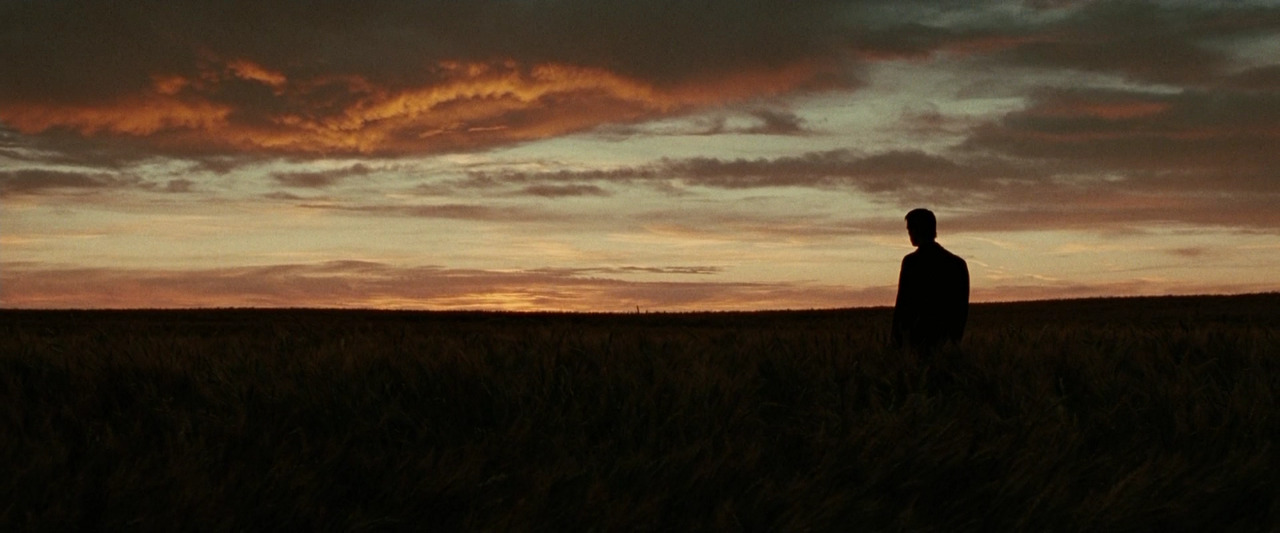
This lost classic from 2007 is one of the last features Deakins shot on film, ever since then he has made the full transition to digital film. It's hard to pick just one image from Andrew Dominik's masterpiece as it is one of the most beautifully photographed movies of the 21st century, the train station shadow/smoke scene is one other iconic moment that comes to mind, but for my money nothing beats this gorgeous frame in which Brad Pitt's Jesse James look over the sunset as he contemplates his next move. It's an eerie, evocative shot that once again shows just how great Deakins can shoot the first sunrise of the day (cue Sicario for another great moment of the sunset)

"I couldn't actually do what I wanted to do photochemically,. "I know some movies look digital but it's kind of the way they're shot and the technology and processing that's being used on them. But I don't think the average person would notice it ... and it just had a better sense of the changing times and the idea that this world was dying," he says. "And in a way, that's what Jesse James knew. It was a much more kind of reflective and thoughtful"  Hitfix, Incontention

"Eve and WALL-E" WALL-E, 2008


Director Andrew Stanton and his WALL•E team kept asking and referring to Deakins for his vision on how the first act of the film could feel live-action. Of course going to Deakins for advice meant that the animators were looking for ways in manipulating the light. His imprint on the films dialogue free first 20 minutes is there, the visual aesthetic takes your breath away as the use of different colours and schemes proves just how powerfully visual an animated can be.

 "The real world, the natural world that we live in just isn't as well-lit as your typical animated world is. There are shadows here. Areas in half-light over there. And if you can take that into account as you're planning your camera movements on a CG production, make those sorts of necessary adjustments to light levels as you're composing your shots, you'll then wind up with scenes that look much more naturalistic when they're up there on the big screen." And while Deakins is quick to play down whatever small role he played in WALL•E's eventual enormous box office success "Seriously. I only consulted on a few shots for the first 20 minutes of that film," Huffington Post


"The Japanese Jellyfish" Skyfall, 2012


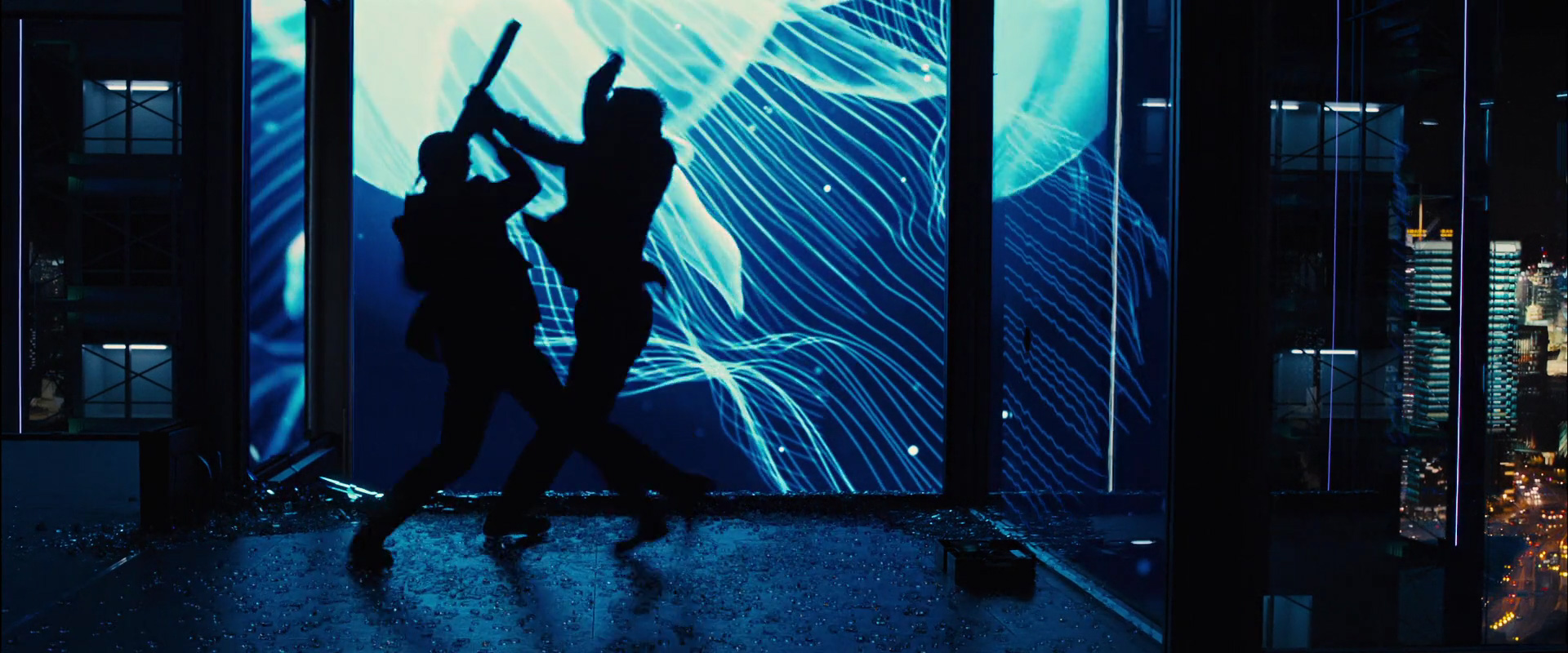
Skyfall is by far the best shot Bond film. Its images simmer and make the film such a cinematic, enticing treat to behold. No wonder many have called Skyfall the greatest of James Bond movies. Send Deakins to shoot a movie in Japan and you'll end up with one hell of a finished prodyuct. The imagery that stuck with me the most was that of the Shanghai office interior where James Bond intercepts Patrice, a hired assassin that ruthlessly goes after 007. Their fight, shot in a silhouette with a distinctive neon blue signage, features a prominent jellyfish floating in the background

"We were coming out of the monochromatic gray of England, so we wanted to arrive in Shanghai with a bang—a lot of color and movement of light. Gradually we came to the idea of making everything glass, so the whole thing was this big box of magical reflections. We built a model to see how the reflections would work and so we could position the big billboards and have the assassin firing at the hotel room in the right position. Then we built the set on the soundstage and spent a number of weeks rigging it, positioning every light. The jellyfish originally were just a stand-in image, but it was such a good choice, it stayed. We needed images for the monitor, and the art department found this footage of jellyfish floating through the frame,”

“When it came time to discuss what we really wanted to put on those screens, Sam and I looked at each other and said, ‘Well, why don’t we just leave it as jellyfish?’ It looked interesting, and it was a really deep blue, and we wanted this whole Shanghai section to feel quite cold. So that’s how the jellyfish got in the film — they were just stand-ins, really!” Shot Significance: “The calming, poetic nature of the jellyfish imagery builds the tension of the scene. If the imagery had been frenetic, like what you usually see on billboards, we wouldn’t have been able to build that sort of menace. And that’s what we were after: the ultimate cat-and-mouse scene.” Roger Deakins

"Freedom" The Shawshank Redemption, 1994


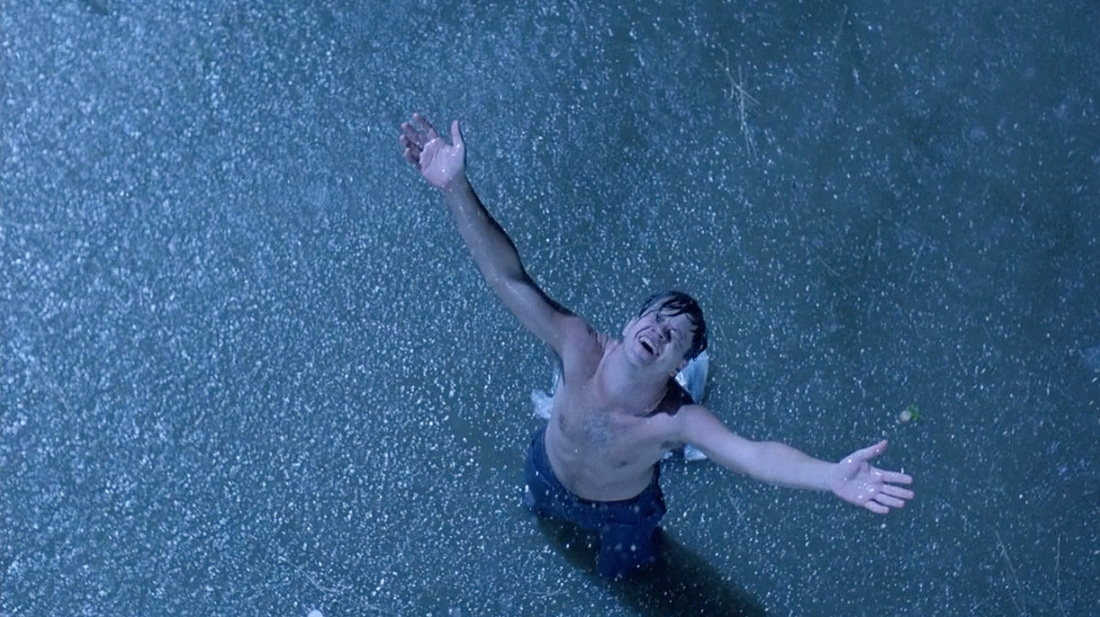
Deakins earned his first Oscar nomination for shooting The Shawshank Redemption. A film which started off as a decently reviewed prison drama and has turned into a stone cold classic. That famous shot of Andy escaping from the prison, arms outstretched as the rain pours down on him? You know, the moment so powerful that it was repurposed on the poster? Yeah, that wasn't originally part of the plan. Or at least what Deakins says,

"It was a difficult schedule on that film, and we had quite a lot of night work scheduled for when Tim's character escapes from the jail: He was going to run across the length of the field and catch a train that was going by the prison,"  "There was a lot of stuff planned, and schedule-wise, we just couldn't do that. So this shot, with Andy standing there in the rain, had to be this iconic shot that signified the end of the sequence ... because we couldn't afford to shoot the rest of it, basically!" The film came out in 1994, the same year another Tim Robbins–toplined, Deakins-shot movie with a funny name debuted. "One of my neighbors came up to me the other day and said, 'You know, I really like Shawshank, but one of my favorite films is The Hudsucker Proxy!'" laughed Deakins, who noted another similarity between the Coen brothers comedy and Shawshank: "When The Hudsucker Proxy came out, hardly anybody saw it. It was quite a blow for the boys and me, because we'd put so much into that film, and I thought it was really good! But when Shawshank was released, too, it made nothing theatrically; then, when it had a video release, suddenly it was on the charts for a year. It's all very odd." Roger Deakins


"Night to Dawn" No Country For Old Men, 2007


This bravura No Country scene, which goes from night to dawn as Josh Brolin is pursued by criminals, has an incredible use of light throughout, add in one very ardent pit bull and you've got a night of terror for our hero. In order to capture the dawn shots, Deakins shot some in the morning and some at magic hour, though he confessed that he can't tell which came when.

"I think that was one of the most difficult sequences I've ever done, really, I'm not 100 percent happy with it, but I'm not 100 percent happy with anything, really. It was really hard to do, given our budget and schedule." We were filming in New Mexico, and the weather is so different in the mornings and the evenings. Nobody really notices it, but it's obvious to me that the clouds build up during the day and you've got a lot of them in the evening shots, while the morning shots are crystal clear. There are quite a few of those mismatches." Roger Deakins


"Ready for War" Sicario, 2015


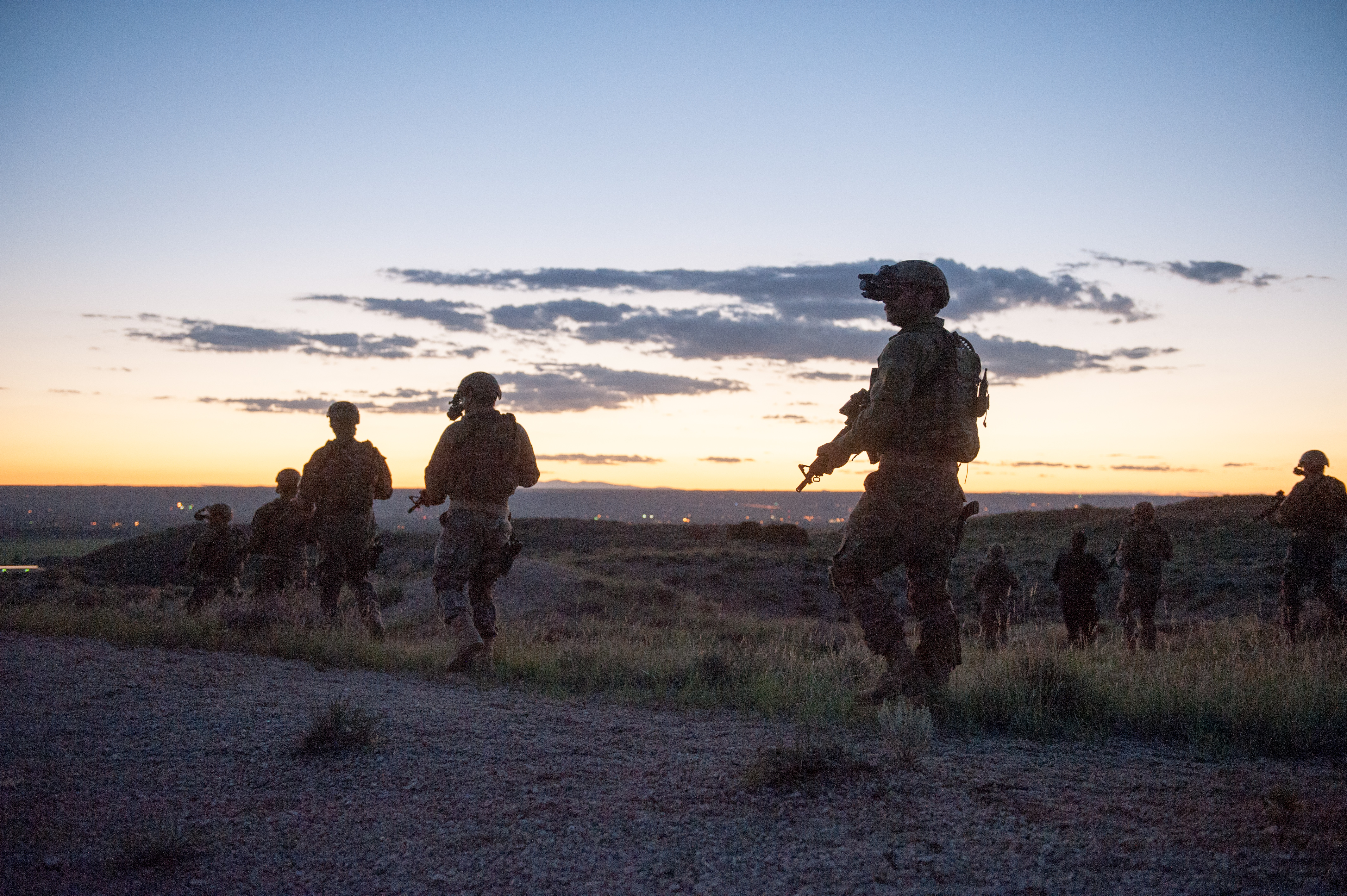
It seems like Deakins has taken a real liking to Quebecois director Denis Villeneuve. They collaborated together on Prisoners, Sicario and the upcoming Blade Runner sequel. Sicario is as much Deakins' film as it is Villeneuve's. Following FBI agent Emily Blunt, the film has Deakins returning to the similar landscapes and as those from “No Country For Old Men". These are clean, saturated colors and might just be Deakins' best digital work to date. The shots of a danger-filled Mexico City and tempty, isolated deserts brings out the best in Deakins' talent. However, we can't ever shake off the finale in which Villeneuve and Deakins follow their soldiers into the field of battle as the sunset looms over their silhouetted bodies.

"You always run tests for something, but we didn’t do that many tests on Sicario. It was mainly testing the night vision system and the FLIR (thermal imaging) camera, but there weren’t too many other things we tested. I rarely work with more than one camera. Even on Skyfall, it was mostly a one-camera show. It’s a different approach to filmmaking. [Sicario director Denis Villeneuve] is quite decisive about what shot he wants tobe on for what part of the action. So it’s not a matter of getting a load of cameras out and just getting coverage. To me, that’s not filmmaking. Denis has a very precise way of approaching things. He likes working single camera and so do I." Roger Deakins

"One of the most notable influences on our choices of camera placement, framing and lighting was the style of Jean-Pierre Melville. He’s able to attain a sort of simple yet stylish realism… we tried to stick with that spirit in filming Sicario, with an economy of means that in English we refer to with the expression ‘less is more" IndieWire

Interview with "James White" director Josh Mond


“James White” might just be the total opposite of Amy Schumer’s summer fling, “Trainwreck”, yet it is very much about a trainwreck. Starring Christopher Abbott (of “Girls” fame) and a never better Cynthia Nixon, James White is about a man – or boy, if you will – who has to deal with so many issues, both physical and mental, that watching it we are just waiting for the moment when it all implodes and the breakdown occurs. I recently spoke to the film’s director, Josh Mond. His connection with the filmmakers at New York’s Borderline Films – Sean Durkin, Antonio Campos, and Josh Mond – is becoming a cinematic movement. These three guys write, direct and produce each other’s films. So far we’ve had Campos’ directorial debut “Afterschool”, and three years later a bigger splash, Durkin’s brilliant “Martha Marcy May Marlene”, which gained many awards for Durkin and star Elizabeth Olsen. Campos followed up “Afterschool” with an ever better feature, “Simon Killer”. Josh Mond is up next; his directorial debut, “James White”, is the best of the lot so far.
“I really feel like we’ve set up a world where we get to work with our friends, not even just each other but so many others like for example our DP Mátyás [Erdély] (who also photographed Son of Saul) right down to our costume designer. We really just want to build and continue our relationship with people like we are with each other.” The shoot was short, but incredibly emotional: “We shot the film in December of 2013, a total of 22 days I think. We had 18 days in New York and 4 days in Mexico.” Mond and aforementioned cinematographer Mátyás Erdély give us a high-wire act, an impeccable artistic feat, with Erdély using his camera for abnormally efficient close-ups on his main character to enhance the claustrophobic feel of the movie. “I thought it was just right for the story we were telling. With the help of a handheld camera we could present the energy that this character experiences. As for my DP, Mátyás, I’m pretty sure his body is still hurting a little bit from carrying the camera around all the time. It really is arduous work what we tried to do, but we figured the movie can be powerful if shot this way.”
After having met and developed a friendship during the shoot for “Martha Marcy May Marlene”, Christopher Abbott and Josh made a short film together, “1009”, that served as sort of an experimental precursor to “James White”. “A lot of it was shot very close to the face, and later, when I was editing the short, it suddenly struck me only then and there in the editing room that he was doing stuff that I didn’t realize he was doing before. So I called him and I told him that I was writing that part for him now. After a while he just read a bunch of drafts and gave me some notes. He was then a part of it already. I can’t wait to work with him again.”
From the very first scene of “James White”, our main protagonist James is bouncing and dancing around drunk/high, mid-day in a dingy nightclub. It’s a hallucinatory scene that sets the tone for the rest of the film. The camera comes in and out of focus on an extreme handheld close-up, which puts you in the head of an immature, self-centered young man who gets one reality check after another from there on in. “We wanted to start the movie out like he’s high, at his highest moment, or really his lowest,” said Mond. From there James leaves the nightclub and ends up at a shiva for his estranged father at the house of his mother, played by Cynthia Nixon, who’s battling cancer. Nixon is a wonder to behold, as she delivers an awards-worthy performance of intense feeling. Nixon’s own mother died of similar circumstances only a few months before the shoot had begun, and Mond’s mother, Corinne, inspired “James White” as she too succumbed to cancer. “Things were really beginning to gel for the company, “Martha Marcy May Marlene” was sold to Fox Searchlight, we had a great deal with them, and then I got a phone call to come home right away because she only had a few hours left. I got a chance to see her and then she passed away not too long after that.”
When asked about any filmmaker who might have had an influence on him, Mond right away mentions Michael Haneke, whose movies always deal with the uncomfortable, the taboo, the complications of humans. In light of his mother’s cancer, James White tries to cope with the whirlwind of emotions by continuing to go out, get drunk, get high, sleep with women, and exude violent behavior. It’s not a happy movie, and you might need a drink or two after having watched it, but the artistry is phenomenal. After its incredible bow at Sundance in January, where it was praised in every way, an experience that Mond calls “surreal”, the 28-year-old director’s film is about to get released to a public that might not be ready to deal with the many “heavy” issues at hand, but that would be a mistake. It’s a topic that one way or another we’ll have to all deal with in our lifetime. Mond says, “I realized that what makes you connect most to a movie are the things that you feel uncomfortable sharing.”
Mond talks about the first of many meetings he had with Nixon for the movie, the bond they built, and the connection they had with a disease that seems insufferably permanent in our world. He said about that meeting, “Cynthia was just very generous and truthful with what she shared; Chris and I met with her a couple times. It also helped me deal with the emotions I didn’t understand at the time. There was shame, guilt, sadness, anger, fear, all of the above.” Josh’s sister helped him heal as well: “she called and said, ‘you may think this is the worst thing that could ever happen, but you’re so lucky you got to spend that time with her and share (this) with her, because it’s a really beautiful thing.’”

http://www.awardsdaily.com/2015/11/18/interview-josh-mond-director-of-james-white/

Interview with Screenwriter Nick Hornby on "Brooklyn"


Whenever I get an opportunity to talk to Nick Hornby, the conversation always shifts away from the topic at hand and instead veers towards our unadorned love for Bruce Springsteen’s music. Hornby’s love for music in general shows in every book and every screenplay he writes: “High Fidelity” was a love letter to the “record store”, “About a Boy” had countless references to pop music, and in “Wild”, Witherspoon’s lonesome hiker marches on her epic way, humming the 1987 Springsteen song, “Tougher Than the Rest” before declaring, “Sing it, Bruce!”
“I listen to music a lot during the working day,” says Hornby. “Loud/fast/urgent or moving and emotional or, sometimes, repetitive contemporary classical. I don’t listen to it while I’m working, but during breaks, and it all finds its way in somewhere.” Then the conversation shifts back to Springsteen: “Apparently Steve Pond was in the front row of the Springsteen DVD show for the upcoming River box set,” he says.
The 58-year-old British author and screenwriter has more than just that Springsteen box set to get excited about these days, as he’s been getting Oscar buzz for his delicately touching screenplay “Brooklyn”, an adaptation of Colm Tóibín’s novel of the same name. “The awards talk,” he murmurs. “Well, I’m glad I live in my town rather than yours! It’s pretty constant in L.A. If you tried to start that conversation [in the UK], where people don’t follow how it works and don’t really know we’re already part of the race, you’d seem a bit presumptuous. But most of the time it’s just the kind of excitement a writer never gets in a working day.”
Before Hornby started writing screenplays, Hollywood adapted two of his novels into great movies: “About a Boy” and “High Fidelity” (which features an amusing cameo from The Boss himself – Bruce Springsteen). Both were critically acclaimed and nailed the blue collar Hornby touch that makes his writing such an authentic treat, so much so that rumors actually exist of a possible Hollywood sequel to “About a Boy”. Surprised about the question, Hornby puts it to rest: “I don’t know where those rumors came from. I can’t imagine writing a sequel to any of my novels at the moment.”
The difference between the cinematic and the novelistic approach is night and day; both have their merits, but concessions have to be made when it comes to the silver screen: “Well, a script is an unfinished thing. It needs the work of a few hundred other people before it gets to where it needs to be. It doesn’t and shouldn’t belong to you. Even an unpublished novel is still a novel. And you have so much room and time in a novel – every single line in a screenplay has to fight against every other line for oxygen.” No matter the concessions, Hornby seems to be a natural at the cinematic game: he got a Best Adapted Screenplay nomination for 2009’s brilliant “An Education”, received a WGA nomination for last year’s two time nominee “Wild”, and his latest endeavor – John Crowley’s “Brooklyn” – is one of the most buzzed about titles for awards contention this year. His wife, producer Amanda Posey, has played a key role in bringing Hornby to the big screen. “My wife and her producing partner actually asked me to do Brooklyn, and I can’t say no to them!” he says. “I loved the book and could see a way of doing it.”
All three of his screenplays feature strong female lead roles and he is quickly becoming the best writer for women in Hollywood. “It’s probably not a coincidence that the last three screenplays have been about young women”, he says. “”An Education” taught me that if you write a big, strong part for a young woman, you get the opportunity to work with the best actresses in the world, because there is, ridiculously, nothing else for them.” It’s a sad fact that hasn’t gone unnoticed in the headlines, with many actresses strongly coming out and fighting for equal pay and others just not finding the amount of work necessary to sustain a career. “The best male actors are not so interested in independent cinema, because they’re getting these huge paydays from studios, plus they get big parts as well. Reese, Carey, Saoirse and all the others just don’t see roles of that magnitude most of the time. It’s ridiculous, of course. The talent is out there, in spades, and the market too. But this imbalance works to the advantage of those of us who want to make movies that have a chance of lasting.”
“Brooklyn” is a beautifully made film about good, well-intentioned people trying to do their best in life. The gorgeously crisp and colorful cinematography by Yves Belanger is to die for, as is the direction by John Crowley, which is stylishly slick enough to harken back to a time when handsomely made, feel-good pictures worked marvelously well in Hollywood. This is an old-fashioned movie done right, a heartfelt effort by people who very much care about story and character. Nick Hornby’s screenplay captures his usual impeccable ear for small talk. Saoirse Ronan plays Ellis, an Irish girl who moves to New York to start a new life, but finds herself doubting that decision once there. The movie will make her a household name, and there’s already talk of a possible Oscar nomination for her performance – which originally had Rooney Mara cast in the lead role – and for the film itself, which is exactly the kind of crowd-pleasing treat the Academy eyes year after year. “Saoirse is incredible,” he says. “It’s impossible to imagine anyone else in the world pulling that off. So subtle, so moving… she pulls you in and doesn’t let go.”

http://www.awardsdaily.com/2015/11/13/nick-hornby-talks-about-his-screenplay-for-brooklyn/

Hidden Gems of 2015

Every year people lament the state of contemporary cinema. People claiming that Hollywood is churning out way too many abysmal sequels, prequels, adaptations and seems to be running out of ideas don't seem to realize that if you manage to work past the endless stream of negativity, there is hope. Now, more than ever before, there are countless ways to find hidden gems that might not have even played at your local theater. It's not just VOD anymore, an entirely different market exists consisting of movies that skip the theatrical release and go straight to home viewing through services like Amazon and Netflix. No one can see everything, there's tons of cultural noise out there, and with close to 300 movies released every year, it's easy for a great movie to get lost in the shuffle. Well, that's where I come in. The following 11 titles did make it to theaters, barely, but deserved more attention. Don't mind chiming in with your own picks.

Predestination
One of the strangest most interesting movies I saw this spring starred Ethan Hawke. In the Spierig brothers' "Predestination", Hawke plays a temporal agent who constantly time travels to find a criminal that has obsessed him for god knows how long. To explain what happens in this movie is probably as hard as explaining Christopher Nolan's "Inception" upon first viewing. Mind bending and brilliantly conceived, "Predestination" is a movie that sometimes trips on its own format. In fact I guessed a few of the big twists before they actually happened, but it really is just a blast to sit through a film juggling this many ideas and that just simply wants to blow your mind – even if that's not always the case. The film takes pride in its lack of subtlety and in trying its best to shock, provoke and entertain in equal doses. For a year that finally seems to be recognizing the impact of female-driven cinema, "Predestination" provides a smart and vital additional angle to this year's feminist narrative. It reminded me of a great Agatha Christie book with a modern, 21st century, transgender twist. This is the best Wachowski brothers movie that they never ended up making.
Tangerine
"Tangerine", an ultra-low budget film shot on an iPhone for chump change and directed by Sean Baker, comes at you like an exhilarating force of nature. It doesn’t care if it shocks you or riles up your senses. It’s a fervent product of Sundance and one of many indie summer releases that first premiered over there this past January. It’s an imperfect movie but one filled with abundant energy in its every frame. Groundbreaking is the right word, for it is ultimately the first of its kind: a film shot on an iPhone with transgender actors taking on leading roles. Witness how evolving awareness of transgender issues has sparked a wealth of fresh cultural expressions. Jeffery Tambor is gut wrenchingly great in TV’s best show "Transparent" (with "Fargo" not too far behind if you must know) and if you haven’t heard of Caitlin Jenner then you’ve clearly been living under a rock. The film takes place on Christmas Eve in California and deals with a transgender sex worker who just finished serving a short sentence in prison and finds out her pimp/boyfriend cheated on her. She obviously doesn’t take the news very well and sets out to find the “fish” he cheated on her with. What ensues is a screwball comedy that never winces; in fact, it bites. It’s a hell of a good time, but more importantly it’s incredibly stylish filmmaking . Of course the fact that it was shot on an iPhone already makes it an important milestone film, but the L.A subculture that it introduces makes it all the more fresh and happening

The Gift

The biggest big studio surprise of the summer was, sadly, a movie that many people had not heard much about. With 108 reviews on RottenTomatoes “The Gift” has an outstanding RT rating of 93%. Its metascore on Metacritic stands at 77. So what happened between the critics and audience awareness? As with most mini-budget movies, the marketing was micro — but despite that unavoidable reality, it ranked #3 at the box-office when it premiered and since earned an impressive $28 million on a budget investment of $5 million. Directed by “Zero Dark Thirty” actor Joel Edgerton, “The Gift” is a tense, creepy psychological thriller that has so many twists and turns in its screenplay that you never know what’s coming next. Edgerton directed, produced, wrote and starred in a movie so inspired that it’s reminiscent of Hitchcock and “The Turn of the Screw.” Starring a nastily corrupt Jason Bateman and the vastly undervalued Rebecca Hall, we need more of her at the movies, “The Gift” is a razor-sharp dissection of marriage and friendship that reminds us how we can never escape our past. Go in knowing as little as possible and come out knowing more than you were prepared to find out. It's a nifty little B-movie that ends up turning the screw off your head.

Shaun the Sheep

"Shaun the Sheep" features some of the best dialogue-free scenes in recent memory. The film has scarcely any spoken words, as it just relies on its visuals to entertain us, and does a marvelous job at that. Clearly influenced by Charlie Chaplin and Buster Keaton's physical screwball comedy, directors Richard Starzak and Mark Burton have fashioned a classic out of such a simple story. A complete freak accident sends a farmer tumbling down the road to a bigger city where he loses all memory of his life and accidentally becomes a famous hairdresser for the celebrities. It's up to his flock of sheep to get him back to the farm, but not without going through the most insanely crafted screwball adventures imaginable. Just like Wallace and Gromit, the cast of characters were well known in the U.K. prior to the film's release, but if audience reaction and the deluge of rave reviews is any indication, this won't be the last we hear of them. The stop-motion animation is breathtakingly beautiful with layers of details in ever frame. The British deadpan wit is also in prime display here, with a little Monty Python-esque skit comedy thrown in for good measure.  I’d probably put this in an exclusive category of stop-motion classics such as “The Fantastic Mr. Fox,” “Chicken Run,” “Wallace and Gromit: The Curse of the Were-Rabbit” and of course “The Nightmare Before Christmas.”

Grandma

If I said that 75-year-old Lily Tomlin has never been better than in this phenomenal movie by Paul Weitz (American Pie, About a Boy) would you be impressed? Well you should be, because Tomlin’s had a phenomenal career: “Nashville,” “The Late Show,” “9 to 5,” “All of Me,” and “Flirting With Disaster” have all had a little Tomlin-esque spiciness sprinkled at their core and all the better for it. She was also, once upon a time, Robert Altman's muse -- which quite frankly tells you everything you need to know about Tomlin. What she does in “Grandma” is heartbreaking and nothing short of astounding. She brings the spiky, zesty nature she’s always been known for, but plays with our emotions until we reach a finale that seals the deal on the truly amazing quality of her work. Tomlin's Elle Reid is a foul mouthed, all-too honest lesbian granny that aides her suddenly pregnant granddaughter to find enough money for an abortion. Taking place in a single day, the film is an episodic romp that gets deeper and more fragile as it goes along. It's not necesarilly a film about aging as much as it is about the deeper connections we miss in life. David Edelstein said it best when he remarked "Grandma marks a new era in gay cinema — one’s that confident and mature enough to acknowledge regret." Expect a torrent of awards love to come Tomlin's way in the months to come, she'd probably be my pick for the New York Film Critics Circle "Best Actress" Award.

Infinitely Polar Bear

Mark Ruffalo gave the best performance in "Spotlight", but that wasn't even the best acting he gave this year. In "Infinitely Polar Bear" he's a manic-depressive mess of a father that tries to win back his wife by attempting to take full responsibility of their two daughters while she gets out of the city to complete her business degree. Ruffalo creates one of the most entertainingly inappropriate, but ultimately disturbing accounts of mental illness in recent memory. His mannerisms and gestures look scarily real, but so do the twitches and spasms that run throughout his body, a sign of the physical and mental unrest that inflicts this tangible character.  The director is Maya Forbes, a Harvard graduate and first time filmmaker that based the movie on her own experiences as a child in Cambridge where she was raised by her father who had bipolar disorder. The movie is an ode to her dad, a lovingly rendered portrayal of a man trying his best, but chased away by inner demons. Much of what happens in Forbes' movie can be crushingly real or even unbearably painful, but she seems to find light in every dark shade present. She doesn't direct the movie as much as live through it which, given the backstory, is quite a heroic and formidably therapeutic attempt. Ruffalo, one of the very best actors of his generation, completely floored me.

Heart of a Dog

The brilliant Laurie Anderson's film is more than just an ode to her deceased dog Lolabelle. This exploration filled non-fiction film is about the deepest questions we can possibly ask ourselves as human beings. The themes range from death, love, memory, surveillance all the way to the nature of language. It's all beautifully narrated by Anderson, who's soothing voice reveals the depths of pain she has encountered in the past few years with the death of her husband Lou Reed, her mother Mary Louise and beloved dog Lolabelle all coinciding one by one. Her narrative voice becomes a kind of melodic flow rather than a plain spoken worded ordeal- it intensifies the stories she tells us and is an integral soundtrack to her personal journey. Most of all this is a film about mortality, the one theme that eats us up as human beings, the meaning of which will never fully be explained in our lifetime. That doesn't mean we can't keep asking ourselves questions about it, that's part of who we are and what makes us feel relentlessly alive. We might never come to terms with it, but there's something wondrously mysterious about it all - the meaning we try to find out of this personal journey might never be fully comprehended, but there's a real beauty in coming to terms with the unknown. I don't use the term very often, but "Heart of a Dog" is the definition of a "work of art".

Mississippi Grind

I'm a sucker for gambling movies. I'm also a sucker for road trip movies. Mississippi Grind is both of those, so of course it makes this list. Ryan Fleck and Anna Boden (Half Nelson, Sugar) are also one of the very best Indie filmmakers in the business. In Mississippi Grind, the highly talented Ben Mendelsohn plays Gerry, a gambler who is unquestionably down on his luck facing personal and financial ruin until he meets Curtis (Ryan Reynolds), a young poker player who also craves the adrenaline of a quick financial gain. They bond through their love of card playing, dice rolling, and chip throwing. They go from Iowa to New Orleans in search of the big win, and their journey turns "Mississippi Grind" into a road trip movie. Curtis claims "The journey's the destination," but the same can be said about the film which seems to have taken pieces of Altman's "California Split" and Karel Reisz's "The Gambler". Both leads are perfectly cast. Mendelsohn is at times mesmerizing and Reynolds shows us that he has acute acting chops if given script pages with some meat to chew on. Together they make a formidable pair of losers. Two men who would appear to be fun to be around but are reckless and therefore dangerous to be associated with. And therein lies the beauty and intricacy of Mississippi Grind. Shot on film, Mississippi Grind almost has that 1970's film feel. It's methodical in its pace and is not afraid to rely on the charm of its characters to further elaborate its narrative.

James White
Opening in very limited release on November 13th, "James White" is already destined to be overshadowed by the marquee holiday titles aiming for box office gold and awards love. Starring Christopher Abbott -- of "Girls" fame -- and a never better Cynthia Nixon, the film might just be the total opposite of Amy Schumer's summer fling "Trainwreck", yet this film is very much about a trainwreck. A man -- or boy if you will -- has to deal with so many issues, both physical and mental, that watching it you are just waiting for the moment when it all implodes and the breakdown occurs. What you don't realize is that the breakdown has already started: from the very first scene he's bouncing around drunk mid-day in a dingy club, and things only get worse after that. Nixon plays this boy's mother, whose cancer that was previously in remission has come back in full stride, and next thing you know she's at stage 4 and with only weeks to live. Meanwhile her son, trying to cope with the whirlwind of emotions, continues to go out, get drunk, get high, sleep with women, and exude violent behavior. It's not a happy movie, and you might need a drink or two after having watched it, but the artistry is phenomenal. After its incredible bow at Sundance in January, where it was praised in every way, director Josh Mond's film is about to get released to a public that might not want to deal with the many "heavy" issues at hand, but that would be a mistake. "James White" is an impeccable artistic feat with Mond using his camera for abnormally efficient closeups on his main character to only enhance the claustrophobic feel of the movie.

99 Homes

Ramin Bahrani’s tense but terrific film stars Andrew Garfield as Dennis Nash, a man whose family home gets foreclosed by arrogant, money-hungry real estate mogul Ray Carver, devilishly played by Michael Shannon. Circumstances lead the desperate Dennis to work for Carver to get his home back. Both are excellent, and Laura Dern as Dennis' mother is heartbreaking in an exceptionally resonant role, showing us the immense talents this underused actress possesses. Bahrani brings an authentic documentary-style feel to the whole thing, using hand held cameras to swerve with the characters and raise the tension. This is about a society gone astray, hell a country gone astray, and a poisonous system that doesn't just seems unfair, but criminal. This is a movie for its time about its time, that is frighteningly urgent and has more than enough relevance to pack a punch. Late film critic Roger Ebert was a staunch supporter of Bahrani’s films and for good reason. He’s a unique voice that finally makes his big studio picture debut here. You can tell there’s a studio behind him here because “99 Homes” does have to make some concessions in its final cut and is not a perfect movie, but the artistry is major and Bahrani creates a movie that'll give you nightmares.

Victoria

Sebastian Schipper’s high-wire act of a movie is more than just a stunt. Shot in a single 138-minute take, but not one cut, it’s a grim, but powerful look at a Spanish girl named Victoria who meets 4 German men in the wee hours of the night in Germany and embarks on a harrowing journey with them. Schipper and his ace cinematographer Sturla Brandth Grøvlen  make the camera move poetically through the after hours of Berlin with elegant ease, never has Berlin looked this menacing, but breathtaking in a movie before.  Grøvlen's camera seems like its own acting beast and breathlessly dictates the white knuckled tension.  I fear many might shrug it off as just a gimmick, but that would be very far from the truth. Yes Schipper's film is in fact a phenomenal technical achievement, but one done with the alerting sentiment that there needs to be a good story behind the gimmick. There are some scenes of unquestionable tension here as hoodlums, clubbers, hustlers, romantics navigate in an out of the story, but character development rarely gets forsaken.

Contenders - Best Foreign Language Film


Weighing in on the Foreign Language Film contenders has become a sort of tradition for me at AD. Of course my commendable efforts to try and watch as many of the films as possible pales in comparison to Nathaniel Rogers’ current project/obsession over at The Film Experience, where he’s literally trying to watch all 81 submissions. When I bump into him at TIFF every year, he’s almost guaranteed to tell me that he’s off to see some random country’s Oscar submission. I of course haven’t seen all of them, but I have seen most of the buzz-worthy titles and I do want to thank the people who have helped me with screeners along the way. Such a project would not be possible without all the film festivals. Just recently, Montreal’s Le Festival Du Nouveau Cinema — which ended this past Sunday — helped me find the missing pieces of the puzzle, with screenings of their impeccably well organized program.
This year we hope that the major snubs that happened last year in this category — with Two Days, One Night and Force Majeure not getting nominated — do no repeat themselves. The fact that the Academy lets the countries themselves pick the film is somewhat of a problem and leads to a biased agenda. Iran obviously picked the 171 minute Islamic epic Muhammad: The Messenger of God over imprisoned filmmaker Jafar Panahi’s scathingly brilliant social critique of Iranian society Taxi. Thailand not only didn’t choose Apichatpong Weerasethakul’s masterful Cemetery of Splendour, but in fact banned it from ever showing in the country due to a few “un-patriotic” details shown in the movie. Germany said no to Sebastian Schipper’s incredible 134 minute one take wonder Victoria in favor of safer bait-y fare Labyrinth of Lies, and China decided to choose — huh? — Go Away Mr. Tumor, a romantic comedy based on a webcomic over Jia Zhangke’s heartbreaking dissection of Chinese societal ills Mountains May Depart. I’m only scratching the surface here, but many other countries opted for the safer, non-political route with their films, which makes the category all the more controversial.
Take as an example Cemetery of Splendour. Apichatpong Weerasethakul is quite possibly the most forward thinking, prophetic filmmaker of world cinema today and yet his country treats him like a traitor. So much so that Weerasethakul has recently stated that he will not be making another movie in his native country ever again, instead opting to explore the South American movie scene. It’s their loss, as Weerasethakul is a filmmaker that is considered by many to be the best current director in the world. His films do not follow the conventional narrative and instead opt for dreamy surrealness, popping your eyes out with the most incredible imagery, knocking your senses out with an unabashedly masterful use of sound and luring you in with its haunting storytelling.
Moreover, what kind of political statement would be made if Jafar Panahi’s Taxi was nominated. Panahi has been under house arrest for more than five years now and has been banned from making any kind of movie for the next 20 years. Yet, he remarkably continues to find loopholes and make the most creatively ingenious films imaginable and then finds a way to sneak them out of the country and into film festivals worldwide. Taxi won the Golden Bear this past Fenruary at the Berlin Film Festival. For a lesson in how to make movies with the most dire of constraints infringing on your creativity, just watch any of Panahi’s three post-house arrest movies, especially 2011’s This is Not a Film, the best of the bunch. His situation has not only changed the way he makes movies, but in the process has made him a wholly better filmmaker.
I’ve come up with ten titles that I believe are the standouts in the Foreign Language Film category. With all the complaining I’ve done set aside, most of these titles are actually pretty great movies and represent some of the better parts of world cinema.
Son of Saul
Lazslo Nemes’ Son of Saul. is a holocaust movie shot from the point of view of a concentration camp prisoner forced to burn the bodies of gas chamber victims after leading them to the trap. The movie is an immeasurable accomplishment, with scenes of staggering beauty and incredible pain. Nemes’ masterpiece reinvents the Holocaust movie by focusing more on the psychological nuance of the tragedy rather than just shock. If there was a better, more artistic movie at TIFF 2015, I didn’t see it. The movie opens with Saul finding out that the last group he led to the gas chambers included his 7-year-old son. Saul is a man so persistent in giving his deceased boy a proper burial that he risks his life and the lives of his co-prisoners just to find a proper rabbi for the kiddish ritual. His risk-taking can sometimes be maddening, but there is something to be said about a man who still believes in keeping his tradition and religion intact, even in the face of unspeakable horror. The Jews around him are building up a resistance and are prepared to fight, but Saul seems completely aloof, focusing instead on finding a rabbi and having a burial. Using a hand-held camera can sometimes end up being damaging to the overall narrative of a film, but here it compliments the story and gives it a fresh spin. The fact the first time filmmaker Nemes was just 28 when he wrote and directed this masterpiece speaks volumes about his talent. Some scenes are so deeply realized and profoundly thought out that it feels like you’re in the hands of veteran master. The film uses its camera to find dizzyingly surreal moments for its characters and supplies a uniquely original take on a used up cinematic genre.
The Assassin
The Taiwanese submission, The Assassin, is Hsiao-Hsien-Hou’s first film since his critically acclaimed Flight of the Red Balloon back in 2008. It justly won him the Best Director prize at Cannes earlier this year, which is the obvious award the film should be getting, as it is truly a master class in directing a movie. Just like his other fantastic movies, the filmmaker takes his time here, making every shot look like a beautifully painted stroke. His martial arts film is not concerned with plot as much as it is about trying to convey indelibly breathtaking imagery: “There are already so many martial arts films with that style, why bother making another one,” he told Film Comment. Tackling the Wuxia martial arts genre, Hsien-Hou’s film is about a female assassin in 7th century China named Nie Yinniang who embarks on a mission to kill the family that abandoned her when she was just a child. Yinniang is played by a beautifully talented actress named Qi Shu who can evoke more feelings and hurt in a single stare than most actors can in words and gestures. The movie isn’t about the fighting, yet when it does occur it is done in such an artful, seductively nasty manner. The way the whole thing is shot looks like something we’ve never seen before, a movie that is almost certainly a work of art and that can have each and every one of its frames frozen in time for us to gasp at its beauty. The Northeastern Chinese sets were built not on soundstages, but outdoors, so that natural light could be used. The cinematography by Mark Lee Ping Bing is thus filtered with so much beauty, it’s like looking inside a jewel box. This might not be the Academy’s cup of tea, but the solid reviews it’s been getting will almost certainly make it one of the lasting true contenders for the category.
Mustang
Dheepan might have won the Palme D’or earlier this May at Cannes, but that wasn’t enough to persuade the French to choose it for the Oscars. Dheepan is a remarkable film, in Sri Lankan with French subtitles, but Mustang — this one is Turkish with French subtitles — is just as remarkable. Opening on November 20th, it’s not only a genuinely infuriating and touching movie, but it might also be one of the very best of its kind, a film about female empowerment in a small society completely lacking in it. The story of the five Turkish girls of Mustang becomes a love poem for, as Brian Tallerico stated, “the millions of women who have looked at the world around them and found they needed more.” The tale of five spirited young sisters imprisoned in their deeply repressive male oriented family home is an unequivocal triumph for its first-time female director Deniz Gamze Erguven. She directed the movie while pregnant: “It was a commando operation. I was exactly halfway through my pregnancy when we wrapped, and we were shooting twelve hours a day, six days a week. It put me in the same position of fragility as the girls, which wasn’t a bad thing since it meant we were all in the same boat.” She shoots her movie like a pro with a primal understanding of the cinematic form and her characters. What’s even more astounding is her work with the young actresses, all of whom more or less have never acted in a movie before. There are shared similarities to Sofia Coppola’s The Virgin Suicides, another female driven, female directed film. Erguyan replied that she “saw The Virgin Suicides when it came out and read Jeffrey Eugenide’s book, but Mustang is not a derivation of it.” Mustang is about teenage angst in a freedom constrained society. “I wanted to talk about what it’s like to be a girl and a woman in modern-day Turkey, where the condition of women is more than ever a major public issue. I frequently left Turkey for France and everytime I’d go back to Turkey I felt a form of constriction that surprised me. Everything that has anything to do with femininity is constantly reduced to sexuality, it’s as if everything a woman or even a young girl does is sexually loaded.” It’s a story that is sadly quite relevant in that part of the world — with arranged marriages, strict dress codes and proper “non-seductive” behavior being prescribed for women.

The Second Mother
Two particularly interesting films about motherhood are vying for a nomination this year. They couldn’t be more different from each other. Director Anna Muylaer’s The Second Mother tackles the generational and class divides happening in her native Brazil. Actors Regina Casé and Camila Márdila shared the World Cinema Dramatic Special Jury Award for Acting at Sundance and the film won the Audience Award at Berlin. This is the story of a Sao Paulo nanny named Val who has to live with the guilt of having left her daughter Jessica until she re-enters the picture and decides to crash at Val’s workplace, When Jessica arrives, cohabitation is not easy and has Val pondering the past and re-envisioning her own future. Everyone will be affected by the personality and candor of Jessica with Val finding herself right in the middle of it. Muylaer’s film is trying to show the dividing class structure in Brazil and how it’s being -rightfully so- destroyed by the next generation. Jessica doesn’t understand why her mother gets treated so poorly, especially by the matriarch of the family who seems to have her values and nose stuck up in 21st century bourgeouis-ism. The story is also a touching ruminification on mother-daughter relations. Regina Case’s performance as the mother is eccentric, neurotic, but ultimately moving Muyaler’s direction is passionately laid out. When it comes to female directors “if your film is doing well, it’s because of us.” she told AD. Look for a great interview by Jazz this week with the star and filmmaker of this great movie.
Goodnight Mommy
The mother in Goodnight Mommy couldn’t be more different than Val – in directors Veronika Franz and Severin Fiala’s film she has come back from a mysterious accident with her face bandaged up due to plastic surgery and an overall newly found aggressive behavior. Her two sons start to suspect the worst, Is this really their mother? After all, she wasn’t this brutally honest and frank with them before. The notion that an imposter has taken over the matriarchal role seems somewhat preposterous at first, but the hysterical behavior the mother starts to impose on her children starts to worry both the children and the viewers themselves. The rest of the movie is too spoiler-filled to really go in-depth, but the surprise ending is one of the few welcome “twists” in recent cinema. This is a hard, tough watch that doesn’t give us any easy answers, but the filmmaking is breathtakingly, horrific imposing an almost Freudian aspect to the mother and son genre. Audience response has been warm to Goodnight Mommy, but can older more conservative voters respond the same way film geeks/fanboys have online? One thing’s for sure: Franz and Fiala impose tough, controlling, obsessively detailed frames to their movie and make something disturbingly special.
A Pigeon Sat on a Branch Reflecting on Existence
Roy Andersson’s films resist definition. As one critic pointed out: ‘Why would you write about a Roy Andersson film? You might as well dance about a cake.’ Don’t pay attention to the pretentious title, this Swedish film is actually quite an amazing miracle. The 2014 Golden Lion winner at Venice is an episodic, deadpan dramedy from Andersson’s brilliant, twisted psyche. The conclusive piece of his “living” trilogy that started with 2000s Songs From the Second Floor shows us the abyss of human existence and the pointlessness of some human lives. A knowledge of Kafka’s works might help, I was also reminded of Waiting for Godot in this seemingly modern tale of two unsuccessful and troubled travelling salesmen – it all feels like a metaphor for something otherwordly that cannot be comprehended. There’s nothing conventional or familiar about it. Roy Andersson’s movies are like that. You better brace yourself for a sequence of images, scenes and characters that may or may not fit together but are guaranteed to surprise, amuse and shock you. Andersson tackles death here, but tries to give it a twisty irrevocably deadpan style. sometimes you’re not sure what his point is but that’s part of the charm. I’ve heard some people say that they were bored to tears by the film, but then again this isn’t a film for short attention spans. As we stand it’s one of the bigger titles of the race, with much critical baggage on its back, and a respectable box office intake, but will voters adhere to its rebellious narrative?
The Club
The Club is Pablo Larrain’s latest provocation. It just won another Best Film award, this time at Montreal’s Le Festival Du Nouveau Cinema, which concludes a year where the film won prizes left and right including the Grand Jury Prize at the Berlin Film Festival in February. After directing the excellent No, he sets his eyes out on the controversial sex abuse scandals of the church that happened in his home country. If Tom Mccarthy’s Spotlight didn’t show the perpetrators or the victims of these horrendous crimes then Larrain doesn’t shy away from doing so. The Club is about the evil men that committed the abuse and the isolated, small town house they live in for penance. It’s also about the victims, in particular one disturbed victim that seeks revenge. There are four men, a nun -whom has comitted a different kind of sin- and an overall gloomy atmosphere to the whole thing. To make matters worse a fellow priest who has just joined the house shoots himself in the head, a Church head comes to visit to inspect and possibly close down the house. Rage follows, but so does the fact that what is supposed to be prison for these men is actually a retreat, filled with recreational activities and a free pass they do not deserve. Larrain meticulously crafts the film with the eye of a proven filmmaker, he doesn’t shoot the film as much as live in it by trying to understand his characters and their motivations “I try to love my characters as well, even though they could be the meanest person in the world, and have done things that you could consider immoral or wrong.” the director told IndieWire earlier this year. The formula works wonders with The Club.
The Clan
Pablo Trapero’s The Clan owes a lot of its narrative style to Martin Scorsese’s crime movies, with a rock and roll soundtrack, frenetic long takes and absurdly violent crime scenes. Trapero won the Silver Lion for direction this past September for this harrowing Argentian true story of the Puccio Clan, a family who kidnapped and killed in the 80s. It is all rendered with such horrific grittiness onscreen that it’s not hard to look away in some scenes. Trapero has taken the route of forcing us to identify with his heinous main characters, which makes this film more closely related to a Rob Zombie movie like The Devil’s Rejects than it does to any other crime film. It is however a little more restrained than the aforementioned filmmaker’s twisted visions, but nevertheless we are given the task of watching a family patriarch -deviously played The Secret in Their Eyes’ Guillermo Francella- embark in the most disturbing kidnappings, for political reasons, all in the meantime having his family abide and become more than just passive accomplices. Some of the victims are kept in the downstairs basement, where the screams can be heard from the upstairs family kitchen. The family doesn’t say a word, adhering to the father’s twisted agenda – yet the only one with a moral compass is his oldest son Alex, who starts to rebel against his old dad. The director has said that “What’s interesting for me was to tell the story of the relation between a father and his son and this is universal” . The film has become a phenomenon in his native country, breaking opening weekend box office records and having been seen by more than 2 million people in its first month of release alone.
Labyrinth of Lies
Of course, any World War II film about justice has to be part of the discussion. Giulio Ricciarelli’s film Labyrinth of Lies is about the conspiracy by the German government to cover up many of the crimes committed by Nazis during the second world war. It takes place in 1958 and has a young prosecutor investigating the case. His efforts are, however, obstructed by the powers that be who’d rather not be reminded of the past. In a particularly flabbergasting scene, the prosecutor asks his young colleagues what the word Auschwitz means to them. None of them come up with an answer. Unlike the other pictures on this list, Labyrinth of Lies does not enter the Oscar race with any prestigious Film Festival awards or critical acclaim on its belt, just look at its metacritic score 62, instead this is the kind of film that will have audiences saying it is a great movie. A potent crowd pleaser. Most pundits think this will get nominated. It is a safe, sometimes meandering, but often interesting story that only seems to be scratching the surface of the harsher truths at stake here. Ricciarelli directs it with all kinds of prestige-picture flair, but this isn’t even close to being the best German film of 2015.
Rams
Fresh off winning the top prize this year with Cannes’ Un Certain Regard section, Grimur Hakonarson’s Icelandic film Rams was high atop my must see list for this article. Taking place in a secluded part of Iceland the film is about two sheep herding brothers who are so good at what they do that they are rewarded for their prized rams. Yet all is not well with this pair of siblings as they don’t talk to each other anymore nor do they even try to make eye contact. Tragedy strikes the small town when it is discovered that a brain and spinal eating disease has rummaged the village’s sheep and that the villagers must kill off their entire herds. This of course doesn’t sit very well with our two brothers who somehow try to take matters into their own hands, with both comic and tragic results. The brothers must fight together by putting aside their own egos aside and taking extraordinary measures to save the remaining sheep. This means breaking a 40 year silence between them, with one brother saying to the other, “No sheep – just the two of us.” Rams is about a deeply rooted culture threatened by extinction, it is about famillial ties that cannot be broken, but most importantly it is about a heritage that is very dear to the Icelandic people and that seems to bring people together in times of crisis.

The Emergence of Denis Villeneuve in Sicario


Denis Villeneuve is not a filmmaker who sees the light at the end of the tunnel. If you’ve ever seen any one of his movies you’ll know that there is a sense of dread and uneasiness to every frame, the feeling that nothing good will happen and that everything is just wrong. Yet, the 47-year-old director hasn’t exactly tackled melancholic stories in his career either: His movies have included child abductors, terrorists, drug lords, hitmen, high school shooters and depressed alcoholics. Yet since his American debut, Prisoners, starring Jake Gyllenhaal and Hugh Jackman, he has steadily but surely built up a following that is making him a reputable force to be reckoned with. That film’s polite but good reviews were transformed over the last few years into an undeniable cult following. The grisly murder mystery at the center of the story has typical B-movie tropes, but he has a knack for making a script better just by the way he films, paces, and directs. About this he says, “All my life, I’ve searched for good screenwriters; I love writing, but I’m not a good screenwriter and I take forever to complete a script. For the first time ever, I’m receiving screenplays from Hollywood that actually intrigue me. I had heard so many horror stories about foreign filmmakers going to Hollywood that got fucked by the system. Martin Scorsese warned me in fact that ‘You need to remain intact, that’s the most important thing.’ ”
Prisoners was a big step forward in getting his name across. He admitted, “It was a film that was horribly American, almost a kind of western.” Villneuve followed it up with Enemy, a film he shot prior to Prisoners, also starring Gyllenhaal. About Enemy he stated, “That was a very personal film adapted from a Portuguese novel by José Saramago. When I read it I felt the same sensation as when I was a kid and saw 2001: A Space Odyssey. It was very much about masculine identity.” This will probably not be the last time he works with Gyllenhaal either. “We very much were a creative team with Enemy, Jake was very into the whole process. We we’re feeding off of each other – so much so that I find the film is almost a documentary on Jake’s subconscious.”
On a personal note, I lived through the Montreal film scene when Villeneuve, Jean-Marc Vallee, and an 18-year-old Xavier Dolan among others, revolutionized French-Canadian cinema, and in the process gave themselves a shot at the Hollywood studio system. It was a very exciting time, but it was always Villeneuve that I kept an especially close eye on. People who saw his movie Maelstrom back in 2000 knew this was a talent to watch. The film, narrated by a doomed fish, features a career-making performance by Marie-Jose Croze as a depressed, suicidal woman who gets romantically linked to the son of the man she killed in a hit and run accident. The style was grimly unique and had a surrealist aspect to it that was almost too frightening to watch. Or maybe it was just the images Villeneuve conjured up with his camera – he could find the most basic looking detail in a frame and accentuate its impact just by the way he positioned a camera or had the cinematographer light up the scene. “It’s strange, when I finished Maelstrom I told myself, no more movies with a female lead. My first three films had that. Yet with my following film, Polytechnique, I made a film about the female condition and Incendies, the Middle East female. It just seems like women inspire me and that’s a good thing.”
The Polytechnique school shooting in Quebec was still a big deal many years after it happened; it affected a generation and Villeneuve was one of those people. Shooting a film about the tragedy was a daunting task, and the film he made was not without controversy in Canada.  During a class, a gunman shot 28 people, killing 14 women, before committing suicide. He began his attack by entering a classroom at the university, where he separated the male and female students. He told the women that he hated feminists, claiming that he was “fighting feminism” and calling the women “a bunch of feminists.” He shot all nine women in the room, killing six. He then moved through corridors, the cafeteria, and another classroom, specifically targeting women. ”Polytechnique is an organic film, a beast. The film is alive.” The film jumps back and forth in time, meditatively trying to find some peace with the tragedy. Villeneueve’s film tries to tackle the human cost of gender warfare and comes up with varying but troubling answers. Think Gus Van Sant’s Elephant, but French-Canadian. Shot in beautiful black and white by Pierre Gill, it’s an astonishing statement by a filmmaker who wants his voice to be heard. It justly won the Best Picture Genie award (the Canadian equivalent of the Oscars), his second one after 2008’s Maelstrom triumph. The following year he triumphed again with Incendies, winning his third Best Picture Genie. 
The fact that Villeneuve is becoming such a hot commodity is not surprising. Before he broke through in the States, he had made four highly impressive French-Canadian films. After each one I thought, “this might break through and get him known”, but it never happened. It’s a tough business, but the films got progressively better, and when his career finally reached its peak with Incendies, his trailblazing 2010 Oscar nominated masterpiece, audiences could no longer ignore the talent. “I didn’t have time to rest. The last day of shooting Polytechnique I directly went to day one of shooting Incendies. These were two projects that I really took to heart, but they mentally and physically drained me.” Political, angry, and thoroughly engrossing, Incendies is a Middle Eastern nightmare that gets progressively more disturbing as it goes along. Brother and sister lose mom, find out their dead father is very much alive, learn that they have a sibling they never knew existed and decide to go to a violent Middle Eastern country to find out more of their mother’s past. It’s pure Villeneueve: aggressive, violent, and thoroughly pessimistic about human nature. “The anger that was in the source material really, profoundly touched me,” he recounts.
This journey has brought Villenueve to – what is so far – his best American movie with Sicario, a movie he calls a “dark poem”. Villeneuve is slowly but very surely getting to a groove of studio filmmaking that will likely propel him to join the very best in Hollywood. If that isn’t already the case, it sure as hell will happen in the next few years. Sicario is a monster of a movie. Villeneuve stages the action like a true master, moving his camera to the beat of the violence. It’s with these action scenes that you realize just how talented the man is. They seem like very simple scenes to shoot, but they aren’t.  It’s a good thing then that Sicario’s full-throttled sequences are refreshing, plentiful, and the highlights of the film, as they encompass a wide array of claustrophobic feelings and put you right in the thick of the action, especially in a highway shootout that is bound to become an iconic piece of cinema.
Dealing with the Mexican-American problems at the border and beyond, Sicario is highly relevant right now. It is nothing new that this year’s political campaigning has had Mexico very much at the forefront of the discussion. All the unusual talk of wall-building notwithstanding, there are core issues to be dealt with in the future. Talking to The Guardian at Cannes earlier this year, Villeneuve has said that “The movie is about America … how America fantasizes that it can solve problems beyond its borders, and about the collateral damage that results … and the legality and moral issues around that … It’s a movie that deals with idealism and realism and the tension between both … It takes place on the Mexican border, but it could have just as easily have been set in Afghanistan or the Middle East or various countries in Africa. In North America, we allow ourselves to do things that other countries can’t afford to.”
A lot of the film’s brilliance has to do with the cinematography that Roger Deakins brings to the table. This is Deakins’ second collaboration with Villeneuve – they make a great duo – and the film is almost as much a showcase for Villeneueve as it is for the famed cinematographer. Villeneuve seems to be giving carte blanche to Deakins with every movie, which isn’t a bad idea, and the two complement each other to great degrees. “I always profoundly felt Roger wanted to make the movie. One thing I adore about Roger is his discipline and his rigor. He exudes so much respect from the cast and crew. When I started editing the movie I was just floored by what he had done.
Sicario has been compared to Steven Soderbergh’s Traffic for its investigation of the Mexican drug cartel and both starring Benicio Del Toro. That’s where comparisons should end, though. Relying heavily on atmosphere, a pulse pounding score from Jóhann Jóhannsson and a never better Emily Blunt, Villeneuve shoots the whole thing like a pro, giving us epic wide screen shots that take advantage of the breathtaking locations and his usual gloomy visual style. Its bow at Cannes came with a standing ovation and positive reviews, however it’s only now that the film is truly lifting off. Positive word of mouth – and there’s plenty of it for this movie – will propel this film into awards contention. Benicio Del Toro’s turn as the titular Sicario – a hitman by definition – is mysterious, mesmerizing and brutally brilliant. 
Blunt also deserves to be part of the Best Actress conversation. She’s just one of the very best actresses around and her role as Kate Macer is an important one for Villeneuve as well. “There is obviously a lot of work to be done for women’s rights, there aren’t any good parts for women in movies these days … I think of this as my contribution.”  Sicario had a bumpy road pre-production, as the movie’s backers wanted the Kate Macer role rewritten for a man. It was something his screenwriter, Taylor Sheridan, had been “advised” to do, but Villeneuve and Sheridan refused. “It isn’t easy to get a film made where the protagonist is a woman – there’s less money, people are afraid, and it’s really sad that it’s still like that today,” Villeneuve said. “It’s ludicrous, and this film shows that attitude is dépassé…” safe for Enemy and Prisoners, Villeneuve’s five other films have dealt with female identity. Much of this might have to do with his upbringing, which was dominated by two very prominent figures – his grandmothers – whom he calls “very powerful women.”
The movie feels epic in scope, but is actually very intimate in detail, which is a big part of why it works so well. Villeneuve never forgets that at the end of the day, it has to do with story and character. The fact that the 47-year-old director rarely gives interviews only enhances the intrigue of the man. I had the chance to meet him a couple of times in Montreal, and he gives off a shy but amicable feeling that is the polar opposite of his films. His passion for cinema is clearly felt, but so is the way he never fully reveals himself in conversation. 
Hollywood has clearly been impressed by the man. Villeneuve has already wrapped up his next film, Story of Your Life, a science fiction film starring yet another female lead, Amy Adams. He’s also been given the outrageously important task of directing the sequel to Blade Runner, with a script by original helmer Ridley Scott, and Harrison Ford to star. “I don’t have the pretense to say I will do as Ridley Scott. I am totally different.” Of course Roger Deakins will be the cinematographer. Villeneuve has stated that his ”mind is more in America than Europe right now.” We hope it stays that way.


http://www.awardsdaily.com/2015/09/30/jordan-ruimy-talks-with-director-denis-villeneuve-about-sicario/

Scorsese and De Niro teaming up again


It’s no secret that Robert De Niro is one of the greatest actors that ever lived. Just look at the list of classics: Mean Streets, Taxi Driver, The Godfather Part II, The Deer Hunter, The King of Comedy, Once Upon a Time in America, Brazil, The Untouchables, Midnight Run, Goodfellas, Cape Fear, Heat, and Casino. Is there any other actor that can claim to have been in this many great movies and given this many great performances? That’s of course a topic for another story, but notice how Casino was listed last. That’s where many people believe De Niro “gave up” serious films and for the next two decades resorted to choosing movies that didn’t live up to his talents. In fact, there are people in their twenties today who think De Niro is best known for the Fockers trilogy! That’s just criminal and doesn’t do justice to the now 72-year-old legend.
Well, there is great news this week that made movie geeks rejoice. While being interviewed by Digital Spy for his latest film, The Intern, De Niro was asked about the long-planned Scorsese collaboration, I Heard You Paint Houses. “We are doing it… We should be doing it sometime next year,” De Niro said. “We’re slowly, slowly getting it in place.” This is quite possibly the best news a die-hard movie fan could hear, especially with the fact that De Niro and Scorsese are not getting any younger and that Joe Pesci is rumored to be coming back after announcing his retirement back in 1999. Scorsese, Pesci, De Niro -– does it get any better than this? Their collaborative efforts are right up there with Bergman/Von Sydow, Hitchcock/Stewart, and Huston/Bogart.
* * *
Although Scorsese has been as productive and brilliant these last few years as ever before, replacing De Niro with DiCaprio as his muse, De Niro’s career arc has been a different story. Maybe years of method acting and gaining/losing drastic amounts of weight for iconic roles took a toll on him; how else can you explain the constant duds that he’s been churning out year after year?
It’s of course not all that bad, and shades of the brilliance he once showed in abundance have poured down in a few well-chosen movies here and there. If you do catch Nancy Meyers’ The Intern, you will notice a sweet, soulful performance from De Niro that is the clear highlight of the movie. These kinds of performances from De Niro are few and far between these days, but they do happen. A few weeks from now, he’s set to appear in the highly anticipated Joy, starring Jennifer Lawrence and directed by David O’ Russell, his third film with the filmmaker. The buzz is that De Niro’s performance is great –- we all hope it is -– and that he could garner an eight Oscar nomination for it.
Despite his recent duds, here are six examples post-Casino De Niro performances that prove he’s still got it and will “bring it” next year when the new Scorsese film is shot.
Conrad Brean in Wag the Dog (1997)
A presidential sex scandal hits and his advisers try to cover it up as fast as possible. What do they do? Hire a Hollywood producer and a professional spin doctor played by De Niro. “A good plan today is better than a perfect plan tomorrow,” says De Niro’s Conrad Brean, who cooks up a phony international crisis with Albania. De Niro plays Brean as a poker-faced genius who makes you believe a spin doctor can save the day by telling lies: “We’re not gonna have a war, we’re gonna have the appearance of a war,” he says with much-garnered confidence. Just like in Ronin, De Niro seems like a match made in heaven for David Mamet’s poetic street dialogue. He’s never been this wittily relaxed before.
Sam in Ronin (1998)
“You ever kill anybody?” De Niro’s Sam is asked in Ronin. “Yeah I hurt somebody’s feelings once,” he replies in a deadpan way. In my opinion this was the last De Niro-esque performance of his illustrious career: it’s raw, edgy, and dangerous. John Frankenheimer’s movie has some of the best car chase scenes ever put on celluloid and has altogether remarkable chemistry between stars De Niro and his director, two old-school giants. Playing a CIA strategist turned mercenary, De Niro turns out be a pretty badass James Bond in a role that has him spouting out words by screenwriter David Mamet –- who also wrote a great latter De Niro role in Wag the Dog. “You worried about saving you own skin?” Sam is asked midway through the film. “Yeah, I am,” responds De Niro, “It covers my body”.
Paul Vitti in Analyze This (1999)
It’s not uncommon for De Niro to play a gangster, but it is uncommon for it to be in a comedy. Analyze This was one of the first times we saw De Niro’s comedic side. Playing respected mobster Paul Vitti, he visits Billy Crystal’s shrink to try and take control of his crumbling psyche. It works. “You got a gift my friend. You, you, you’re good,” tells Vitti to his frightened shrink. De Niro is hilarious, encompassing to perfection a viciously intimidating side to his gangster, but adding self-contained humor to his role. “Fuck Freud,” says Vitti to a scared shrink who tries everything to get rid of him as a client. The chemistry between Crystal and De Niro is contagious and feels so naturally delivered. The misbegotten sequel that followed should be forgotten, and this original movie always remembered.
Jack Byrnes in Meet the Parents (2000)
Playing father-in-law from hell Jack Byrnes, De Niro perfected the comedic gold that he started with Analyze This just a year before Meet The Parents. Byrnes is a retired horticulturalist who might also be an ex-CIA agent. It helps that co-star Ben Stiller and De Niro seem to be feeding off of each other’s manic energy. “Have you ever purchased pornographic material?” hilariously asks De Niro to Stiller’s ill-received and aptly named Greg Focker during a now iconic lie detector test. Everything about the De Niro’s performance works here, from his sizing up of Stiller’s character, to telling him that he’s going “down, down to Chinatown,” and even down to the smallest details as in the way he calls Greg “Focker”, this is pure comedic gold.
Nick Wells in The Score (2001)
It took four decades for the two Don Corleone’s -– De Niro and Marlon Brando –- to finally make a movie together. The fact that it was The Score might disappoint some, but it shouldn’t detract from the fact that it’s actually a good caper movie. A weaker actor might have overplayed the character of Nick Wells -– an aging thief who is persuaded by a rookie, played by Edward Norton, to execute one last heist -– but it’s De Niro’s steadiness that becomes part of the movie’s subtle, refraining style. Norton and De Niro basically compete to see who can under-act the other (it sounds dull but it isn’t). He’s positively mesmerizing and overshadows the Brando scenes quite a bit.
Pat Solitano Jr. in Silver Linings Playbook (2012)
De Niro richly deserved his Oscar nomination for Silver Linings Playbook. Playing Pat Sr., a sports bookie with a major case of OCD and an even unhealthier obsession with the Philadelphia Eagles, De Niro found a role worthy of his incredible talents. In a memorably touching scene, De Niro wakes up his son in the morning and, failing to convey the repressed emotions in his mind, all Pat Sr. can do is subtly cry and hug his son. In another poignant moment he tells his son to seize the moment, and seize the fortune that has been dealt in his hand: “When life reaches out at a moment like this it’s a sin if you don’t reach back, I’m telling you it’s a sin if you don’t reach back! It’ll haunt you the rest of your days like a curse.” It’s the best De Niro performance in 20 years and proof that the legendary actor still has it in him to deliver.

http://www.awardsdaily.com/2015/10/03/scorsese-and-de-niro-together-again-in-2016/

Interview with "Brooklyn" actress Saoirse Ronan


It is no surprise that Saoirse Ronan gives one of the most deeply felt and wonderful female performances of the year in Brooklyn. After all, this is an actress who was nominated for an Oscar when she was just 13 years old for her pivotal role in Joe Wright’s Atonement. “When Atonement happened I was just a kid, and I can’t say I expected the nomination to happen” she tells me. Now 21 years old, Ronan has blossomed into everything we thought she could be. In recent years she has starred in Peter Jackson’s The Lovely Bones, kicked serious cojones in Hanna and most recently was cast as Zero’s secret crush in Wes Anderson’s The Grand Budapest Hotel. This all in a span of just six years.
Brooklyn is a beautifully made film about good, well-intentioned people trying to do their best in life. The gorgeously crisp and colorful cinematography by Yves Belanger is to die for, as is the direction by John Crowley, which is stylishly slick enough to harken back to a time when handsomely made, feel-good pictures worked marvelously well in Hollywood. This is an old-fashioned movie done right, a heartfelt effort by people who very much care about story and character. The screenplay was written by Nick Hornby, and captures his usual impeccable ear for small talk. Saoirse Ronan plays Ellis, an Irish girl who moves to New York to start a new life, but finds herself doubting that decision once there. The movie will make her a household name, and there’s already talk of a possible Oscar nominations for her performance –- which originally had Rooney Mara cast in the lead role –- and the film itself, which is exactly the kind of crowd-pleasing treat the Academy eyes year after year. “I pronounce it Sersha,” she tells me of her name. We might as well learn it well because a performer with this much natural, freewheeling talent and personality doesn’t come along often.
The actress sits down with me at her comfy suite at the Marriott hotel and is clearly exhausted from hours of interviews with the press, but her publicist tells her that I’m the last one for the day and the atmosphere loosens up a little and a smile appears on her pale rosy cheeked face. “Let’s make this one the best damn interview. I’ve got a good feeling about you,” she says with a smile. The young actress seems to also have a tiny case of the sniffles, and is eyeing the cup of tea her publicist is holding for her. “You know I’m doing OK, but it’s weird I always get sick every time I do press,” she says. Wearing a black dress and black leather boots, she asks me about my country of origin since I strike her as “too naturally tanned”. I tell her it’s all over the map, but that the tan is due to my Moroccan heritage. “Oh my,” she responds, “we filmed Hanna in Morocco. What a crazy place. Loved it. Everywhere I’d go I would be stared at, the only pale white girl in a country of sun people.”
Her origins are particularly interesting. When recession was at its peak in Ireland, and before she was born, Ronan’s parents decided to move to New York in the early ‘80s. They worked very hard and in very blue collar ways. Her father had a steady job as a Bronx bartender, whereas her mother was a nanny. Three years after Saoirse’s New York birth, they moved back to Ireland. Saoirse’s research for her role in Brooklyn eventually led to a particularly meaningful talk with her mom, which became an emotionally overwhelming task for the actress. “To have my mom speak about her journey and when her and my dad moved over there, what that was like for them. That was tough to listen to, I’m gonna cry, but it really helped me not just for the role but for my life …” The film unintentionally has become a love letter to her mom: “When she saw the film at Sundance, I just went up to her and I literally jumped up off the stage and ran to her arms. And she said, ‘You just got it. You got exactly that fear and that excitement I had.’” Even the ones closest to her were flabbergasted by the similarities. Saoirse recounts, “There was a journalist I knew that saw the movie back home in Ireland and he said to me that when he watched it, it was the first time he saw a movie of mine where it didn’t feel like me onscreen or anyone else really, but instead he saw my mother on the screen … I don’t think I realized it in the moment, but what I did with this performance is channel my mom.”
It wasn’t just her mom though. The film was also about her own journey from Ireland to the U.S. She reminisced about a time when she was in fact the very girl she plays in Brooklyn. “A year before we went into production I had moved out, left home and I had gone through that whole emotional journey that (my character) goes through. So, I loved it from the beginning, however it was only when we actually shot it that it meant so much more to me.” I tell her she’s not the only one to have the story hit her on a personal level, but the same goes for me and my own parents and everyone else. “Exactly, I think this story is actually for everyone. For anyone who ever left home, moved away from home, moved down the road, went to college, or left the country they grew up in. Those situations give you a feeling of not knowing where you belong, we’ve all gone through it. That’s what I went through when I moved from Ireland to London for acting or when I moved from Ireland to New York quite recently. It can be very overwhelming and frustrating… I related to everything. Everything. Every single saying, every aspect of what my character’s journey was.”
Now that I’ve caught her attention and she is really gets into the conversation we’re having, she lifts her legs up on the couch and starts to make herself a little more comfortable. Her catching green eyes now glued to what the next question might be, a perfect time to ask her about the ever ongoing topic of female roles in the industry. This year, however, has been a defining one for great female performances and the one Ronan gives here is one of the very best. This is a strong performance, one in which the Irish girl she plays makes up her own decisions and decides her own fate in life with no male influence subsiding her. “She’s a woman, and she’s facing two tough choices and it’s up to her to decide. Now what’s important here is that she made the decision, that this time it was her that made the decision … not any outside influence. I want women to go see it, and to feel empowered by that and to relate to that situation.”
The film – which debuted at Sundance in January and had a strong showing this past September at TIFF, which in turn led to the triumphant screening recently at the New York Film Festival -– might be conventionally told, but the underlying feminist tones are strongly effective, and make it an atypical, curiously relevant studio-backed film. “To see a character like her, set at that time and not have it be solely about the men in her life, that’s pretty feminist. Every single woman in this film is strong and independent and yet feminism couldn’t flourish back then.” I ask her to elaborate on that and she ponders, trying to think of the right way to put it. “In a way, it’s become sort of unpopular now for us to be treated as equal citizens. Some people treat feminism as taboo. To me, feminism is just that we’re equal to men and that’s all we really want. Brooklyn has a character that truly believes in that at a time when it was taboo to think that way.” Just when she was getting revved up and ready to go to deeper places with the interview her publicist re-enters the room and tells her the interview is done. “Really? I was just getting started here,” she laughingly says, “oh well, I knew I had a good feeling about you.” The same can be said about her career –- she’s only getting started.

TIFF 2015 Review


The question is unavoidable, but recurrent. I get it year after year at the Toronto International Film Festival: “What’s the best thing you’ve seen?”. In this list-crazy society, obsessed with best/worst comparisons, people want to know which movie of TIFF 2015 is likely to be best remembered. The choice is easy for me: Lazslo Nemes’ Son of Saul. is a holocaust movie shot from the POV of a concentration camp prisoner forced to burn the bodies of gas chamber victims after leading them to the trap. The movie is an immeasurable accomplishment with scenes of staggering beauty and incredible pain. It is perhaps the only indisputable masterpiece I saw at the fest.
This year’s edition of TIFF didn’t seem to have as many of the hot sales that happened last year. A last-minute bidding war is, however, currently happening for Equals, a sci-fi romance starring Kristen Stewart. The film received mixed reviews, but the bidding war is said to be at around $16 million as we speak. Remember last year when Paramount decided to buy Chris Rock’s Top Five for the impressive sum of $12.5 million? That didn’t turn out so well. As of this writing, not even Michael Moore’s pro-socialist documentary Where to Invade Next has found a buyer. Many highly-touted movies had a tough time getting traction. Several that came into town with a slew of expectations were received with a polite meh and emerged with their Oscar dreams battered.
The Telluride-effect, was at its peak this year as Steve Jobs and Carol — not to mention Suffragette — decided to bypass TIFF altogether by going to Telluride and New York. The sighs that greeted the would-be contenders had enough effects that it had many critics already talking about NYFF more than ever before, with Spielberg’s Bridge of Spies, Zemeckis’ The Walk, the aforementioned Steve Jobs and Carol all being screened there, New York will be a major factor in shaping the race. With sadly no one title breaking out in spectacular fashion, critics have been generally leaning towards Spotlight being the unofficial winner, but Room’s Audience Award win a week ago has shifted the game. Lenny Abrahamson’s Room is the real deal, a hypnotic labyrinth into dark humane feelings. Based on Emma Dongue’s best-selling book of the same name, it features awards worthy performances from Brie Larson and 8-year-old newcomer Jacob Tremblay. The best way to watch the film is by knowing as little as possible, the tonal shifts are too major to reveal anything, but do know it is one of the very best movie I’ve seen so far this year.
It is no surprise both Spotlight and Room actually debuted at Telluride. However if one born and bred TIFF film did emerge it was without a doubt James Vanderbilt’s Truth. The film works like a morality play for our times, using the journalistic approach Vanderbilt used for his Zodiac screenplay to great effect. The cast is unanimously perfect, but the standout is Cate Blanchett, exceptional as 60 Minutes producer Mary Mapes. The Martian is another one, an unabashed popcorn movie that had everyone cheering for Matt Damon’s astronaut. The first half has the lost astronaut trying to survive the red planet. With nearly no dialogue, save for his video journal, we watch Damon’s astronaut try to survive in the harsh confines of the red planet. He builds his own crop (wait until you see how) and manages to survive while his crew heads back to earth thinking he was wiped out by a debris storm. In its best moments The Martian has brilliant, almost silent moments that bring to mind a hybrid of Castaway meets Gravity.
Safe for the already mentioned Blanchett performance, the acting at TIFF was great. Julianne Moore was superb in two movies (Freeheld, Maggie’s Plan), Ben Foster deserved praise for his portrayal of Lance Armstrong (The Program), a movie that had its entire cast become contenders (Spotlight), Johnny Depp made a strong comeback (Black Mass), Alicia Vikander outshone Eddie Redmayne and became a star (The Danish Girl), and Brie Larson gives her career-best work, and meets her match with brilliant newcomer newcomer 8-year-old Jacob Tremblay (Room).
Idris Elba also gave career-best work in Beasts of No Nation. Dealing with child soldiers in an unknown African country, this is a movie that means to provoke and it does. The young actor Abraham Atta gives a striking debut as the young child soldier, but Elba, bulked up, in sunglasses and a paramilitary officer’s beret, acts his guts out. Towering would be the right word to describe his performance. Buoyed by Dan Romer’s dazzling, dreamlike score, Fukunaga creates moments that recall a young Terrence Malick.
One of the best reviewed movies was Charlie Kaufman’s Anomalisa. What is there to say about it that hasn’t already been said? I’ll leave it to Sasha for an eventual full in-depth review, but writer-director Charlie Kaufman has crafted a unique work of art. The film is a frustrating, but brilliant portrait of a man that doesn’t see the good in people. He is lonely, isolated and miserably unexcited about humanity. That is until he meets a woman who breaks the mold for him. Since this is Charlie Kaufman there is a ton of neurotic existentialism. The movie is essentially episodic in nature, with around 10 set-pieces -most of them working brilliantly, but even those that don’t give us important clues to the story’s overall mystery.
The film is a look at the fleeting nature of attraction and Kaufman seems to be dealing with a lot of personal issues in the screenplay. It’s no stretch to say Kaufman’s state of mind is clearly not very Zen and the film seems to be a therapeutic way for him to deal with his inner demons. Oh and did I mention it’s all done in stop motion animation? Beautifully rendered and created. It’s been a great year for feature animation, with this summer’s Shaun of the Sheep another standout. Kaufman doesn’t lose control of his movie the same way I felt he did with Synechdoche, NY. The film is riddled with small details that watching the film once is just not enough. I can’t wait to see it again.
If a few of the big Hollywood productions disappointed, there were some real foreign gems that had people talking: Chili’s The Club, Denmark’s Men and Chicken, France’s Evolution and Eva Husson’s Bang Gang (A Modern Love Story) will all be festival regulars from now until the end of the year. However, nearly all of the 10 best movies I saw at the TIFF had already screened at other festivals earlier in the year: Cannes, Telluride, Venice and even Berlin are represented in my list. Sundance favorites James White and The Witch — both harrowing, but brilliant movies — also had impressive followings.
1) Son of Saul
Lazslo Nemes’ masterpiece reinvents the Holocaust movie by focusing more on the psychological nuance of the tragedy rather than just shock. If there was a better, more artistic movie at TIFF 2015 I didn’t see it.
2) Anomalisa
A work of brilliant genius from Charlie Kaufman. The film is a look at the fleeting nature of attraction, all done in stop-motion animation and with enough imagination to shame most of its live-action counterparts. It’s also very touching.
3) Victoria
Sebastian Schipper’s high-wire act of a movie is more than just a stunt. Shot in a single 138-minute take, it’s a grim, but powerful look at a Spanish girl named Victoria who meets 4 men in the wee hours of the night in Germany and embarks on a harrowing journey with them.
4) Room
Lenny Abrahamson proves 2014’s Frank was no fluke by directing Brie Larson and newcomer Jacob Tremblay in a film that starts off as a disturbing thriller, but becomes an even more disturbing, engrossing psychological study.
5) Truth & Spotlight
Two brilliant journalism dramas that had the critics going nuts. James Vanderbilt’s Truth featuring an incredible performance by Cate Blanchett. Tom Mccarthy’s Spotlight with spot-on screenplay and the best ensemble of the year so far. It looks like a Redmayne vs. Keaton race all over again.
6) 45 Years
The unraveling of a 45 year marriage is devastatingly delivered onscreen by British filmmaker Andrew Haigh and a never better Charlotte Rampling performance that deserves all the praise in the world.
7) Deephan
The Palme D’or award winner from director Jacques Audiard is one of the very best immigrant dramas in recent years. Jesuthasan Antonythasan stars as an ex-Tamil fighter that frees Sri Lanka with two women he doesn’t know to France. They pretend to be a family, but realize the violence has followed them there.
8) Beasts of No Nation
38-year-old Cary Joji Fukunaga follows his triumph in True Detective with an absorbingly raw take on African civil war. Idris Elba owns the screen in a career defining role as the commander of child soldiers. Dan Romer’s dazzling, dreamlike score and Fukunaga Malick influenced direction make this an incredible experience .
9) Bang Gang (A Modern Love Story)
Directed by promising director Eva Husson, this unflinching and mesmerizing French film has early day Sofia Coppola’s style mixed with Larry Clark’s Kids. An absorbing look at promiscuous high schoolers and the way sexual experience has changed among the new generation of teenagers.
10) Sicario
Denis Villeneuve’s best American movie is not easy stuff. Detailing America’s war on drugs it presents to us a new action heroine in the form of Emily Blunt’s Kate Macer. The action is relentlessly brilliant, but the repercussions and themes hit us just as hard.

TIFF: The Lobster, Dheepan, Black Mass


The rain’s been pouring the last two days at TIFF but hopefully the skies will clear before this year’s Telluride giants arrive to build on the buzz they created a few weeks ago. I’m looking forward to the way Spotlight, Beasts of No Nation and Room will fare with everyone here.
This time last year in Toronto, everyone was talking about Whiplash, and the thunderous applause it garnered at the Ryerson theater. This year it’s all about three Cannes favorites: Sicario, Son of Saul and The Lobster. Everywhere you go people are asking if you’ve seen these three movies. They are the standouts of the fest thus far, but there are still 5 days of premieres left and we’re all hoping for a surprise to take over the fest and get some fresh buzz going. James Vanderbilt’s Truth is said to be that movie, if you believe the select few who have seen it. We’ll know for sure as early as Tuesday when the press screening will take place at the Scotia Bank theater.
Johnny Depp gives his best performance in almost 10 years in Black Mass. He’s almost guaranteed a nomination, but prospects for the film are uncertain. Director Scott Cooper lets Depp take change of the proceedings as Irish gangster Whitey Bulger — a role that ticks all the boxes for Depp to finally win that much eluded Oscar. We already knew that just by watching the trailer a few months ago. Joel Edgerton co-stars as the FBI agent — who happens to be Bulger’s childhood buddy — and convinces the gangster to become an informant for the FBI. Edgerton is actually a talented filmmaker in his own right. He directed this summer’s sleeper The Gift, a superb movie.
The Lobster is a wholly original vision by Greek director Giorgos Lanthimos. It will be divisive for many reasons: When Sasha saw it at Cannes she wrote “I don’t know if Lanthimos got baked to write The Lobster but it does seem like the stoned ramblings of someone brainstorming about an imaginary world where people must form couples or else be turned into animals.” The first half of the film is great, before it narrows its focus a little too tightly in the second half. That’s been the main observation by many who saw it at Cannes and it is my main issue as well. Lanthimos is a true talent, Dogtooth is one of the great movies of the past half decade. He encompasses and creates worlds unlike any other. Did he get super baked to write this picture? If so, more directors should meet his dealer. The visual and surreal nature of the first hour is a breath of fresh air, the hotel in which these strangers stay in is gorgeously thought out and a world which I wish the film dealt with at greater lengths. This is a film that is truly a breath of fresh air amid some of the stuffier Oscar fare playing here.
The Danish Girl premiered at Venice but did not travel to Telluride. Directed by Tom Hooper, it stars Eddie Redmayne as Lili Elbe, one of the first persons known to undergo gender reassignment surgery. Surprisingly, the role shares many similarities with Redmayne’s Oscar-winning turn in The Theory of Everything, focusing on a marriage where the wife makes extraordinary concessions for her husband’s sudden dramatic crisis. Redmayne’s performance in The Theory of Everything was harrowing and brilliant. In his second run in a row for Best Actor, he’s more tender, gentle and sensitive. Hooper shoots the film exactly as you would expect him to: safely, dependably, elegantly and somewhat guardedly. Although Redmayne’s performance will be the main attraction for most people, attention should be paid more thoroughly to his co-star Alicia Vikander who gives a brilliant performance as Gerda Wegener, the wife. Vikander is a star in the making, just like Felicity Jones was in Theory, and provides much needed artistry to the film’s masterpiece theater setting. The subject matter is provocative, Redmayne’s transformation is convincing, Vikander is hot and an actress to be reckoned with.
Jacques Audiard’s Dheepan won the Palme D’Or this year at Cannes and caused a slight backlash because of it. Don’t listen to the critics; this French film is top notch. It features a great performance from lead Jesuthasan Antonythasan, who plays a former Sri Lankan Tamil warrior fleeing his native country along with two Sri Lankan women, seeking refuge in what they think is a peaceful neighborhood in France. Many refugees in the film have lied to get away from the civil war in Sri Lanka. Dheepan and his companions pretend they are a family of three, but in reality they are not father, mother and daughter. Understandably, there’s ample reason for tension between the three of them, which is clearly felt in every scene.
The film tells what transpires when title character, a former Tamil Tiger, takes a job as a caretaker in a crime- and drugs-ridden apartment block in the Paris suburbs. Many immigrants have fled the strife of their own country, only to find themselves embroiled in deadly struggles of a different kind. As a caretaker of a rundown building, Deephan is faced with problems he clearly doesn’t see coming, since the place has been overrun by gangsters who conduct their business with brutality on a nightly basis. This doesn’t sit well with the main character, who’s clearly dealing with a case of PTSD, so he decides to take matters into his own hands. In the end, the peaceful caretaker Dheepan is forced to become a fierce fighter once again.
The film is raw and one of the very best to address the Sri Lankan Tamil conflict. Audiard has sometimes struggled to give his great films a proper climax (A Prophert, Rust and Bone) and Deephan is perhaps another example of that. The last several minutes may be divisive, but the resonance the film leaves for the viewer is rare in cinema these days. It provokes, asks questions, and provides an emotional experience that is hard to shake.

TIFF turns into Cannes

The first two days of screenings in Toronto have yet to reveal any irresistible standouts. The films that premiered at Cannes seem to be the biggest draws so far, but it appears the most promising fare at TIFF will roll our over the next few days. Each of the three premieres that have been screened thus far — The Martian, Demolition and Where to Invade Next? — were met with solid approval, but none of them seem to have taken off into the same stratosphere as Carol, Spotlight, Beasts of No Nation and Steve Jobs at Telluride. As it stands now, that’s the situation. No film has caught fire with particularly strong buzz, but that will hopefully change soon as more movies are unveiled.
After its bow at Cannes, where it got mostly positive reviews, Denis Villeneuve’s Sicario finally had its North American debut. The 3 o’clock screening at the Scotia Bank theater was as packed as any screening could get. The line stretched outdoors and the excitement was palpable. Villeneuve is French Canadian. Along with Xavier Dolan, Jean Marc-Valleeone, he’s one of the major Quebecois directors who have broken through the Hollywood system the past few years. All three are artistically driven filmmakers who seek to make art out of commercial films.
Sicario has been compared to Steven Soderbergh’s Traffic for its investigation of the Mexican drug cartel. That’s where comparisons should end. Sicario is a whole other beast, relying heavily on atmosphere, a pulse pounding score and Roger Deakins’ beautfully gritty photography. Emily Blunt, in the best performance of her career, is a SWAT team agent who gets promoted by a task force official (Josh Brolin, in a meaty role) to follow him through various danger zones of Mexico and learn about the nitty gritty goings on. Benicio Del Toro is a mysterious consultant hired to assist in the case, a man who doesn’t speak the whole truth and fully reveals himself as the story goes along. It’s his best role since 21 Grams and elevates the pulpy material to intensely real levels.
Villeneuve shoots the whole thing like a pro, giving us epic wide screen shots that take advantage of the breathtaking locations and his always gloomy visual style. Taylor Sheridan’s screenplay (his first; he’s known primarily as a TV actor) has bumpy stretches, especially when the action takes a break, but the cast and crew elevate the drug drama into something artistic and twisty. It’s a good thing them that Sicario’s action sequences are refreshing, plentiful and the highlights as they encompass a wide array of claustrophobic feelings and put you right in the thick of the action, especially in a scene involving a raid inside a secret cartel tunnel. Blunt becomes an instant Best Actress hopeful playing the muscular, take no bull heroine Kate Macer. She has long been one of the most underrated talents in the industry, but here, given a juicy leading role, she brings it and proves her worth as an actress of considerable power. If The Devil Wears Prada, Edge of Tomorrow and Looper proved anything to us it’s that this actress has that extra something special most actors would die to have: good looks, personality and an immeasurably true talent. With her piercing blue eyes and bulked up physique she owns Sicario from beginning to end.
* *
Michael Moore’s film — Where to Invade Next? — is a casual, lightly amusing look at various countries in Europe that have adopted protocols and laws that seem to be right up Bernie Sanders’ alley. Not a bad thing altogether, but often eccentric. Moore’s doc is the first film he’s shot almost entirely outside the United States. Unlike his other documentaries, the message is broad and all over the place, but the ideals and rights he stands for are important — his point being we could all put our egos aside and perhaps learn a thing or two from these neighboring countries. France has a chef cooking up the lunch menu at the public elementary school cafeteria, Slovenia has free College education, Italy makes their workers take 2 hour lunch breaks and 8 week mandatory vacations a year, and Germany teaches its students about their country’s worst deeds, particularly the Holocaust. If you’re someone who’s been turned off by Moore’s style of filmmaking before, then this movie won’t convert you. It might not come close to reaching the peaks of Roger and Me, Bowling for Columbine or Fahrenheit 9/11, but Moore is first and foremost an entertainer, an artist who takes his subject matter very much to heart. At of tonight the film still had no distributor, but it will surely get one before TIFF is over.
* *
The press got its first look at Jean Marc Vallee’s Demolition, a film that had been expected to be a big player for this year’s awards cycle before it was pushed to a 2016 release date. Vallee is a unique talent who’s French Canadian films like Cafe de Flore and C.R.A.Z.Y are well worth seeking out, he’s a visual stylist who concentrates a lot of his time in the editing room to try to get the right flow to his movies. A good example would be last year’s Wild which had a very organic non-linear narrative.
Demolition uses the criss-cross Vallee editing technique to tell the story of recently widowed husband — played by Jake Gyllenhaal — who therapeutically decides to demolish and repair various things, much to the chagrin of his father in-law played by the excellent Chris Cooper. Yes, that plot alone is filled with obvious metaphors about trying to start over and rebuild, but the film is surprisingly light on its feet and has a very redemptive feel to it. All that aside, I found Gylenhaal to be the reason to watch Demolition. He’s great and if this had been released in 2015 I’d say he would have had a decent shot at a nomination given that he was robbed last year for his career-best work in Nightcrawler.
In my view, the film gives the great Naomi Watts short shrift. She plays a lost soul who compliments Gylnehaal’s character a little too well. She isn’t given much screen time, in fact her character disappears for a long stretch only to suddenly come back near the end. As uneven at it may be, the film has artistry that I found as commendable as Vallee’s other two American films (Dallas Buyers Club and Wild). His use of music has always been there in his style, and in Demolition he uses certain passages of music to reinforce a state of mind or a mood that one of the characters might be feeling. There’s an especially amusing use of Heart’s “Crazy On You” which is very well done.
* *
Lazslo Nemes’ Son of Saul is a holocaust movie shot from the POV of a concentration camp prisoner forced to burn the bodies of gas chamber victims after leading them to the trap. The movie is an immeasurable accomplishment and the best directed movie I’ve seen this year, alongside George Miller’s Mad Max: Fury Road. There are scenes here of staggering beauty and incredible pain, sometimes we wince and sometimes we just can’t look away at the filmmaking on display. This isn’t your typical holocaust movie, it doesn’t intend to only shock as much as just put you right there with the lead characters as they work the chambers, furnaces and ovens.
The movie opens with Saul finding out that the last group he led to the gas chambers included his 7-year-old son. Saul is a man so persistent in giving his deceased boy a proper burial that he risks his life and the lives of his co-prisoners just to find a proper rabbi for the kiddish ritual. His risk-taking can sometimes be maddening, but there is something to be said about a man who still believes in keeping his tradition and religion intact even in the face of unspeakable horror. The Jews around him are building up a resistance and are prepared to fight, but Saul seems completely aloof, focusing instead on finding a rabbi and having a burial.
Using hand-held camera can sometimes end up being damaging to the overall narrative of a film, but here it compliments the story and gives it a fresh spin. The fact the first time filmmaker Nemes was just 28 when he wrote and directed this masterpiece speaks volumes about his talent. Some scenes are so deeply realized and profoundly thought out that it feels like you’re in the hands of veteran master. The film uses its camera to find dizzyingly surreal moments for its characters and supplies a uniquely original take on a used up cinematic genre.
At Cannes it came as a shock to many critics when Son of Saul lost the Palme D’Or to Jacques Audiard’s Deephan. I’ll be talking about that movie next week when I interview its star and director.

Notes from TIFF


A strong showing at Telluride and TIFF can build important awards buzz for foreign films. That’s happened for Son of Saul, still the best film I’ve seen at this fest, as well as another international offering frequently buzzed about, Canadian filmmaker Denis Villeneuve’s Sicario. Telluride has yet again assembled a concise, essential lineup. Most of the big films getting buzzed about here first premiered at Telluride (Beasts of No Nation, Anomalisa, Room, Spotlight) but several essential movies were left to open at TIFF.
Here are some notes about TIFF’s fourth and fifth days:
1) Spotlight is the real deal
Add Spotlight to the shortlist of best of the fest. Nobody expected it to not do well at TIFF, but the standing ovation it got at last night’s premiere was the icing on the cake. This is very much a movie to be reckoned with and the one American movie that has succeeded the most so far this festival season. It doesn’t have the dark, stylized musings that David Fincher brought to Zodiac or Michael Mann to The Insider, but this is a movie’s movie with a strong screenplay, by Josh Singer and McCarthy, and moments that demand your complete attention. If there was anything that this movie taught us over the last few weeks it’s that there still is a demand for newsroom dramas, but more importantly well-made 1970’s cinematic era inspired dramas.
McCarthy’s previous films, Win Win, The Station Agent and The Visitor are among the best movies of their respective years and deal with characters that are as fleshed fully out and humane as any out there. It helps that McCarthy is a part-time actor and understands the craft. His obvious knowledge of the acting brings out one great performance after another in this movie. Best of all is Michael Keaton, who’s having a hell of a comeback and giving the Academy another good case for Best Actor acknowledgement.
2) The Program is actually a very good movie
The range of reviews for Stephen Frears’ Lance Armstrong movie have been perplexing, but there’s no doubt in my mind that The Program is a fantastic artistic statement. Frears directs a never better Ben Foster, who plays the controversial cyclist who ran a doping program for the entire U.S Postal team. Armstrong beat testicular cancer and ended up winning seven straight Tour de France titles, albeit doped. Instant hero worship followed and a massive Nike campaign to fight cancer blinded people of his sins. Foster is a towering force of nature that owns every scene and builds a menacing presence in every frame of the film. He deserves best actor notices, and carries the film which is helped by Frears’ subtle direction that recalls his other true life story work in The Queen. The Program tries to get to this fascinating man’s psyche and Foster creates a complex cinematic villain for our times. We knows the story very well and Frears knows that, so he decides to build a character study that focuses on a man that at times even convinced himself that he was telling the truth.
3) The Meddler is Susan Sarandon’s best performance in 20+ years
You heard me right. Sarandon’s performance as a middle aged, eccentric, neurotic, Jersey mom that moves to L.A. is hilariously spot on. The premiere had many industry people eating up every line delivered by Sarandon. When was the last time you can truly say she’s had a role that fit her immeasurable talents? 1995’s Dead Man Walking — in which she was directed by then husband Tim Robbins — comes to mind. That was 20 years ago, but this performance is bound to get some heads turning if handled properly and Sony Pictures Classics knows what kind of brilliant performance they have here. The character study that director Lorne Scafaria deftly handles with comical hand-held shots is an all out showcase for Sarandon. The film has just been screened today for the press and is expected to have a 2016 release, that is unless the studio decides to gives Sarandon the much-needed awards push this year.
4) Freeheld and Maggie’s Plan have put Julianne Moore back in the race
Moore is again sublime in Freeheld, the true story of New Jersey police officer Laurel Hester, who fought to have her pension benefits transferred to her domestic partner (Ellen Page) after she was diagnosed with terminal cancer. Why wouldn’t she be great? There is no surprise that she delivers emotional nuance and definitely helps invigorate the film. She also steals the show for her supporting role in Rebecca Miller’s Maggie’s Plan. Moore plays an uptight danish oddball that divorces Ethan Hawke’s elusively perplexing writer, after he meets and cheats with Greta Gerwig’s much younger Maggie. The role for Moore is pure deadpan, recalling Maude in The Big Lebowski, but a little weirder/crazier. It really is the sign of a great actress when you can switch back and forth between drama and comedy and make it look so effortless. Moore is utterly fearless and we are lucky to have such a talent to behold.
5) Bang Gang (A Modern Love Story) is the under-the-radar movie that has everyone talking
This is a movie that gave me the same vibe as the first time I saw Larry Clark’s Kids. A dozen or so sexually promiscuous high school kids decide to take advantage of a friend’s parents being out of the town and organize orgy parties they nickname “Bang Gang”. Director by Eva Husson, the film is unflinching and mesmerizing. It’s got people talking here and that is quite the achievement given the fact that more 300 movies are being screened in 10 days. It truly is a modern love story showing us how sexually liberated today generation is and their misguided attempts at finding love or some kind of freedom. I find it’s better than Larry Clark’s movies, more subtle in fact, and can sometimes encompass a world of emotions in a single frame.