


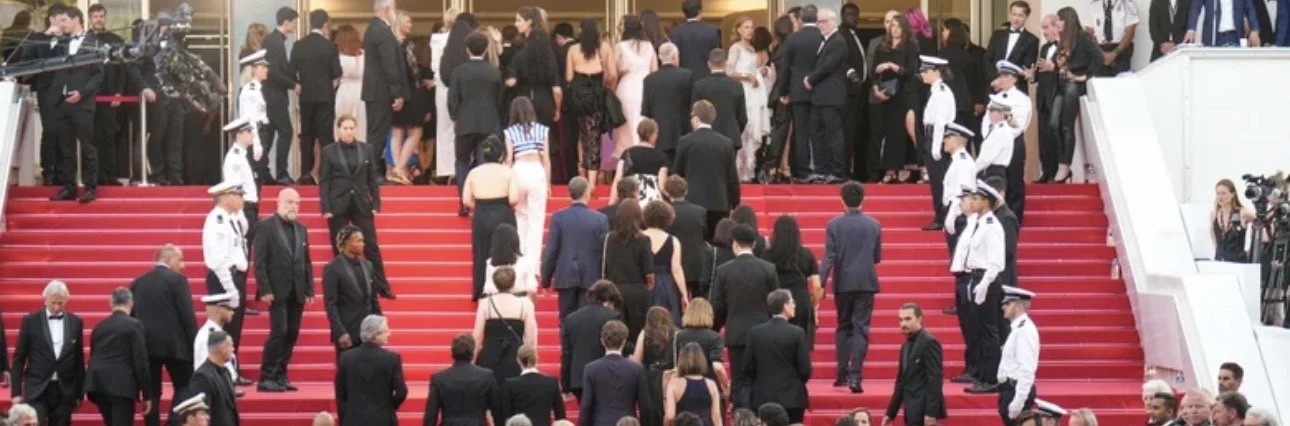
I return to the Cannes Film Festival year after year. It is the most physically punishing of all the major festivals, a psychologically consuming immersion in cinema — one where critics routinely watch three to five films a day while running on little sleep and deadlines. All worth it, of course. Seeing a truly great film justifies the exhaustion and sensory overload of the festival.
For 11 days, Cannes replaces ordinary life with a total focus on cinema. From morning until late at night, it is a place where you are constantly processing what you’ve seen, even while hurrying to the next screening. The days are structured almost entirely around film schedules, with little room for pause. This pace creates a kind of cinematic saturation, where each new film competes with the memory of the last.
Ultimately, film criticism at Cannes is not merely opinion, but a process of thought that requires time and distance — something Cannes often disrupts with its speed, ratings, and overload, especially now in the social media age. Sure, ranking films or assigning quick judgments can be fun, but the real truth lies in writing and reasoning carefully amid fatigue, distraction, and sensory overload. One has to truly see and process a film, rather than merely sit through it, before attempting to judge it. Good luck doing that here.
That’s why it’s a fool’s game to fire off a reaction the moment the credits roll, or to get pulled into one of the critics’ grids that will be circulating around town over the next ten days. Full admission: I’m participating in one again this year, but I’ll be holding off on rating each film for as long as possible — delaying judgment until there’s simply no other option but to submit one.
At the same time, Cannes is exhilarating because of its concentration of global cinema and the possibility of discovery. This year, in the official selection, there are new films by well-known auteurs such as Andrey Zvyagintsev, Pawel Pawlikowski, Cristian Mungiu, Ryusuke Hamaguchi, Pedro Almodóvar, Asghar Farhadi, and James Gray. Well over half the competition has titles clocking in at over two hours, with Hamaguchi’s film (“All of a Sudden”) the longest at 3 hours and 16 minutes.
Then you have the sidebars happening around town. For example, this year Directors’ Fortnight — known by non-Americans as Quinzaine des Réalisateurs — has a starrier lineup than usual, which, let’s be honest, were almost all rejected by Cannes’ Thierry Frémaux. The one question I’ll keep hearing in the hallways of the Marriott, where Quinzaine films screen, is whether the latest works from Kantemir Balagov, Bruno Dumont, Radu Jude, and others deserved a better fate.
I tend to skip the opening night film, with a habit of only arriving the day after. In the last ten years, the only truly worthy opener — worth arriving early for — was Leos Carax’s “Annette” in 2021. This year, Pierre Salvadori’s “La Vénus électrique” will take the slot, a roaring ’20s-set comedy that sounds trifling, though amusing enough.
As for the next 10 days: don’t pay attention to the standing ovations. Trades will have their stopwatches ready to tell us Salvadori’s film earned 10 minutes of nonstop applause, only for us to later learn the reviews were actually mediocre. Just remember, Kevin Costner’s “Horizon: Chapter One” had a 12-minute standing ovation.
As for the Palme d’Or favorite, Neil Young — the de facto bookie of the fest — has Rodrigo Sorogoyen’s “The Beloved” (7/2 odds) in pole position, followed closely by Andrey Zvyagintsev’s “Minotaur” (9/2). Odds are, and given history with such things, these are way off, and the Palme will go to something unexpected.
That unexpected film might be Emmanuel Marre’s “A Man of His Time,” which has had a handful of pre-fest screenings in Paris and is easily the buzziest film coming into the festival, at least internally speaking. I keep hearing rave after rave, albeit from French critics, which makes me wonder if it will translate as well to the English-language press.
Anyway, by the time you get to the end of Cannes, everything starts to blur a little. You leave with half-formed opinions, a few convictions, and a shortlist of things — a handful, if you’re lucky — that you might still be thinking about weeks later. That’s the part that keeps me coming back. Not the rankings, not the chatter, not even the noise around “winners,” but those rare moments when a film cuts through all of it — the fatigue, the schedule, the noise — and still feels like it’s there with you months afterwards.

Mukdeeprom is well known on the arthouse circuit for his work with Apichatpong Weerasethakul (“Memoria”), and he also shot three Guadagnino movies.