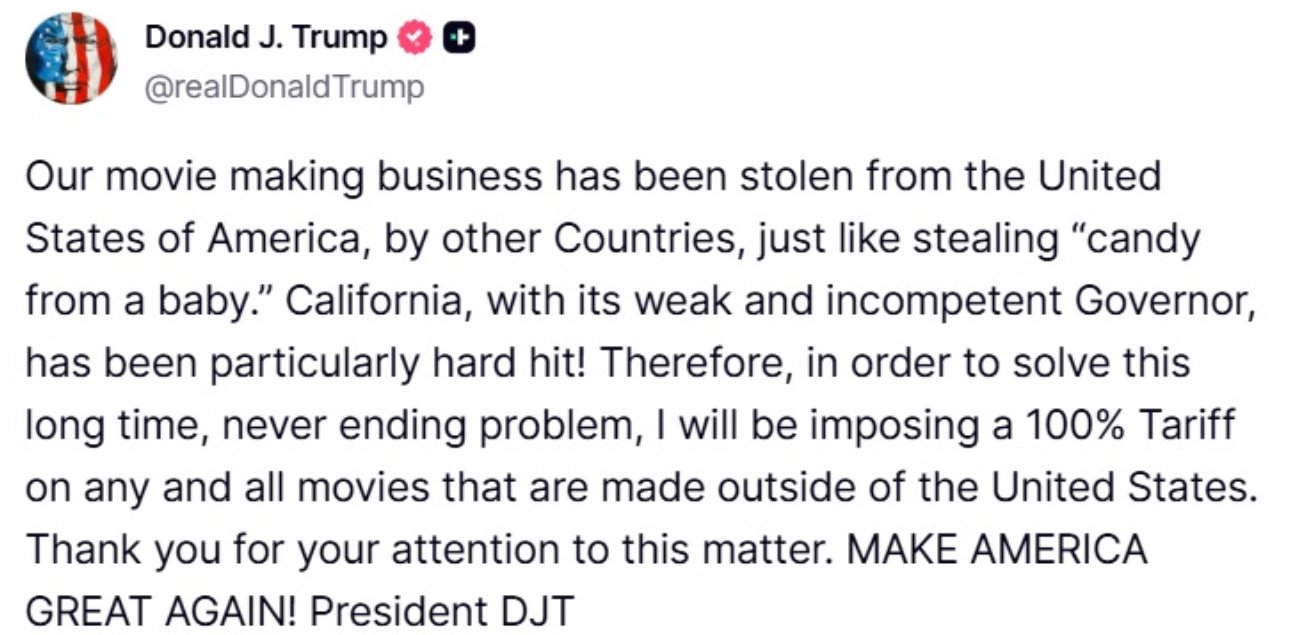
Donald Trump’s plan to get the industry talking about tariffs appears to be working—here’s this morning’s tweet:
Mass Hollywood freakout 2.0 is upon us.
Correct me if I’m wrong, but whenever the President orders a tariff, it must first go through the U.S. Trade Representative and then the Commerce Department. That’s the official process that would be required to impose 100% tariffs on movies produced overseas.
Has Trump even started that process? Instead of buying into the media’s morning frenzy, I see this as another attempt to grab headlines—especially since it’s been months since anyone talked seriously about his potential movie tariffs.
Trump has labeled productions that shoot outside the U.S. as “stolen” goods, just like “stealing candy from a baby” and previously framed them as a “national security threat.” He goes on to bash California governor Gavin Newsom for the lack of productions in that state.
I’m also curious about the status of Trump’s special envoy to Hollywood, Jon Voight, who was tasked with devising a plan to support the entertainment industry. Months ago, Voight met with guild officials and studio executives, hinting at a possible federal tax incentive. Has that plan been shelved?
The film industry has long advocated for stronger federal tax incentives to boost domestic production, rather than relying solely on state-level programs. California, in particular, has been hit hard by so-called “runaway productions.”
There’s concern that Trump could attempt to restrict international filming. Major productions often go to countries like the UK, Canada, and Australia because of their attractive incentive programs. Major studios find it too expensive to shoot in the U.S. especially when they can get huge tax breaks in foreign countries.
So yes, the details of Trump’s 100% tariff plan remain unclear. From what we can tell, it seems aimed at studios that choose to shoot outside the U.S. Logistically, though, this would be extremely difficult to enforce. How could it even work in practice?
In the end, and if Trump does indeed go forth with the tariffs, there are likely only two outcomes: studios comply, or they unite and take legal action—which seems more likely.

Following “Air,” this is Affleck’s latest stint behind the camera. He has cast himself in the lead role, alongside Kerry Washington, Steven Yeun, and Gillian Anderson (“The X-Files”).