

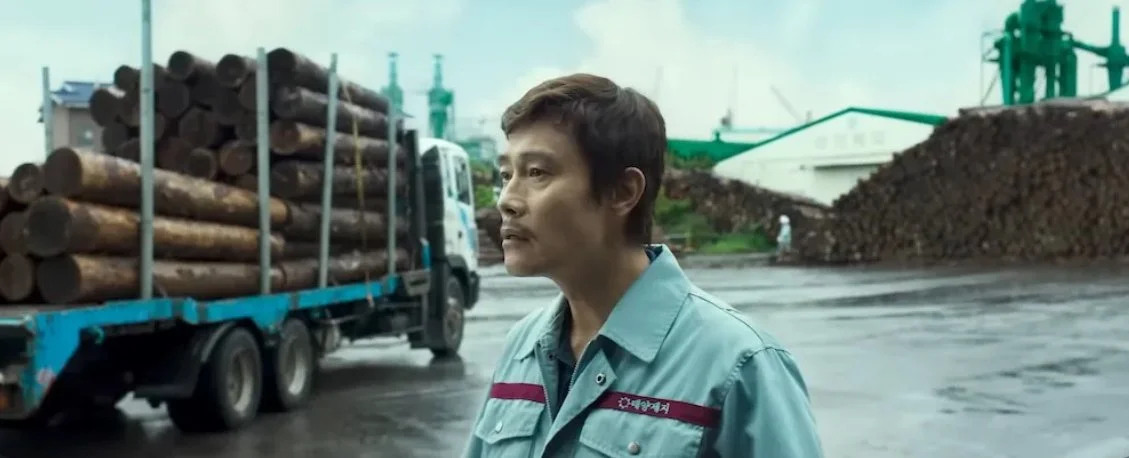
Any Park Chan-wook fans?
“No Other Choice” is certainly a Park Chan-wook film—the same tone, the same moving rhythms, the stylistic set pieces, the brilliant editing and the sudden plunges into grandiose direction. It’s all there.
The story is adapted from Donald E. Westlake’s 1997 satirical thriller “The Ax”—previously brought to the screen in 2005 by Costa-Gavras, to whom Park dedicates this work. Though perhaps not Park’s greatest achievement (that remains “Oldboy,” with “The Handmaiden” a close second), it will be hard for most of his aficionados to resist the pleasures of this film.
The film follows Man-su (Lee Byung-hun), a paper factory manager who has been fired from his job of 25 years. Shattered by the blow but unable to articulate the depth of his loss, he becomes consumed with the need to restore his dignity in the eyes of his family—by finding another paper industry job before his severance money disappears and he loses his house.
When this proves impossible, he devises a murderous plan: eliminate his competition to secure the only other paper mill job available in town. He insists he has “no choice” but to kill.
What’s most interesting about this film is how Park undercuts expectations: Man-su falters in his plan early, and the story veers into other territories. Subplots pile up. His wife takes a job as a dental hygienist for a man whom Man-su suspects of pursuing her; his stepson, accused of shoplifting, catches sight of his father’s suspicious behavior.
There are, of course, kills. Man-su remains a man on a mission. He lies to his wife that he’s going to “job interviews.” Two notable set pieces, in which he attempts to eliminate his competition, are particular highlights of darkly absurdist action. Shot with perverse precision—with spurting jugulars and compositions that are exquisite in their cruelty—they showcase Park at his most technically dazzling.
The screenplay—credited not just to Park but also to Don McKellar, Lee Kyoung-mi, and Lee Ja-hye—is the film’s biggest snag. Park can make anything look elegant, his direction here again proves he’s one of the best in the world, but the storytelling trips over itself. He’s juggling too many balls, and Park keeps tossing in more. The movie wants to be about everything at once, and Park, usually such a ruthless organizer of chaos, lets the mess show.
The film insists on its own logic, as absurd as it sounds. It is at once a satire, a thriller, a family melodrama, and a farce. The screenplay is a juggling act: too many characters circling in the air, not enough time to land them. This isn’t ‘Kill Bill,’ where the list is crossed out one by one; it’s messier, with Man-su’s targets scattered amidst his own family chaos.
Park has been dreaming of adapting Westlake’s novel for decades, calling it his “lifetime project.” Maybe he’s waited too long—his career has set a standard even he can’t always match. “No Other Choice” may not define his career, but its best scenes are as dazzling as anything he’s done.

Marvel's "Ghost Rider" just hired one of the best cinematographers working today. Linus Sandgren will serve as DP on Shawn Levy's MCU flick, and, most notably, the project will be shot on film.