

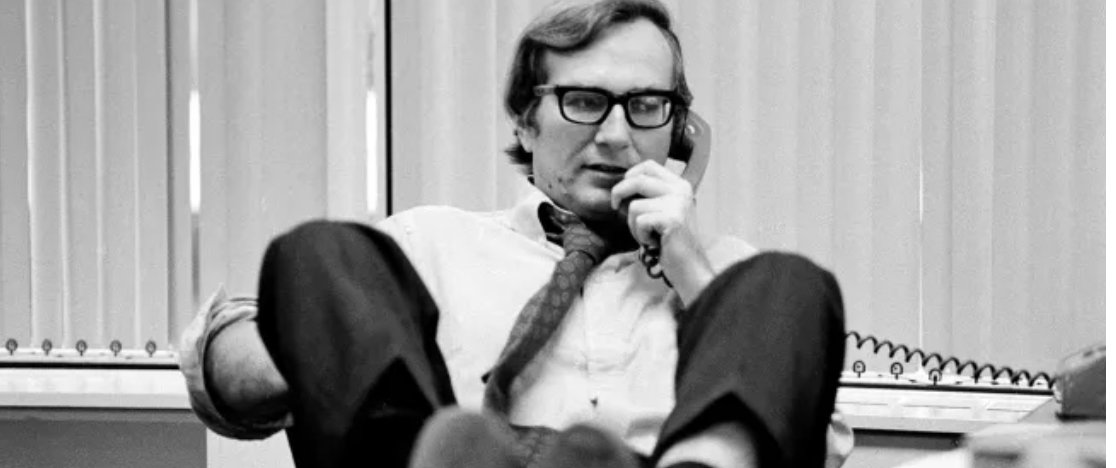
Laura Poitras’ latest documentary, “Cover-Up,” the best film I’ve seen at Venice, so far, is a direct encounter with Seymour Hersh, and at 88 he still comes off like a man allergic to bullshit.
For nearly six decades, Hersh has been reporting truth bombs the mainstream press would rather sweep under the carpet—My Lai, Abu Ghraib, Watergate, CIA spying. It’s an astonishing résumé, but what Poitras and co-director Mark Obenhaus capture isn’t just the résumé. Hersh himself, by turns charming, irritable, cagey, is a magnetic presence on screen, exuding the battered, and highly pessimistic, charisma of someone who’s had to fight too hard for too long and yet, still can’t stop.
The Hersh sit-down takes place at his home office, in conversation, papers and boxes scattered all over his office, almost deliberately. There’s nothing glossy here; Poitras doesn’t need gloss. She has Hersh’s voice, who speaks like a man who knows where the bodies are buried, and most likely realized, decades ago, that intel agencies had bugged his communications.
The documentary moves through the greatest hits of Hersh’s career, using stunning archival footage, and the sheer scope of his reporting makes the film feel like an alternative history of America, told from the view point of someone who never trusted the story being told by the mainstream press.
The last stretch, when it brushes against more recent Hersh stories, wavers a bit, as if Poitras wasn’t sure how much weight to give Hersh’s late-career work. It’s quite clear the establishment press has closed its doors on him, and Hersh now publishes on Substack, still trying to find the next big bombshell — his most recent grenade implicated the CIA in the bombing of the Nord Stream Pipeline.
If the documentary has a centerpiece, it’s the My Lai Massacre—the story that made Hersh and still disturbs to this day. Hundreds of Vietnam civilians gunned down, for no reason. Poitras approaches it with urgency and fury. Even though the likes of The Washington Post and The New York Times were well aware of what happened in My Lai, they initially refused to report on it, until Hersh finally did.
Watching “Cover-Up” feels like an encounter with history, journalism, and a man who won’t stop fighting the powerful, even as the powers-that-be continuously aim to shut him down. Poitras has always been fascinated by anti-establishment fighters, from Edward Snowden to Julian Assange, and now Hersh had been added to her canon of films.

Edward Berger seems to have settled on what comes next. His Lance Armstrong biopic, starring Austin Butler, is now holding casting calls, with production eyed for January.