

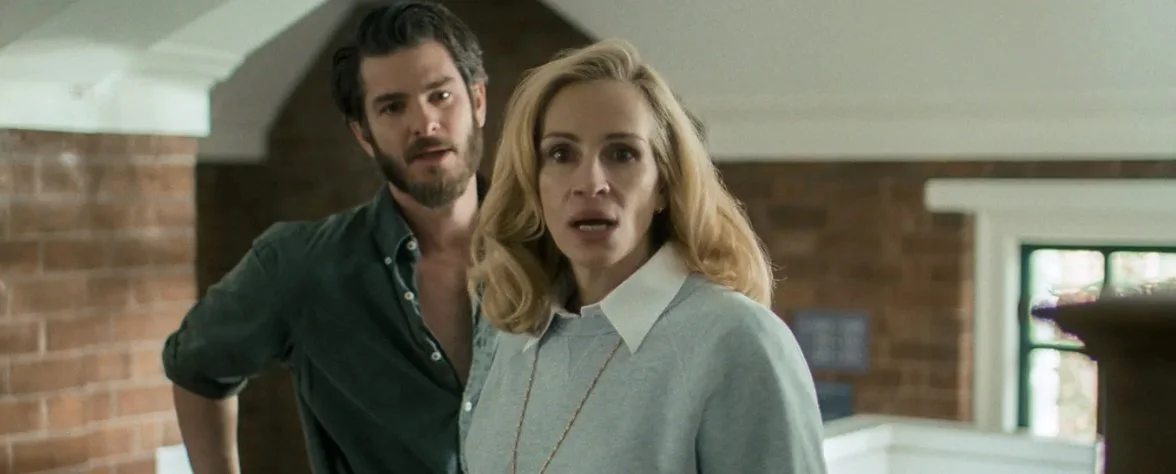
Unlike Todd Field’s “TÁR,” which confronted cancel culture and abuse of power with symphonic subtlety, Luca Guadagnino’s “After the Hunt” prefers bombast. It sets its culture clashes in countless scenes. TÁR had winks, and casual cruelties, but restraint. This one doesn’t.
The result is a film that’s getting outright panned by critics here on the Lido. As it stands, it’s Guadagnino’s worst-reviewed film — 43% on Rotten Tomatoes, with 14 reviews counted, and 56 on Metacritic . I expected a divisive response, but not like this.
Nearly every character in “After the Hunt” is connected to the Yale orbit; professors and students alike. They’re all privileged. But are the accusations they toss off at each other genuinely truthful?
Guadagnino and screenwriter Nora Garrett seem to be having a lot of fun here tackling culture war clashing. Almost to the point of making the film’s themes more important than the characters. Alma mockingly tells Maggie’s non-binary partner, “They, knock it off!” There’s a scathing joke aimed squarely at “privileged” campus protesters. Trigger warnings are mocked at. As the line uttered in the trailer says, “not everything is supposed to make you comfortable.” And Guadagnino makes sure of that.
The drama begins when doctoral student Maggie Resnick (Ayo Edebiri) accuses philosophy professor Hank Gibson (Andrew Garfield) of sexual assault after a party hosted by Alma Imhoff (Julia Roberts), a fellow faculty member. Alma is stuck in the middle of this he said/she said.
Hank’s side of the story is that Maggie’s only accusing him of sexual assault because he confronted her about plagiarizing her dissertation. Maggie, of course, denied this story. It doesn’t help that Hank has a history of flirting with many women in the faculty, including Alma, whom he might have had an affair with.
For Alma, the accusations revive fragments of her own history, cryptically revealed in flashes as the film progresses. Both Maggie and Hank push her to take their side, but she hesitates, unable to pick an allegiance.
Because these are philosophy scholars in this film, too many of them, most of the back and forth arguing comes with an intellectual bent, to the point where the dialogue can sometimes feel overwritten and flat.
As a film, “After the Hunt” initially absorbs you, and is impeccably performed, though it’s not quite as great, or deep, as it purports itself to be. If the film falters, it’s in momentum; its dialogue-heavy approach eventually runs out of steam. Structurally, it plays more like a mystery: a puzzle of motives and credibility. Is Maggie’s accusation payback for her academic disgrace? A jealous reaction to Alma and Hank’s bond? The movie keeps toying with us, never fully giving us the answers.
Where the film truly clicks is in its central lead performance. Roberts hasn’t had material this layered in years, and she runs with it. As Alma, she’s magnetic — the way she masks panic with unsettling silences is remarkable. Dialogue becomes almost unnecessary; every flicker of expression does the heavy lifting. It’s sharp, precise, and easily some of her best work in a long time.
Some viewers will cringe, branding it a self-serving provocation; others will embrace it precisely for its fearless tackling of a complicated subject matter. Guadagnino doesn’t hand out easy answers — he lets the film mirror back whatever the viewer brings to it. In the end, “After the Hunt” frustrates, even alienates, but it refuses to comfort, and that defiance is worthy enough.

Marvel's "Ghost Rider" just hired one of the best cinematographers working today. Linus Sandgren will serve as DP on Shawn Levy's MCU flick, and, most notably, the project will be shot on film.