




I haven’t properly tackled “Train Dreams” yet, but let me start by saying this: it’s well worth seeing. Try to watch it on the big screen, if you can find it.
Clint Bentley’s new film arrives in theaters ahead of its Nov. 24 Netflix debut, and it’s a minor miracle that something this uncommercial, this quietly transcendent, is even getting a theatrical rollout. Poetic in image and sound, “Train Dreams” is exactly the kind of cinema we keep saying doesn’t get made anymore — lyrical, unsentimental, but profoundly moving.
Watching it, I kept thinking about Terrence Malick. His “The Tree of Life” has quietly become the most influential American film of the last twenty years. Its fingerprints are everywhere — in the hushed voiceovers, the whispery grace notes, the searching camera that moves elliptically. And yet, Malick’s own post-“Tree” work (“To the Wonder,” “Knight of Cups,” “Song to Song,” “A Hidden Life”) has been neglected. Everyone borrowed his language, and the man himself got tuned out. Malick turned into a copy of himself, which had people taking for granted the impact of “The Tree of Life” — its dumbfounding 79th-place showing on The New York Times’ best films of the 21st century list was absurd.
That said, “Train Dreams” feels like the best Malick film we’ve had in over a decade — and it’s not even directed by him.
Bentley co-wrote the script with Greg Kwedar, his partner on last year’s “Sing Sing,” another small-scale film that most audiences shrugged off. But “Train Dreams” is surprising in how much more assured, mature, and unsentimental it turns out to be. Kwedar doesn’t chase trends here; he chases transcendence. He believes in film as a spiritual experience, and that belief is embedded in every frame of “Train Dreams.”
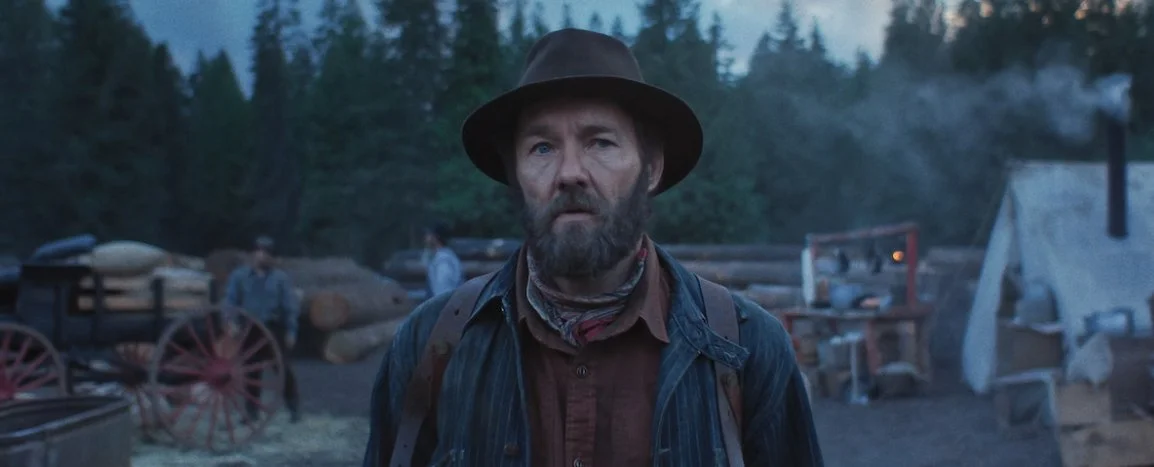
Adapted from Denis Johnson’s 2011 novella, the story follows Robert Grainier (Joel Edgerton), a logger and railroad worker in the early 1900s Pacific Northwest. Grainier is a man of few words. Edgerton, one of the most underrated actors working today, gives a performance so inward and quiet that it almost merges with the landscape. He absorbs pain without admitting it. He works, he suffers, he carries on.
The early stretches have that unmistakable Malickian pulse — the camera alive with light and motion, the world rendered as something holy. But there’s grit too. The railroad disasters pile up. Fire and flood consume everything. Felicity Jones, as his wife Gladys, gives the film its warmth and humanity. Their scenes together are devastating precisely because you know they can’t last. Tragedy, in this world, is inevitable.
Shot by cinematographer Adolpho Veloso and scored by Bryce Dessner (of The National), “Train Dreams” is a sensory experience of rare beauty. Veloso’s camera finds grace in every image; Dessner’s score hums with quiet wonder. The film is barely driven by dialogue — it speaks through tone and texture, and it works.
If there’s a flaw, it’s that the film occasionally tilts toward sanctimony, positioning Grainier as a modern-day biblical figure. However, Edgerton keeps it grounded. His face, filled with fatigue and resilience, rescues the film from turning into parable.
By the time the story reaches its climax, “Train Dreams” has quietly transformed from the portrait of one man’s life into something bigger — a meditation on existence. The cumulative effect sneaks up on you. You don’t feel the film building to catharsis, and then suddenly, by the end, it hits you — hard. I didn’t expect it.

Marvel's "Ghost Rider" just hired one of the best cinematographers working today. Linus Sandgren will serve as DP on Shawn Levy's MCU flick, and, most notably, the project will be shot on film.