Natalie Portman's strange accent in "Jackie" was spot on, according to linguists


Well, that settles it.

"Merely reading that line doesn’t do justice to the voice Portman adopted for the role. If you’re not aware of how Jackie Kennedy spoke, listening to Portman’s Jackie is like the tingle of soda in your throat. It often feels familiar, but in certain spots it pops and jumps. The way she lops off the end of “bitter,” the funny hop in “artifact,” the way she rolls through “remembered” — it’s like she’s invented her own unique way of speaking English"


"But Portman’s delivery is accurate in the way it captures the former first lady’s affect. And that might be the most impressive element of her Oscar-nominated performance." 
"Merely reading that line doesn’t do justice to the voice Portman adopted for the role. If you’re not aware of how Jackie Kennedy spoke, listening to Portman’s Jackie is like the tingle of soda in your throat. It often feels familiar, but in certain spots it pops and jumps. The way she lops off the end of “bitter,” the funny hop in “artifact,” the way she rolls through “remembered” — it’s like she’s invented her own unique way of speaking English

"When Portman was asked how she learned Kennedy’s accent, the actress told the Los Angeles Times that she looked up every interview with Kennedy that she could find on YouTube and watched the first lady’s 1962 White House Tour over and over."
Source: Vox
Earlier last year I wrote this about Pablo Larrain's incredible film:
"Natalie Portman’s performance as Jaqueline Bouvier Kennedy is masterful. If you thought there was nothing else that could be said about that fateful day when JFK was shot and killed in Dallas then you were wrong. Director Pablo Larraín (Neruda) dissects the incident through Jackie’s own eyes. The film takes place in the hours following JFK’s death as the First Lady tries to comprehend the magnitude of the event. Through the use of finely crafted flashbacks, Larrain strips the cinematic conventions that come with bio-pics and gets to the core of Jackie’s psyche at the time. Portman’s performance is a high-wire act of intrigue. She never fully reveals the exact reasons for some of Jackie’s behavior and  though we can never truly know if there was manipulation involved with her grief, this is hinted at. In a way Larrain and Portman are playing with the audience with an immaculate mix of enigma, grief and cynicism. It’s an artfully crafted thing, this “Jackie.”

A foreshadowing of MOONLIGHT


On 2.23.16 I wrote the following:

"The ubiquitous #Oscarssowhite controversy might bring more to the cinematic table than just Chris Rock taking a few jabs at the Academy come next Sunday's Oscar telecast. No, I am also referring to the cinematic spectrum switching gears and celebrating films for political reasons more than cinematic. I don't think people realize just how big this movement really is. It will stretch out and change the way many people perceive films, for the wrong reasons of course. We saw it just last month at Sundance when Nate Parker's "The Birth of a Nation," a mediocre film that was unjustly clebrated by critics, bloggers and audiences alike, stormed out of the gate and became a surefire Oscar contender for 2017. Why am I saying it is a surefire contender if I just said it is mediocre? Because it is a movie that feels needed more for political gain than for actual cinematic qualities. It is a movie that can turn the most knowledgable of film critics blind to its flaws just for the sake of celebrating a film that perfectly fits the current political agenda. What the rave reviews for "The Birth of a Nation" have taught us is that there's a storm coming and it won't let up. The Academy has to atone for its "sins" and critics feel just as guilty for the blame. We are headed towards a direction I have long feared for film criticism, that of blurring the lines between your political and societal beliefs than, you know, focusing on the actual merits of a movie. I would be shocked if 2017 did not produce a few more overpraised films like Parker's and I wouldn't be surprised either if one or all of them underservedly got critics praising them like the second coming for all the wrong reasons."

The Epistemology of Moonlight


By Sarah Foulkes

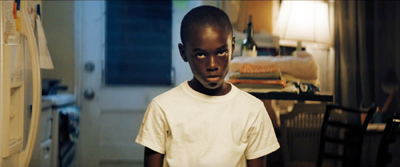
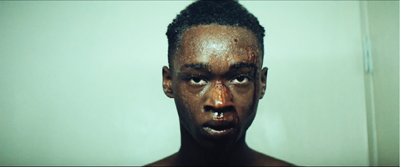
If mainstream cinema is upheld to the task of democratically representing its viewers than it often fails. So when a film comes out that represents marginalized figures it’s passed under the kind of scrutiny that a lot of other films evade. As if clinging to a lifeboat of fair representation, critics and audiences look for holes in the raft - sometimes discarding it entirely, or patching it up with forgiving praise. But Barry Jenkins’ film Moonlight has proven to be an indestructible raft (but not by any means “tear”-proof). As we are prone to do when talking about films depicting minorities, we compare it to the ones that came before it. Indeed, two of the most notable queer films from this century are Brokeback Mountain and Carol. They both take place in pre-Stonewall America. But  Moonlight is set in the present and the twenty odd years leading up to it. Though Moonlight couldn’t be more different from those two aforementioned films, all three share a significant similitude: none of these films stage a coming out scene. In the films set before the 1969 Stonewall riots, coming out is an unwise, if not unthinkable, decision. With characters forced out of the closet and their secret  used against them. Indeed, a lot of queer narratives play out like detective stories. Who will find out their secret and what will they do with that knowledge?  

Moonlight - set in Miami - exists in a world where coming out could ostensibly happen. Chiron is a black queer (or queer black?) boy - a visible and invisible minority. It is perfectly feasible that especially in light of President Obama’s recent legalization of marriage, Jenkins could’ve presented a scene in the final chapter in which Chiron tells his mother that he is gay.  Yet, his decision to not include a cathartic coming out scene reveals the intersectional disjunct within gay rights in contemporary America. Chiron, and many others like him, don’t have the kind of privilege that would ensure a safe coming out. The thought of coming out isn't even addressed. It's not about coming out and revealing his authentic self. That’s not his priority. It's about surviving.  

The closest the film comes to any form of coming out  is in the first chapter when Little asks Juan if he's “a faggot.” This heart-string-pulling scene unveils the disempowering feeling of being, as Eve Sedgwick refers to it, in a glass closet. What do they know about me that I don't? Chiron’s mother, the kids that bully him at school, they have read his queerness before Chiron has had a chance to understand it for himself. Whoever possesses the knowledge about his sexuality has the power.

If the scene on the beach with Kevin is a kind of unspoken coming out scene in so far as he attains his sexual desire, then Chiron does not experience a feeling of liberation. As soon as he walks out of one closet, dozens of others erect themselves in front of him. Chiron must constantly re-negotiate his sexuality with those around him. Indeed, with his very first intimate encounter, he is beaten up and upon retaliation is sent to jail. He learns too early the life-threatening dangers of  queer intimacy. In the final chapter, as Barbara Lewis coos ”Hello Stranger” on the jukebox, Chiron must even re-negotiate and re-introduce his queerness with Kevin, the only person he’s ever been truly intimate with. What happened on the sandy beach left a trace that can easily be brushed away by Kevin,  but not Chiron.

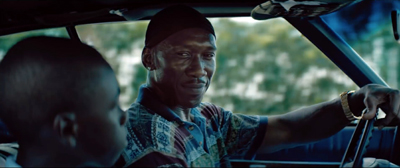
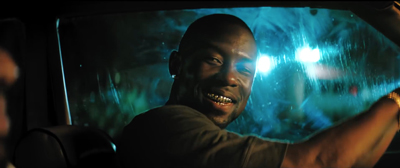
A liminal space between the ocean and the urban, the beach hosts a makeshift baptism with Juan, his sexual intimacy with Kevin, and his dream of Kevin having sex with a girl. The baptism also doubles as a lesson in survival and love. Floating means not drowning, but  also  letting go. The two scenes with Kevin on the beach add to the complexity of Chiron’s - and anyone’s for that matter - sexuality. We can see him working out his sexuality unconsciously.

In the first two chapters, Chiron does not perform his sexuality. In fact, it is his anti-performance, his shyness, that alerts others to his gayness. If this shyness is the outward manifestation of  shame, then we never see his shame recuperated as pride. Jenkins is offering a stinging reminder that amidst the gay pride parades and International Coming Out Days, shame has been left behind with underprivileged bodies of colour.


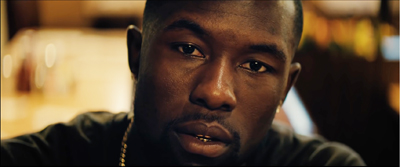
Thus, in the final chapter, it comes as no surprise that in an attempt to mask his queerness, he overtly performs his masculinity and his blackness. Replacing the now-deceased Juan, he is a drug dealer. This hardly surprising development has an interesting relationship to forbidden queerness, for what does drug-dealing deal in, if not the unspoken and all things work masquerading as loitering? And the do-rag that he wears to bed and gold fronts are his uniform. The scintillating fronts  act as a barrier between Chiron and Kevin, between his performed hetero-masculinity and his gay desire. They are quite literally a front.

Another singular decision that Moonlight makes is in its cinematography. Jenkins avoids the trappings of voyeurism and ‘trauma porn’ by directly implicating the spectator through direct address and point of view shots. The viewer is directly confronted with the crazed screams of Chiron’s mother. Moreover, Moonlight is an exquisitely beautiful film with important social and political themes more applicable than ever. Whilst Tangerine - a film about black trans-sexworkers in Los Angeles - employeda very grimy and gritty aesthetic to illustrate the atmosphere and characters, Moonlight suggests that being black and gay in Miami doesn’t have to be defined by grittiness. Rather, the cinematography exquisitely renders the characters’ inner lives. Black, queer bodies that deserve to be captured in beautiful light, and not just moonlight.

SPLIT threepeats at week-end box-office


M Night Shyamalan's comeback has been official since opening weekend of his latest mindbender "Split." The fact that it has held the top spot at the box-office for the past 3 weekends is really astonishing. It has practically made $100 million in those three weeks and will likely increase that tally to 150+ million in the coming weeks. An all out smash for Blumhouse and Universal. "Split" has a budget of $9 million. 

I though it was a silly, but well-orchestrated film that benefited from James McAvoy's incredible split personallity performance. An insider for The Wrap had this to say about the performance: “He’s captivating and magnetic and you can’t take your eyes off him. I absolutely feel without equivocation it’s an Oscar-worthy performance.” Of course, like all January releases, this performance will likely be forgotten as the calendar year goes along. The script is clunky, but is raised by the artistry of Shyamalan's camera and, again, the performances. 

"The Twist." I have to mention the reveal at the end, you should stop reading this instant if you haven't seen the film ...

Bruce Willis' superhero from "Unbreakable" shows up to reveal what will likely be a melding of both films for a future sequel. I have been an avid admirer of Shyamalan's "Unbreakable," which I believe is his best film. There have always been rumors of a sequel happening and I always looked forward to that, but I don't know if I want it to go in the direction the film seems to be hinting it is going. One reason why "Unbreakable" was so good was that it deconstructed the superhero genre to its core and didn't reveal itself as being a superhero movie until its very last frame. This next movie would likely go full on creature vs superhero .... unless Shyamalan will,again. surprise us and give us something more subtle. With all that being said, I do love the fact that people that have never seen "Unbreakable" are now going to discover it. All thanks to "Split."

Damien Chazelle just won DGA, on his way to becoming youngest winner of Best Director Oscar


Damien Chazelle just won the DGA directing award. For all those wishing for Barry Jenkins to pull off an upset, it just became a little harder based on this latest Chazelle victory. He's on his way to becoming the youngest director to win the Best Director Oscar. Was William Friedkin not far off in his claim that Chazelle is, in fact, the future of cinema? Time will tell, but "Whiplash," and "La La Land," despite the flaws, make a good case for a prodigous talent.

And no, 25 year-old Orson Welles didn't win for "Citizen Kane" back in 1941, instead the award went to John Ford and his underwhelming "How Green Was My Valley." Good God. What made his "Citizen Kane" debut even more impressive was the fact that it was Welles' first feature. Then again, Welles loved Ford so much that he watched "Stagecoach" over and over again to study and prepare for the shoot of "Citizen Kane."

The stats are as follows:

Damien Chazelle "La La Land" (31 Years old)
Norman Taurog "Skippy" (32 Years old)
Lewis Milestone "Two Arabian Knights" (33 Years old)
Sam Mendes "American Beauty" (34 Years old)
Frank Borzage  "A Farewell to Arms" (35 Years old)
Lewis Milestone "All Quiet on the Western Front" (35 Years old) 
Tony Richardson "Tom Jones" (35 Years old)
Francis Ford Coppola "The Godfather" (36 Years old)

Where is Jonathan Demme?

Jeffrey Wells over at Hollywood Elsewhere has asked an interesting question: what the hell happened to Jonathan Demme.

"Demme’s key period lasted about 13 years — Melvin and Howard (’80), Swing Shift (’84), Something Wild (’86), Swimming to Cambodia (’87), Married to the Mob (’88), The Silence of the Lambs (’91 — his biggest success) and finally Philadelphia (’93)"
My response: Yeah, more or less until Philadelphia, although I find the latter hasn't aged well over the years. Also you have to add Stop Making Sense, one of the greatest shot concerts of all-time. As far as latter-day Demme goes, along with the aforementioned Rachel Getting Married I'd say The Manchurian Candidate remake was pretty solid and highly underrated. There is nothing else worthy of mention. He definitely failed with his last film, Ricki and the Flash, and his next release seems to be a TV episode he directed for the show "Shots Fired."
Something Wild will always be my favorite Demme. There has never been anything like it, before or after its release. I'd probably rank it in my top 20 of the 1980s.

I still hold out hope with Demme, whose been concentrating mostly on non-fiction documentaries the last 15-20 years.

IMDB getting rid of its message boards on February 20th


Something tells me that it doesn't just have to do with it not "providing a positive useful experience." Anyway, the backlash is here and people are not happy. No kidding, taking away the most popular way to chat about movies online. Nothing comes close, not even reddit. It would happen that after I watch a movie, I would sometimes head over to those boards to read other's interpretation of it. There is good stuff to be found, yes some trolling, but I always thought there was much more good than bad, oh well.

Do we actually need a second season of Stranger Things?


I dug Netflix's Stranger Things for what it was last year: an homage to '80s Spielberg-ian, youthful, adventure yarns. It worked, it gelled, the plot was outrageous and silly, but that's what you'd expect from a show whose greatest influence was 1985's extremely likable, but silly "The Goonies." After the first season ended, I was like "Ok, good stuff, don't really care what happens next." Well lo and behold we have a second season on our hands. A Super Bowl ad will appear during this coming Sunday's telecast. It is highly anticipated by the lore of fans it garnered in its first season, nostalgiasts, people that clearly did not care about the message that "Midnight in Paris" was conveying, that the past always gets romanticized, but that we should be living in the present. People will eventually look through this shows plot holes and go to the next big thing. It's bound to happen.

Petition circulating for Zack Snyder to direct THE BATMAN

Change.org can really make the world a better place, but I don't think this is any kind of exampe to go by.  Jennifer Huneycutt has started a petition for Zack Snyder to take over Ben Affleck's directing duties and helm "The Batman." She has, so far, 3,200 signees which is close to the goal of 5000. Snyder has had his day as far as I'm concerned. He made the DC films succesful money-making blockbusters, but the decidedly mixed reactions to the films have concerned DC and WB enough for them to not include Snyder in any upcoming films post-Justice League.
Her petition goes something like this:
"Snyder has a stellar record with comic book and graphic novel properties. Starting with 2006’s 300, and followed by Watchmen in 2009, he has shown his skill with, and commitment to, being incredibly faithful to iconic source material. Many scenes in both films are panel-for-panel recreations of the graphic novel pages. He doesn’t try to stick his two cents’ worth in every movie, putting his own spin on things (they like to call it “artistic license” in the biz) just because he can. He knows how much these stories mean to their fans, and that goes a long way in my book. He has my respect for that."
"Another reason is continuity. Aside from the abysmal Suicide Squad, Snyder is pretty much in the driver’s seat for the whole DCEU. He directed Man of Steel, and Batman v Superman: Dawn of Justice; and is also slated for Justice League: Parts 1 & 2. So it only makes sense to let him remain in control, for the sake of the integrity of the film universe itself. Having a bunch of different directors work on a single series is just asking for trouble, both in continuity and in the dreaded “creative differences.” (Yes, it has mostly worked for Marvel, but the MCU is lightning in a bottle. Let’s not pretend that makes it a foolproof formula.) He’s already familiar with all the principal characters and their respective portrayers, so he isn’t going to go screwing with established canon or pissing off his stars."
Source: JoBlo

The next three months of movies

I've concluded these are the films that will likely get some kind of traction on my part, but many are still a question mark. I'm watching four of them in the next week so answers are forthcoming.

  • The LEGO Batman Movie 
  • John Wick: Chapter 2 
  • Get Out 
  • Logan
  • Kong: Skull Island
  • Beauty and the Beast
  • The Circle
  • Ghost in the Shell
  • Song to Song
  • The Fate of the Furious

Seen 

  • Personal Shopper
  • A Cure For Wellness
  • Raw
  • Before I Fall
  • Graduation
  • Norman: The Moderate Rise and Tragc Fall of a New York Fixer
  • The Lost City of Z
  • Free Fire

Extended synopsis for LOGAN makes it sound like a futuristic chase-movie ala BLADE RUNNER

It's kind of exciting to have a movie to look forward to in the desolate months of January to April, but that's just what "Logan" is doing with its, what is being touted as, unique take on the superhero genre.
"In 2024 the mutant population has shrunk significantly and the X-Men have disbanded. Logan, whose power to self-heal is dwindling, has surrendered himself to alcohol and now earns a living as a chauffeur. He takes care of the ailing old Professor X whom he keeps hidden away. One day, a female stranger asks Logan to drive a girl named Laura to the Canadian border. At first he refuses, but the Professor has been waiting for a long time for her to appear. Laura possesses an extraordinary fighting prowess and is in many ways like Wolverine. She is pursued by sinister figures working for a powerful corporation; this is because her DNA contains the secret that connects her to Logan. A relentless pursuit begins…"
"In this third cinematic outing featuring the Marvel comic book character Wolverine we see the superheroes beset by everyday problems. They are ageing, ailing and struggling to survive financially. A decrepit Logan is forced to ask himself if he can or even wants to put his remaining powers to good use. It would appear that in the near-future, the times in which they were able put the world to rights with razor sharp claws and telepathic powers are now over."
Thanks go to JoBlo and The Playlist
I will be watching "Logan," at a press screening, on the 16th and it will have its world premiere at the Berlin Film Festival on the 17th. It goes wide on March 3rd.

Harold Ramis cut the reason Bill Murray's day keeps repeating in 'Groundhog Day'. His ex-girlfriend cast a curse on him with his broken watch (set at 5:59). His curse of 10,000 days was broken when Rita kisses him and can actually hear tinkling music, signifying the curse being lifted.


Good decision getting rid of that. The film is timeless because you are not necesarilly given a reason as to why this is happening. The witchcraft would have deteriorated away from the film's, ahem, spell. The full Groundhog Day reveal can be found HERE

The "Best Actor" Oscar showdown this year: Casey Affleck vs Denzel Washington. Is "Fences" Denzel's greatest performance?


Source: Gold Derby

Now that Denzel Washington has won the SAG Actor award I think it's safe to say that we have a race in our hands. I predicted it a few months ago, even before the nominations, it was inevitable. Washington's performance in "Fences" is too good to be ignored. It's up there with "Malcom X," "Glory," "Training Day," and "The Hurricane." In fact, it might be the best work he's ever done. He embodied the character like no other performer in 2016, he knew the role front to back, no thanks to his first performing it on-stage, he knew its smell, its vibe, its contours. This was total embodiment of your art. I just can't see Denzel losing the Best Actor Oscar at this point.

I wrote on 11.25.16:

Speak to any of the supposed Oscar "pundits" and you'll get the same response: "Everyone in the industry knows it's Affleck vs Washington" replied a pundit friend of mine by email recently, "It's not even like there's a third contender" he added. I would agree with that sentiment and it seems like most people do as well. Affleck's delicate, sombre, nuanced performance in "Manchester By The Sea" had me at hello ever since I saw the film at Sundance in January. To say the performance, and the film, stayed with me would be an understatement. "Manchester By The Sea" belongs on the, very, short list for Best film of 2016, right up there with "La La Land," "Paterson," "Made in America: OJ Simpson," "Moonlight" and, the ever so underrated, "Krisha."

"Fences," on the other hand, is an actor's showcase through and through. If the film's problem is that it never fully translates well from the stage to the screen that doesn't detract from the fact that the performances in the film are astounding. Viola Davis is all, but assured to win the Supporting Actress Oscar and Denzel Washington, in the director's chair as well, gives us one of the defining performances of his career as Troy, an African American father struggling to raise his family in the 1950s, but also not able to cope with own demons, still lurking, brewing, from a failed baseball career and the restrictions a black man has in 1950s America. You can tell Washington and Davis know their parts front and back, they live and breathe their characters and flesh them out just enough to let them roll on a cinematic level. 


Source: AwardsCircuit

Source: AwardsWatch

At the moment Affleck is the odds-on favorite to win, but, to be honest with you, Washington stands just as great of a chance to win. He's Hollywood royalty and well beloved throughout the industry + don't discount the little movement called #Oscarssowhite which caused much controversy last year and will likely result in this year being a record-breaking year for African-Americans getting nominated by the Academy.

FRONTRUNNERS

1) Denzel Washington, "Fences"
http://cdn5.thr.com/sites/default/files/2016/11/denzel_washington_fences_still_h_2016.jpg
2) Casey Affleck, "Manchester By the Sea"
3) Tom Hanks, "Sully"
4) Ryan Gosling "La La Land"
5) Michael Keaton, "The Founder"


MAJOR THREATS

Viggo Mortensen, "Captain Fantastic"
Joel Edgerton, "Loving"
Andrew Garfield, "Silence"
Andrew Garfield "Hacksaw Ridge"
Dev Patel, "Lion"
Miles Teller, "Bleed For This"
Warren Beatty "Rules Don't Apply"
Mark Wahlberg "Patriots Day"
Mattew McConaughey "Gold"

If O.J.: Made in America wins Best Documentary at the Academy Awards this year, it will be the longest film to ever win an Oscar.

Sundance 2017 recap and thoughts

Here is something I wrote for Awards Daily about the 39th Sundance Film Festival (HERE)
Over the past 10 days, the Sundance Film Festival proved, once gain, that American independent cinema is in good hands. Over 200 movies screened here at Park City, and the quality was, once again, something to behold.
People were still raving about last year’s lineup, one of the very best in the festival’s 39 year history, which gave us Manchester by the Sea, OJ: Made in America, Love & Friendship, Sing Street, Certain Women, Hunt For the Wilderpeople, The Fits, Swiss Army Man, Weiner, Captain Fantastic, Little Men, Indignation, Camerperson, Green Room, and even Nate Parker’s controversial The Birth of a Nation.
The more Hollywood goes into crass commercialism, the more likely a film festival like Sundance will matter. It’s as simple as that. This year there was a record number of films by women and people of color. In fact, many of those films were the highlights of this 39th edition.
Matt Ruskin’s Crown Heights won the prestigious dramatic audience award. The film, a true story of Brooklyn teenager Colin Warner, wrongfully convicted of murder in 1980s New York, was a by-the-books, but powerful indictment of the American justice system, and reminded me of a more condensed version of Norman Jewison’s The Hurricane. It’s the kind of movie that can stir you up, and get you riled for change.
Over the past 5 years, the Grand Jury Prize has gone to future Oscar nominees: Whiplash, Winter’s Bone, Precious, and Beasts of the Southern Wild. Don’t expect this year’s winner, Macon Blair’s I Don’t Feel at Home in This World Anymore, to do any damage come Oscar time, not to diminish its impact as a fantastic film. Blair has been an actor I’ve been keeping a watchful eye on the past few years, with him being Jeremy Saulnier’s muse in both Green Room and Blue Ruin. Suffice it to say that he takes quite a bit from Saulnier’s visceral style of filmmaking for his feature directing debut, I Don’t Feel at Home in This World Anymore, which loosely borrows its name from Woody Guthrie’s song of isolation, I Ain’t Got No Home. Melanie Lynskey and Elijah Wood make a formidable team in this tale set in the ever-growing “me, me, me” generation. Lynskey’s home is broken into with personl belongings stolen. Wood is the weirdo neighbor that she teams up with to find the perpetrator of the robbery, and he’s the highlight of the film — engrossing, comic, frightening, lonely and armed with nunchucks, you have to see this performance to believe it. They make a formidable, comic team, but the film’s crossings through many genres make it difficult for it to be pinpointed as a comedy. Blair is clearly influenced by David Lynch’s Blue Velvet, which depicted a dark underbelly of Americana that this film seems to wholeheartedly embrace almost religiously. It isn’t a perfect film, pacing issues, including an over-stretched finale, could have used a bit of trimming, but there are many surreal and memorable moments in Blair’s film that will stick with viewers when the film gets its Netflix premiere on February 24th.
Sundance still feels vitally important. Having premiered 9 Best Picture nominees in the past 7 years, it’s a continuous hotbed for low-budget indie filmmakers whose vision is uncompromised by greed. Here are 10 more films that will likely be heard from in the next year or so.
1) A Ghost Story (David Lowery)
David Lowery’s film is one of the most audaciously original narratives I have seen this decade. Shot with friends Rooney Mara and Casey Affleck as a personal side project while he was filming Pete’s Dragon, the film is not necessarily supposed to be scary as much as an engrossing meditation on life and death. The less you know, the better, but the film’s official synopsis is perfectly put together to tell you all you need to know: “This is the story of a ghost and the house he haunts.”
2) Call Me By Your Name (Luca Guadagnino)
The romance between a seventeen year-old Italian boy named Elio (Timothée Chalamet), and an American summer guest Oliver (Armie Hammer) staying at his parents’ cliffside mansion in southern Italy, Luca Guadagnino’s Call Me By Your Name was the film most people believed would survive through next year’s Oscar season, and for good reason. Guadagnino has made one of the year’s best movies — sensual, sexy, and touching, it’s a film that is simply told, but packs a wallop by the end of its 130 minute running time.
3) The Big Sick (Michael Showalter)
All hesitations you might have had about this Judd Apatow-produced film is thrown out the window once Kumail Nanjiani appears in Michael Showalter’s The Big Sick. The film, a touching and heartfelt personal account of the real-life relationship between Nanjiani and his wife Emily Gordon (played beautifully by Zoe Kazan), is one of the best romantic comedies to come around in ages because it makes us actually care about the outcome. This is the best Judd Apatow movie and it wasn’t even directed by Apatow.
4) Mudbound (Dee Rees)
A messy, complex and invigorating account of post-WWII racial tensions in 1940’s Mississippi, Dee Rees’ Mudbound is about the timeless racial struggles that are still happening in America. Rees, whose Pariah is one of the most underrated films of this decade, tells the story of two army men, one white and the other black (Gareth Hedlund and Jason Mitchell), returning home to rural Mississippi, having seen the horrors of war and struggling to deal with the racial injustices at bay. They form a friendship that gets the townspeople talking: neither man cares about the other’s skin color, they just need comfort in each other’s bruised souls, and Rees nails the touching friendship they build.
5) Patti Cake$ (Geremy Jasper)
I called Geremy Jasper’s Patti Cake$ a hip-hop Whiplash, and that’s an apt description for a familia film that also feels like it’s directed by a new, exciting talent. The film’s breakout star, Australia’s Danielle Macdonald, plays Patti, an overweight, extremely white Jersey-born aspiring rapper who can win any free-style battle, but can’t find a way out of her miserable, blue-collar town. Jasper directs the hell out of the film, and his visually exciting style breaks through the film’s familiar tropes by making you care about Patti and her road to a better life. Jasper pulls off the impossible: although you feel like you have seen a film like this one before, you can rest assured that there has never been anything quite like Patti Cake$.
6) Novitiate (Margaret Qualley)
Maggie Betts’ feature film debut, for the most part, does not feel like the work of an amateur. The shot selection, framing, and tone are all top-notch. Set in the early 1960s and during the era of the reform that would be known as Vatican II, a young lady, perfectly played by Diana Agron, decides to join the nunhood due to her unadorned love for God, but things get complicated. A changing, more progressive church, and sexual desire for her peers starts to interfere, leading her to question herself. Novitiate is a messy, sprawling 123 minute film that leaves you truly shaken by its final frame. Melissa Leo, stunning as the conflicted nun from hell, is a particular standout.
7) Icarus (Bryan Fogel)
Given all the attention that Russia’s Vladmir Putin has been getting of late, it would be very hard to find a more relevant film than Bryan Fogel’s documentary Icarus, which deals with the Russian government’s Olympic cheating scandal. The scandal was uncovered by accident by Fogel, who was following a Russian scientist for a doping documentary, but found out he had a much bigger story at hand. This is the kind of film where a twist happens in almost every frame and the filmmaker, Fogel, seems to have stumbled upon a goldmine of a narrative.
8) City of Ghosts (Matthew Heineman)
Another documentary, this one about ISIS stronghold Raqqa, Syria, might be the most definitive document thus far about the Syrian civil war. Director Matthew Heineman gets frontline access to the citizen journalist collective of “Raqqa is Being Slaughtered Silently” as they try to defy threats against their lives by the terrorist organization and fight the misinformation and indoctrination of their people at the hands of evil. Another great Syria documentary, Last Man in Aleppo won the World doc prize. Both are unflinching and unforgettable.
9) Ingrid Goes West (Marti Spicer)
If there ever was a film that dealt with our craze for social media in the most intelligent and assured way, it would be Matt Spicer’s Ingrid Goes West. Thee film has a career-making performance from Aubrey Plaza as an emotionally unbalanced, celebrity obsessed millenial (Aubrey Plaza) who decides to head out west and stalk an Instagram celebrity (a pitch-perfect Elizabeth Olsen) to the brink of martyrdom. It’s one of the best dark comedies to come around in ages and smartly updates the stalker genre for the social media generation. A perfect fit if you ask me.
10) Thoroughbred (Cory Finley)
If Heathers was more artsy and minimalist, you’d get Cory Finley’s finely attuned Thoroughbred. A theater veteran, Finley brings out the best of his two leads, here played by Anya Taylor-Joy and Olivia Cooke, as they get themselves involved in a murder plot that is as highly unpredictable as it is stark and pitch black. It’s a sleek and stylish film that sneaks up under you and never lets go.

Ben Affleck Out as Director of 'The Batman'

Ben Affleck Batman
Affleck stll onboard to play the caped crusader, but as director? Nope. Something tells me he and DC just didn't see eye to eye in terms of the creative freedom needed to make a higher-than-average Batman film. Affleck's statement is as follows:
 “There are certain characters who hold a special place in the hearts of millions,” Affleck said in a statement. “Performing this role demands focus, passion and the very best performance I can give. It has become clear that I cannot do both jobs to the level they require. Together with the studio, I have decided to find a partner in a director who will collaborate with me on this massive film. I am still in this, and we are making it, but we are currently looking for a director. I remain extremely committed to this project, and look forward to bringing this to life for fans around the world.”
Source: Variety