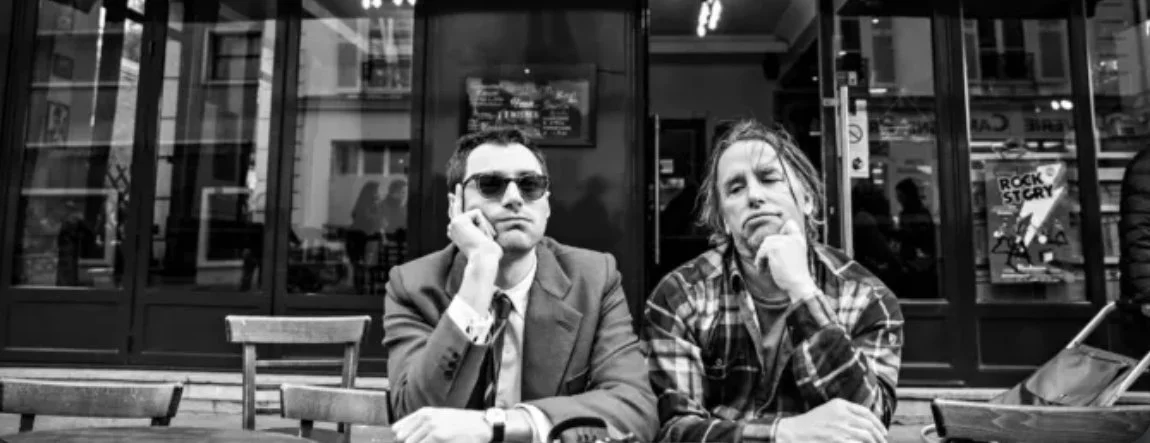
Richard Linklater has always been more interested in moments than plot. In “Nouvelle Vague,” his tribute to Jean-Luc Godard’s “Breathless,” he turns the French filmmaker’s story into — what else — a hangout movie.
There’s no attempt to imitate Godard’s style — no jump cuts, no sudden bursts of chaos. Instead, “Nouvelle Vague” is thoughtful, and beautifully shot, and most importantly, playful. It captures the energetic giddiness of invention. It’s exactly how we should have imagined the filmmaker of “Dazed & Confused” and “Everybody Wants Some!” would tackle the subject matter.
Newcomer Guillaume Marbeck plays Godard as an awkward, sunglasses-wearing enigma — a man of big ideas, little patience, and endless cigarettes. He doesn’t direct so much as feel his way through scenes, trusting instinct over structure. Somehow, people follow him. Somehow, it works.
Zoey Deutch gives the film’s best performance as Jean Seberg, the Hollywood star who struggles to understand Godard’s offbeat methods but grows into the role. Aubry Dullin nails Jean-Paul Belmondo’s charm. Around them, Truffaut, Chabrol, Rohmer, and other New Wave icons appear like ghosts of greatness, each introduced with the reverence of a title card.
There’s not much of a plot here. The film floats from day to day on the set of “Breathless,” where Godard often delays shoots or cancels them entirely. What matters is the process — messy, slow, and full of doubt. But also driven by a belief that something new is being born.
Shot in black-and-white, in the square 1.33 aspect ratio, by DP David Chambille, “Nouvelle Vague” looks stunning. Ironically, it took far more time and money to recreate “Breathless” than “Breathless” ever needed. But that’s part of the charm: a modern filmmaker saluting the past, not by copying it, but by paying tribute.
Linklater doesn’t try to build a myth around Godard. He just observes him — brilliant, difficult, funny — as a young artist trying to change cinema with almost nothing. His method of work might, initially, frustrate his cast, but they eventually grow accustomed to it all, and learn to succumb to the infectious vibe.
In the end, Nouvelle Vague isn’t about what happened on the set of Breathless — it’s about what it felt like to be there. Linklater, as always, is less interested in big revelations than in the rhythms of collaboration, the awkward pauses between takes, the joy of chasing something undefined. As hangout movies go, this one’s loose, affectionate, and deeply in love with the act of making movies.
NOTE: The early reviews aren’t ecstatic, but respectful of the film and Linklater’s attempt to capture a specific time and place.

Still no distributor for "Bucking Fastard," "Alpha Gang," "The Last Photograph," "Closing Night," and "The Life and Deaths of Wilson Shedd." The issue seems to be quality more than a lack of willingness to buy.